

Home
Class 12
PHYSICS
The arrangement shown in figure consists...

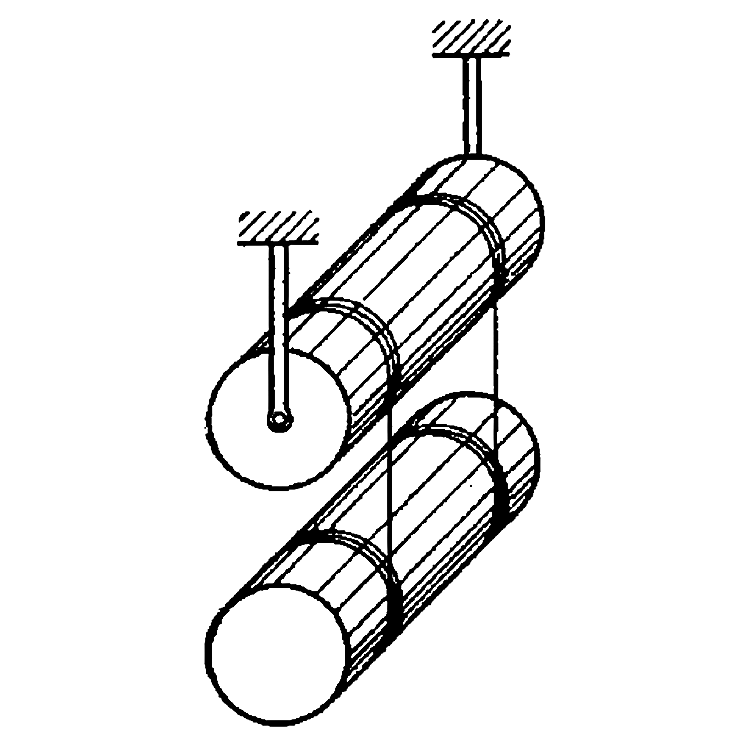
The arrangement shown in figure consists of two identical uniform solid cylinders, each of mass m, on which two light threads are wound symmetrically. Find the tension of each thread in the process of motion. The friction in the axle of the upper cylinder is assumed to be absent.

Promotional Banner

Similar Questions

Explore conceptually related problems

In the arrangement shown in figure the mass of the uniform solid cylindrical pulley of radius R is equal to m and the masses of two bodies are equal to m_(1) and m_(2) . The thread slipping and the friction in the axle of the pulley are supposed to be absent. Find the angular acceleration of the cylinder and the ratio of tensions (T_(1))/(T_(2)) of the vertical sections of the thread in the process of motion.

In the arrangement shown in figure the mass of the uniform solid cylindrical pulley of radius R is equal to m and the masses of two bodies are equal to m_(1) and m_(2) . The thread slipping and the friction in the axle of the pulley are supposed to be absent. Find the angular acceleration of the cylinder and the ratio of tensions (T_(1))/(T_(2)) of the vertical sections of the thread in the process of motion.

A uniform cylinder of mass m rests on two rough horizontal planks. A thread is wound on the cylinder. The hanging end of the thread is pulled vertically down with a constant force F

For the arrangement shown in the figure the coefficient of friction between the two blocks is mu . If both the blocks are identical and moving ,then the acceleration of each block is

For the arrangement shown in the figure the coefficient of friction between the two blocks is mu . If both the blocks are identical and moving ,then the acceleration of each block is

A uniform solid. cylinder A of mass can freely rotate about a horizontal axis fixed to a mount of mass m_(2) . A constant horizontal force F is applied to the end K of a light thread tightly wound on the cylinder. The friction between the mount and the supporting horizontal plane is assumed to be absent. Find the acceleration of the point K .

A uniform solid. cylinder A of mass can freely rotate about a horizontal axis fixed to a mount of mass m_(2) . A constant horizontal force F is applied to the end K of a light thread tightly wound on the cylinder. The friction between the mount and the supporting horizontal plane is assumed to be absent. Find the acceleration of the point K .

In the arrangement shown in figure the masses m of the bar and M of the wedge, as well as the wedge angle alpha , are known. The masses of the pulley and the thread are negligible. The friction is absent. Find the acceleration of the wedge M.