

Home
Class 11
PHYSICS
A particle A of mass m is attached to a ...

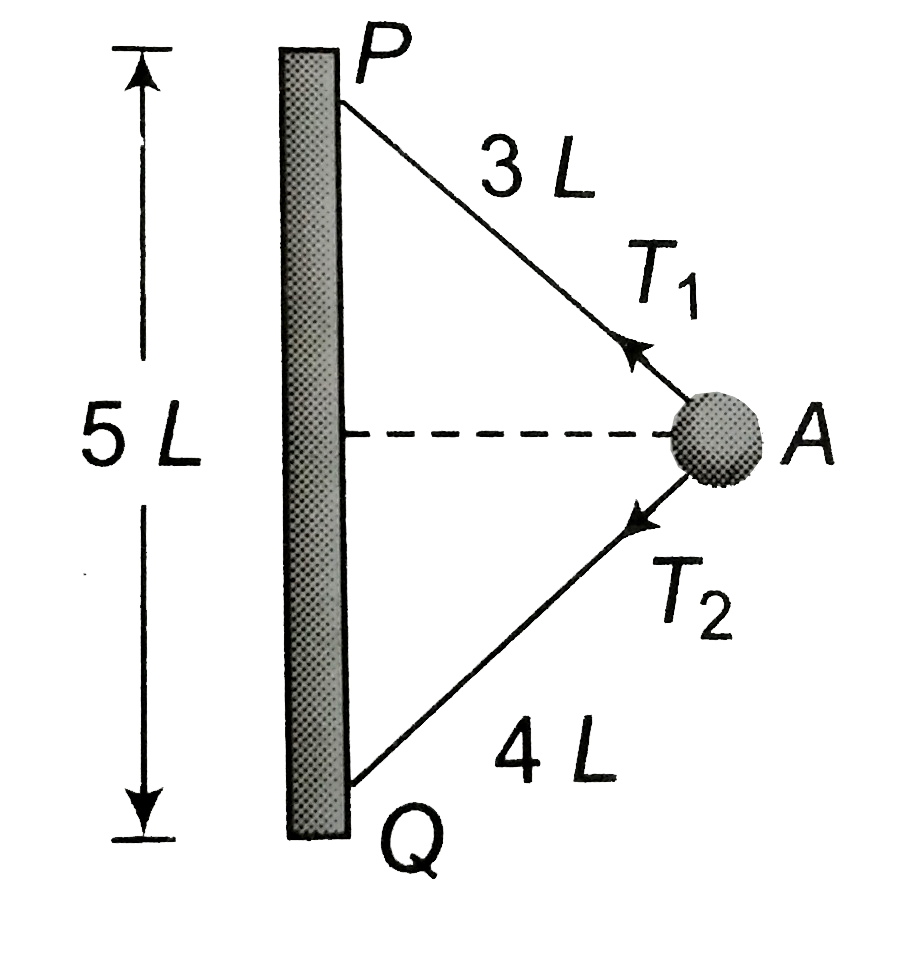
A particle `A` of mass `m` is attached to a vertical axis by two stings `PA` and `QA` of lengths `3L` and `4L` , respectively. `PQ=5L`. A rotates around the axis with an angular speed `omega`. The tension in the two strings are `T_(1)` and `T_(2)`.

(i) `T_(1)=T_(2)`
(ii) `3T_(1)-4T_(2)=5mg`
(iii) `4T_(1)+3T_(2)=12momega^(2)L`

Promotional Banner

Similar Questions

Explore conceptually related problems

A particle P of mass m is attached to a vertical axis by two strings AP and BP of length l each. The separation AB=l. P rotates around the axis with an angular velocity omega . The tensions in the two strings are T_(1) and T_(2)

A particle P of mass m is attached to a vertical axis by two strings AP and BP of length l each. The separation AB=l. P rotates around the axis with an angular velocity omega . The tensions in the two strings are T_(1) and T_(2)

A particle P of mass m is attached to a vertical axis by two strings AP and BP of length l each. The separation AB=l. P rotates around the axis with an angular velocity omega . The tensions in the two strings are T_(1) and T_(2)

A particle P of mass m is attached to a vertical axis by two strings AP and BP of legth l each. The separation AB=l , rotates around the axis with an angular velocity omega . The tension in the two string are T_(1) and T_(2) . Then

A uniform rod of mass m and length L is suspended with two massless strings as shown in figure. If the rod is at rest in a horizontal position the ratio of tension in the two strings T_(1)//T_(2) is

The whole set up shown in the figure is rotating with constant angular velocity omega on a horizontal frictionless table. The ratio of tensions (T_(1))/(T_(2)) is ("Given" (l_(2))/(l_(2)) = 2/1 )

A uniform rod of young's modulus Y is tretched by two tension T_1 and T_2 such that rods gets expanded to length L_1 and L_2 respectively.Find initial length of rod?

Two stretched strings has lengths 'l' and '2l' while tensions are 'T' and '4T' respectively. If they are made of same material the ratio of their frequency is