Home
Class 12
CHEMISTRY
An organic compound A, C(8)H(6) on react...

An organic compound A, `C_(8)H_(6)` on reacting with dil. `H_(2)SO_(4)` and `HgSO_(4)` gives a compound 'B'-which can also be obtained from reaction of benzene with acid chloride in the presents of anh. `AlCl_(3)` Compound B when reacted with iodine and aq. NaOH yields C and a yellow compound D. Identify A to D with proper justification.

Text Solution

Verified by Experts
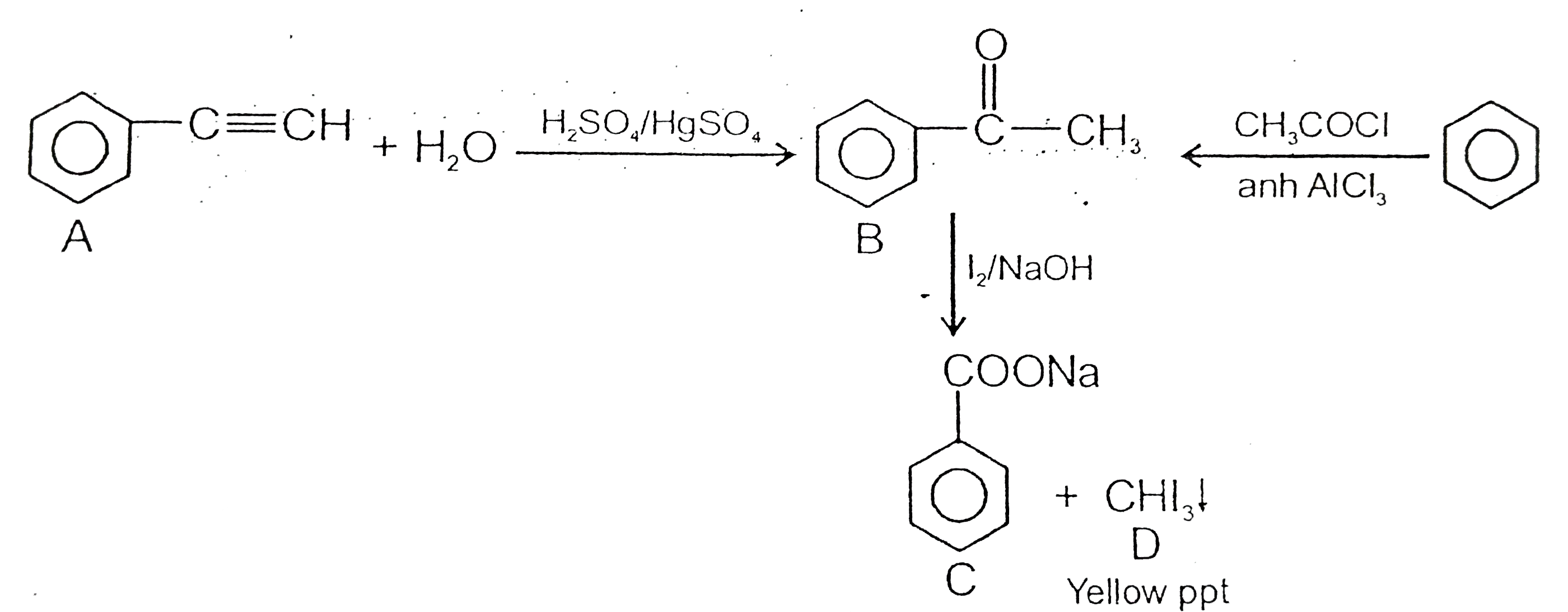
(i) As compound B gives can be formed by reacting `C_(6)H_(6)` with acid chloride in presence of anh. `AlCl_(3)` it is an aromatic ketone.
(ii) As compound B gives iodoform D as one of the products on reacting with iodine and aq. NaOH. Hence compound B is acetophenone.
(ii) Compound A seems to be a derivative of acetylene because it undergoes hydration under acidic conditions to form B which is acetophenone.
Let us put all the facts in sequence
Promotional Banner

Topper's Solved these Questions

  • ALDEHYDES, KETONES AND CARBOXYLIC ACIDS

    AAKASH INSTITUTE|Exercise Illustrations|3 Videos
  • ALDEHYDES, KETONES AND CARBOXYLIC ACIDS

    AAKASH INSTITUTE|Exercise Assignment (Section A Competition Level Questions)|60 Videos
  • ALCOHOLS, PHENOLS AND ETHERS

    AAKASH INSTITUTE|Exercise Try Yourself|5 Videos
  • AMINES

    AAKASH INSTITUTE|Exercise Assignment Section -J (Aakash Challengers Questions)|9 Videos

Similar Questions

Explore conceptually related problems

An organic compound [A] C_(8)H_(6) on reacting with dilute sulphuric acid containing mercuric sulphate gives a compound [B] which can also be obtained from a reaction of bezene with acid chloride in the presence of anhydrous AlCl_(3) . The compound [B] when treated with iodine and aqueous NaOH yields [C] and a yellow compound [D]. Identify [A],[B],[C] and [D] with justification. Show how [B] is formed from [A].

An organic compound ‘A’ C_(8)H_(6) on treatment with dilute H_(2)SO_(4) containing mercuric sulphate gives compound ‘B’. This compound ‘B’ can also be obtained from a reaction of benzene with acetyl chloride in presence of anhy AlCl_(3) . ‘B’ on treatment with I_(2) in aq. KOH gives ‘C’ and a yellow compound ‘D’. Identify A, B, C and D. Give the chemical reactions involved.

A compound X when passed through dil. H_(2)SO_(4) containing HgSO_(4) gives a compound Y which on reaction with HI and red phosphorus gives C_(2)H_(6) . The compound X is

An organic compound A C_4H_8 on treatment with K M n O_(4) // H^(+) Yields compound 'B' C_(3) H_(5) O Compound 'A' also yields compound 'B' an ozonolysis. Compound 'A' is :

An organic compound [A] is C_(5)H_(8)O_(3). On heating with soda lime, it gives [B]. The compound [B] reacts with HCN to give another compound [C] which reacts with thionyl chloride to produce [D]. When the compound [A] is heated with potassium dichromate the product is acetic acid and malonic acid. The compound [A] is a

An organic compound A on heating with concentrated H_(2)SO_(4) gave product B and on warming with alkaline KMnO_(4) gave compound C. Compound A on heating with compound C in presence of concentrated H_(2)SO_(4) formed Compound D, which has fruity smell, Identify the compounds A,B,C and D :

AAKASH INSTITUTE-ALDEHYDES, KETONES AND CARBOXYLIC ACIDS -Try Yourself
  1. An organic compound A, C(8)H(6) on reacting with dil. H(2)SO(4) and Hg...

    Text Solution

    |

  2. Give common names and IUPAC names of the following compounds.

    Text Solution

    |

  3. Write the structures of the following compounds (i) 4-chloropentn-2-...

    Text Solution

    |

  4. Give chemical equations and name the main product formed when (i) Et...

    Text Solution

    |

  5. What are the products formed by reductive ozonolysis of penta-1,3-dien...

    Text Solution

    |

  6. Give chemical equations for following conversions: (i) Propanal from...

    Text Solution

    |

  7. Identify unknown compounds A to E in the following senes of chemical r...

    Text Solution

    |

  8. Complete the reaction

    Text Solution

    |

  9. Complete the following reactions and identify A, B and C, (i) A+H(2)...

    Text Solution

    |

  10. An organic compound [A] with molecular formula C(5)H(8)O(2) is reduced...

    Text Solution

    |

  11. Write reactions and conditions to bring about the following conversion...

    Text Solution

    |

  12. How can we distinguish chemically the following pairs of compounds? ...

    Text Solution

    |

  13. Write the various steps involved in the following conversion : CH(3)...

    Text Solution

    |

  14. Give IUPAC names of the following compounds. (i) HOOC-underset(OH)un...

    Text Solution

    |

  15. Complete the following reactions indicating the major product formed. ...

    Text Solution

    |

  16. A compound [A] of molecular formula C(4)H(9)Br yields a compound [B] o...

    Text Solution

    |

  17. How will you preform the following conversions? (i) Acetaldehyde to ...

    Text Solution

    |

  18. How will you convert benzene into

    Text Solution

    |

  19. Arrange the following in decreasing order of nucleophilic addition C...

    Text Solution

    |

  20. Give suitable explanation for the following: (i) Chloral hydrate is ...

    Text Solution

    |

  21. Hydrocarbon (X), C(7)H(12), on reaction with boron hydride followed by...

    Text Solution

    |

