

Home
Class 11
PHYSICS
Two masses m(1) and m(2) which are conne...

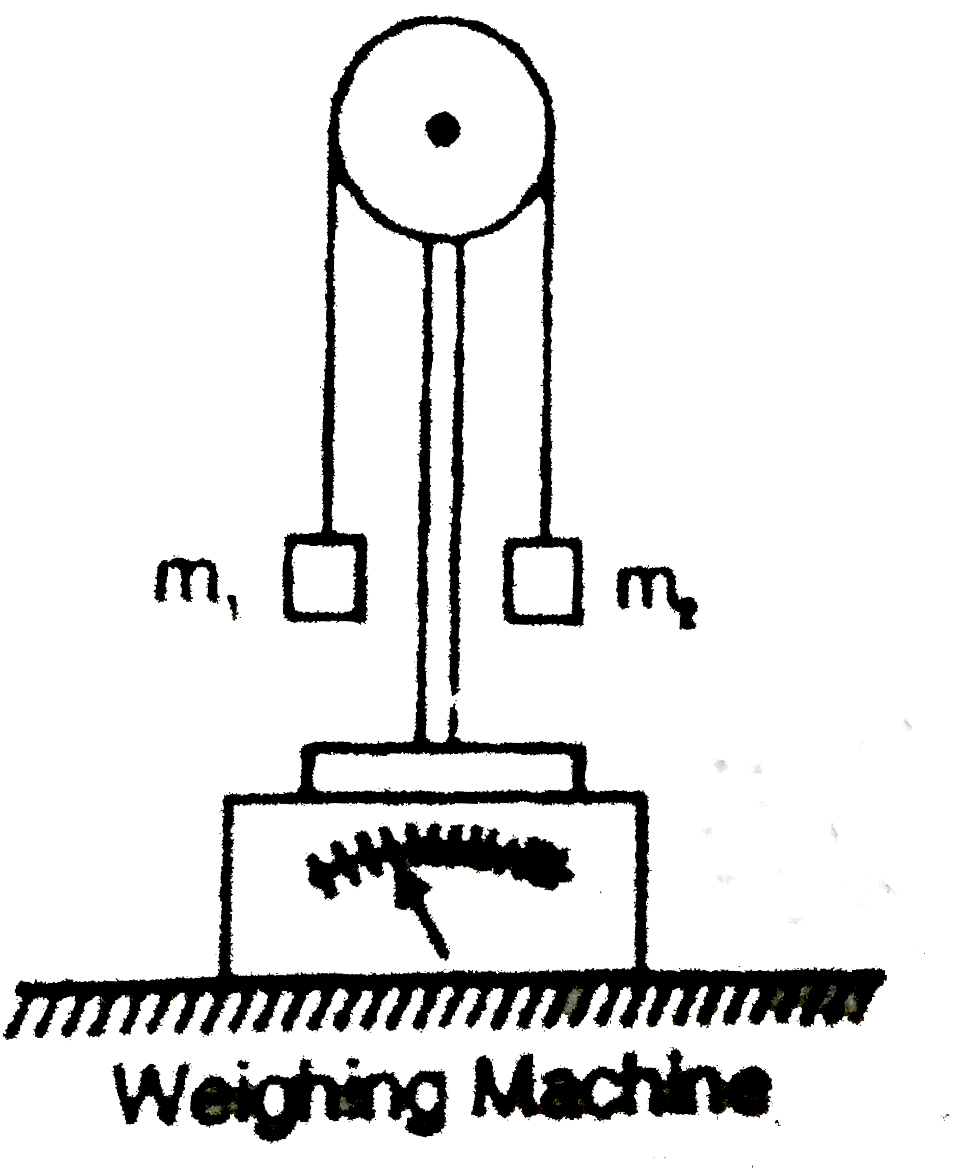
Two masses `m_(1)` and `m_(2)` which are connected with a light string, are placed over a frictionless pulley. This set up is placed over a weighing machine, as shown. Three combination of mass `m_(1)` and `m_(2)` are used, in first case `m_(1) =6kg` and `m_(2)=2 kg`, in seconds case `m_(1)=5 kg` and `m_(2)=3 kg` and in third case `m_(1)=4 kg` and `m_(2)= 4 kg`. masses are held stationary initially and then released. if the reading of the weighing machine after the release in three cases are `W_(1),W_(2)` and `W_(3)` respectively then:

Promotional Banner

Similar Questions

Explore conceptually related problems

Two masses m_(1) and m_(2) . Which are connected with a light string, are placed over a frictionless pulley. This set up is placed over a weighting machine, as shown. Three combination of masses m_(1) and m_(2) are used, in first case m_(1)=6 kg and m_(2)=2kg in second case m_(1)=5kg and m_(2)=3kg and in third case m_(1)=4kg and m_(2)=4kg .Masses are held stationary initiallly and then released. If the readings of the weighing machine after the release in three cases are W_(1) , W_(2) and W_(3) respectively then :-

Two masses m_(1) and m_(2) . Which are connected with a light string, are placed over a frictionless pulley. This set up is placed over a weighting machine, as shown. Three combination of masses m_(1) and m_(2) are used, in first case m_(1)=6 kg and m_(2)=2kg in second case m_(1)=5kg and m_(2)=3kg and in third case m_(1)=4kg and m_(2)=4kg .Masses are held stationary initiallly and then released. If the readings of the weighing machine after the release in three cases are W_(1) , W_(2) and W_(3) respectively then :-

Two blocks of masses m_1 and m_2 , which are connected with a light string, are placed over a friction less pulley. This set up is placed over a weighing machine, as shown. Three combination of masses m_1 and m_2 are used, in first case m_1=6kg and m_2=2kg , in second case m_1=5kg and m_2=3kg and in third case m_1=4kg and m_2=4kg. masses are held stationary initially and then released if the readings of the weighing machine after the release in three cases are W_1 , W_2 and W_3 respectively then:

Two blocks of masses m_1 and m_2 , which are connected with a light string, are placed over a friction less pulley. This set up is placed over a weighing machine, as shown. Three combination of masses m_1 and m_2 are used, in first case m_1=6kg and m_2=2kg , in second case m_1=5kg and m_2=3kg and in third case m_1=4kg and m_2=4kg. masses are held stationary initially and then released if the readings of the weighing machine after the release in three cases are W_1 , W_2 and W_3 respectively then:

Two masses m_(1) and m_(2) are attached to a string which passes over a frictionless smooth pulley. When m_(1)=10kg,m_(2)=6kg , the acceleration of masses is

Two masses m_(1) = 4.8 kg and m_(2) = 5 kg tied to a string are hanging over a light frictionless pully. What is the acceleration of masses when they are free to move ?

Two masses m_(1) and m_(2) are connected with a string passing over a frictionless pulley fixed at the corner of the table as shown in the the coefficent of static friction of mass m_(1) with the table is mu_(s) calculate the minium mass m_(3) that may be placed on m_(1) to prevent it from sliding check if m_(1)=15 kg m_(2)=10kg , mm_(3)=25 and mu_(s)=0.2

Two masses M_(1)=5kg,M_(2)=10 kg are connected at the ends of an inextensible string passing over a frictionless pulley as shown. When masses are released, then acceleration of masses will be

Two masses m_1=5kg and m_2=4.8kg tied to a string are hanging over a light frictionless pulley. What is the acceleration of the masses when left free to move?