

Home
Class 12
PHYSICS
Two point masses of mass m and equal and...

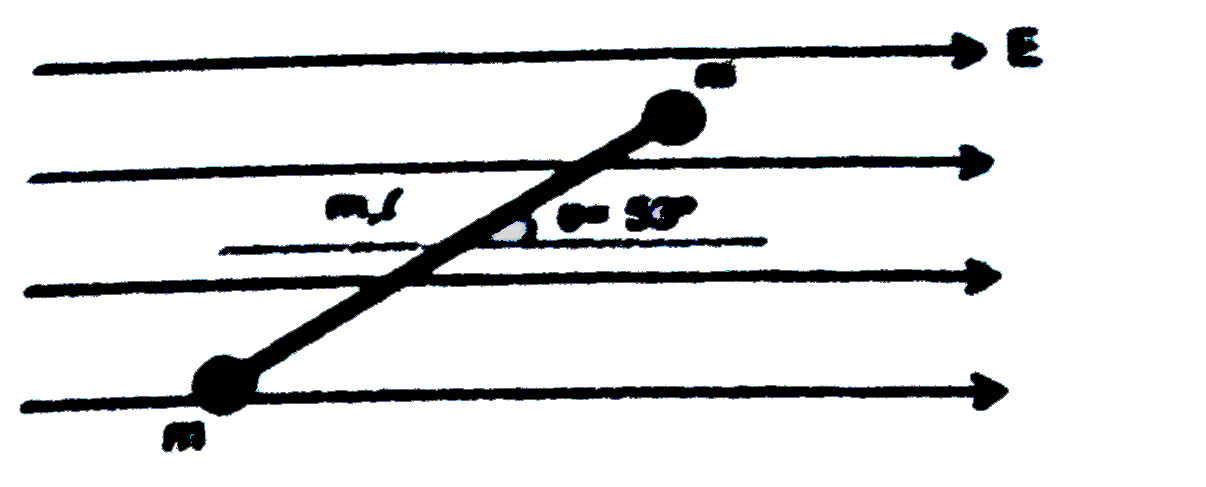
Two point masses of mass m and equal and opposite charge of magnitude q are attached on the corners of a non-conducting uniform rod of mass m and the system is released from rest in uniform electric field E as shown in figure from `theta=53^(@)`

(i) Find angular acceleration of the rod just after releasing
(ii) What will be angular velocity of the rod when it passes through stable equilibrium.
(iii) Find work required to rotate the system by `180^(@)`.

Promotional Banner

Similar Questions

Explore conceptually related problems

A uniform rod of mass m length l is attached to smooth hinge at end A and to a string at end B as shown in figure. It is at rest. The angular acceleration of the rod just after the string is cut is :

A uniform rod of mass m length l is attached to smooth hinge at end A and to a string at end B as shown in figure. It is at rest. The angular acceleration of the rod just after the string is cut is :

A uniform rod of mass m and length L is kept on a horizontal table with L/4 length on the table as shown in figure. As the string attached to the end B is cut, the angular acceleration of the rod about point C will be

A uniform thin rod is released from rest in the horizontal position as shown in the figure. For what value of x, the angular acceleration is maximum.

A particle of mass m is rigidly attached at A to a ring of mass 3m and radius r . The system is released from rest and rolls without sliding. The angular acceleration of ring just after release is

A particle of mass m is rigidly attached at A to a ring of mass 3m and radius r . The system is released from rest and rolls without sliding. The angular acceleration of ring just after release is

A uniform rod of mass 20 Kg and length 1.6 m is piovted at its end and swings freely in the vertical plane. Angular acceleration of the rod just after the rod is relased from rest in the horizontal position is

A uniform rod of mass 20 Kg and length 1.6 m is piovted at its end and swings freely in the vertical plane. Angular acceleration of the rod just after the rod is relased from rest in the horizontal position is