

Home
Class 11
PHYSICS
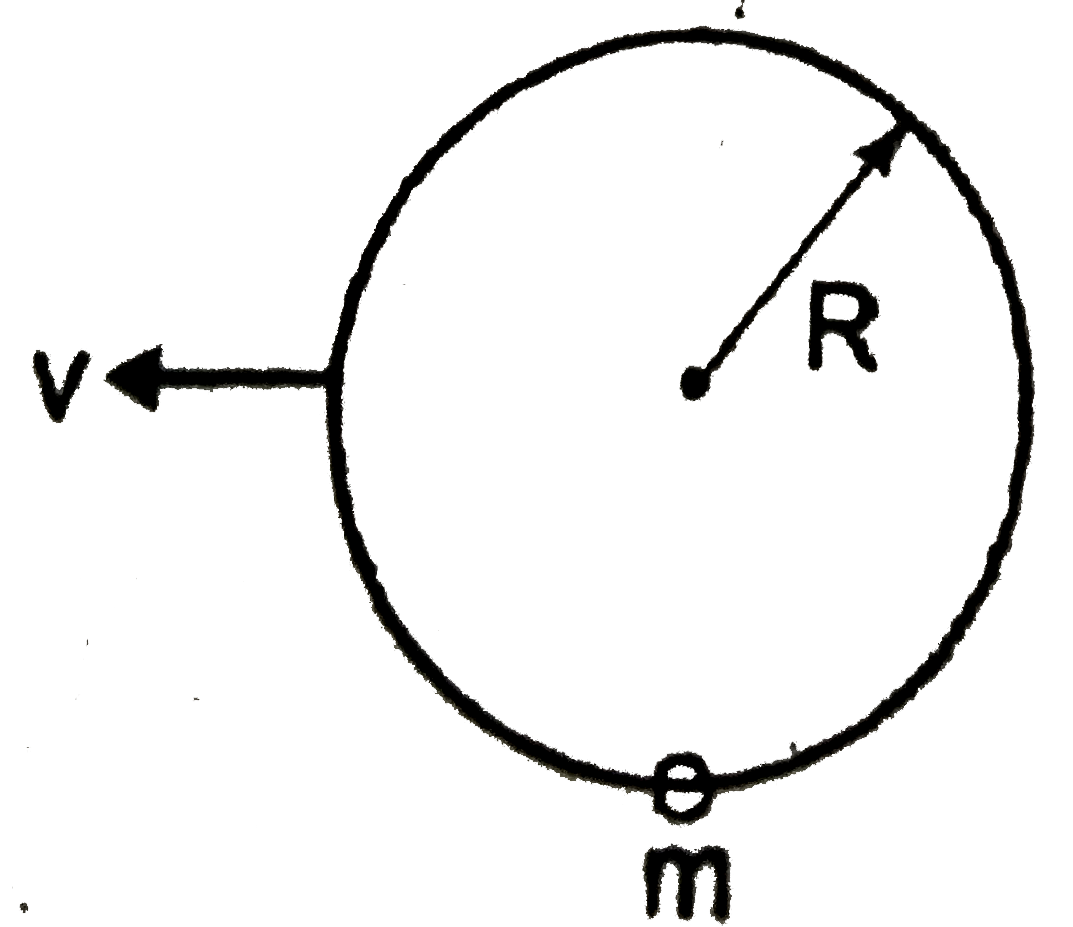
A ring of radius R lies in vertical plan...

A ring of radius `R` lies in vertical plane. A bead of mass `'m'` can move along the ring without friction. Initially the bead is at rest the bottom most point on ring. The minimum horizontal speed `v` with which the ring must be pulled such that the bead completes the vertical circle.

Promotional Banner

Similar Questions

Explore conceptually related problems

A bead of mass m is fitted on a rod and can move on it without friction. Initially the bead is at the middle of the rod moves transitionally in the vertical plane with an accleration a_(0) in direction forming angle alpha with the rod as shown. The acceleration of bead with respect to rod is: z

A bead of mass m is fitted on a rod and can move on it without friction. Initially the bead is at the middle of the rod moves transitionally in the vertical plane with an accleration a_(0) in direction forming angle alpha with the rod as shown. The acceleration of bead with respect to rod is: z

A ring of radius 4a is rigidly fixed in vertical position on a table. A small disc of mass m and radius a is released as shown in the fig. When the disc rolls down, without slipping, to the lowest point of the ring, then its speed will be

A massless ring hangs from a thread and two beads of mass m slide it without friction. The beads are released simultaneously from the top of the ring and slide down along possible sides. Find the angle from vertical at which the ring will start to rise.

A ring of mass M hangs from a thread and two beads of mass m slides on it without friction. The beads are released simultaneously from the top of the ring and slides down in opposite sides. Show that the ring will start to rise, if mgt(3M)/(2) . ltbr.

A ring of mass M hangs from a thread and two beads of mass m slides on it without friction. The beads are released simultaneously from the top of the ring and slides down in opposite sides. Show that the ring will start to rise, if mgt(3M)/(2)

The figure shows a thin ring of mass M=1kg and radius R=0.4m spinning about a vertical diameter (take I=(1)/(2)MR^(2)) A small beam of mass m=0.2kg can slide without friction along the ring When the bead is at the top of the ring the angular velocity is 5rad//s What is the angular velocity when the bead slips halfwat to theta=45^(@) ?

The figure shows a thin ring of mass M=1kg and radius R=0.4m spinning about a vertical diameter (take I=(1)/(2)MR^(2)) A small beam of mass m=0.2kg can slide without friction along the ring When the bead is at the top of the ring the angular velocity is 5rad//s What is the angular velocity when the bead slips halfwat to theta=45^(@) ?

A bead of mass m can slide without friction along a vertical ring of radius R. One end of a spring of force constant k=(3mg)/(R ) is connected to the bead and the other end is fixed at the centre of the ring. Initially, the bead is at the point A and due to a small push it starts sliding down the ring. If the bead momentarily loses contact with the ring at the instant when the spring makes an angle 60^(@) with the vertical, then the natural length of the spring is

A bead of mass m can slide without friction along a vertical ring of radius R. One end of a spring of force constant k=(3mg)/(R ) is connected to the bead and the other end is fixed at the centre of the ring. Initially, the bead is at the point A and due to a small push it starts sliding down the ring. If the bead momentarily loses contact with the ring at the instant when the spring makes an angle 60^(@) with the vertical, then the natural length of the spring is