

Home
Class 11
PHYSICS
A small bead of mass m is carried by a c...

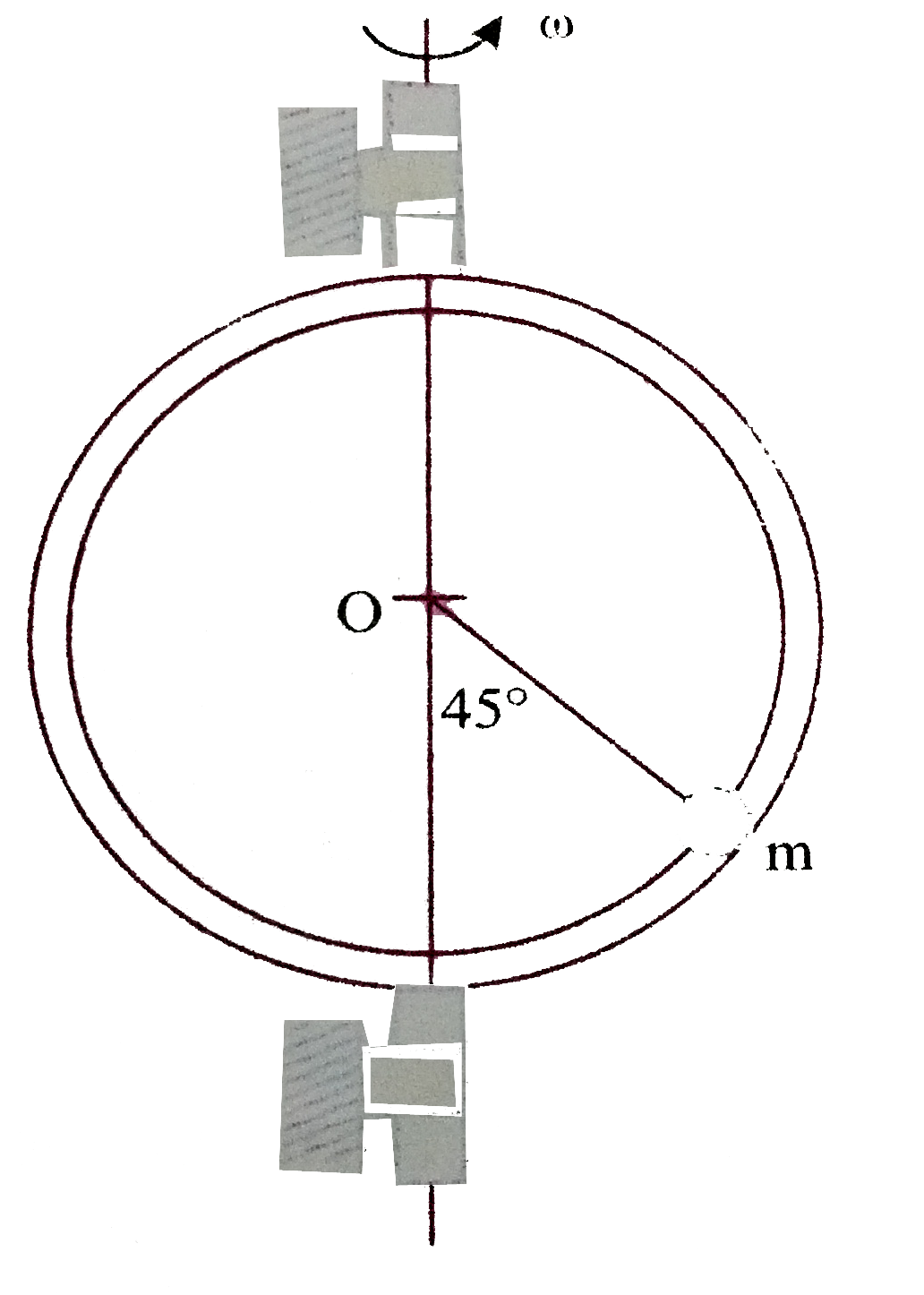
A small bead of mass `m` is carried by a circular hoop having center at `O` and radius `sqrt 2m` which rotates about a fixed vertical axis. The coefficient of friction between beed and hoop is `mu=0.5`. The maximum angular speed of the hoop for which the bead does not have relative motion with respect to hoop. `(g=10m//s^(2))`

Promotional Banner

Similar Questions

Explore conceptually related problems

A small bead of mass m = 1 kg is free to move on a circular hoop. The circular hoop has centre at C and radius r = 1 m and it rotates about a fixed vertical axis. The coefficient of friction between bead and hoop is mu=0.5 . The maximum angular speed of the hoop for which the bead does not have relative motion with respect to hoop, at the position shown in figure is : (Take g = 10 m//s^(2) )

A small bead of mass m = 1 kg is free to move on a circular hoop. The circular hoop has centre at C and radius r = 1 m and it rotates about a fixed vertical axis. The coefficient of friction between bead and hoop is mu=0.5 . The maximum angular speed of the hoop for which the bead does not have relative motion with respect to hoop, at the position shown in figure is : (Take g = 10 m//s^(2) )

The coefficient of friction between the tyres and the road is 0.1. The maximum speed with which a cyclist can take a circular turn of radius 3 m without skidding is ("Take g"=10ms^(-2))

The coefficient of friction between the tyres and the road is 0.1. The maximum speed with which a cyclist can take a circular turn of radius 3 m without skidding is ("Take g"=10ms^(-2))

A body moves along a circular path of radius 5m . The coefficient of friction between the surface of the path and the body is 0.5 . The angular velocity in rad//s with which the body should move so that it does not leave the path is (g-10m//s^(-2))

A body moves along a circular path of radius 5m . The coefficient of friction between the surface of the path and the body is 0.5 . The angular velocity in rad//s with which the body should move so that it does not leave the path is (g-10m//s^(-2))

A car of mass 1000 kg is negotiating an unbanked curve of radius 20 m. If the coefficient of friction is 0.5 and g = 10 m//s^(2) the maximum safe speed of the car is

A bus turns a slippery road having coefficient of friction of 0*5 with a speed of 10 m/s .The minimum radius of the arc in which bus turns is [ Take g = 10 m/s^(2)]

The coefficient of friction between block of mass m and 2m is mu=2tantheta . There is no friction between block of mass 2 m and inclined plane. The maximum amplitude of the two block system for which there is no relative motion between both the blocks is