

Home
Class 11
PHYSICS
A particle of mass m is released in vert...

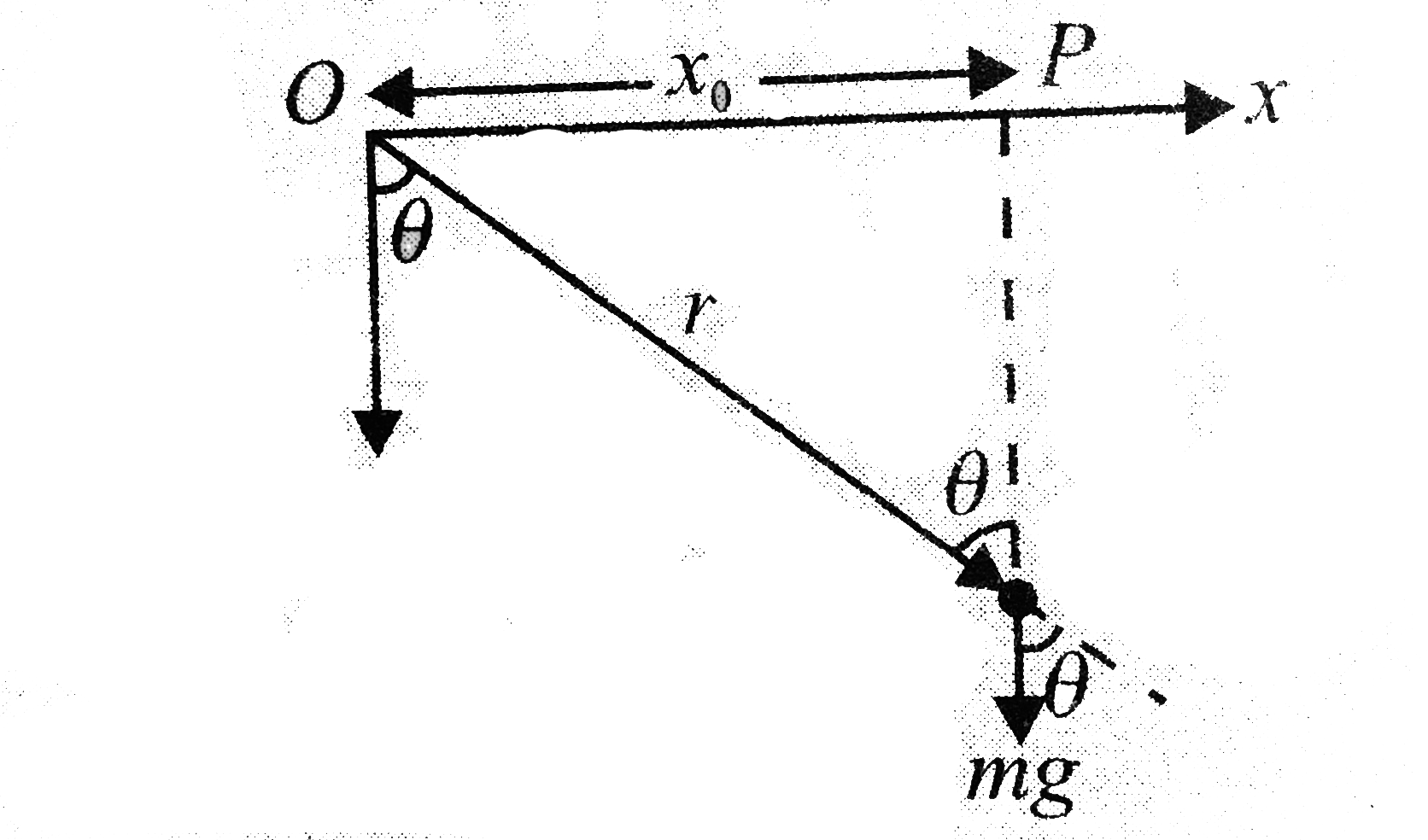
A particle of mass `m` is released in vertical plane from a point `P` at `x=x_(0)` on the `x`-axis. It falls vertically parallel to the `y`-axis. Find the torque `tau` acting on the particle at a time about origin.

Promotional Banner

Similar Questions

Explore conceptually related problems

A particle of mass m is released from rest from point P at x = x_(0) on X-axis from origin O and falls vertically along y-axis as shown in Fig. What is the magnitude of the torque acting on the particle at time t , when it is at the point Q w.r.t.O ?

A particle of mass m is released from rest at point A in Fig., falling parallel to the (vertical) y -axis. Find the angular momentum of the particle at any time t with respect to the same origin O .

A particle of mass m is released from rest at point A in Fig., falling parallel to the (vertical) y -axis. Find the angular momentum of the particle at any time t with respect to the same origin O .

A particle of mass m is projected from origin O with speed u at an angle theta with positive x-axis. Positive y-axis is in vertically upward. Direction. Find the angular momentum of particle at any time t about O before the particle strikes the ground again.

A particle of mass m is projected from origin O with speed u at an angle theta with positive x-axis. Positive y-axis is in vertically upward. Direction. Find the angular momentum of particle at any time t about O before the particle strkes the ground again.

A particle is moving parallel to x-axis as shown in the figure. The angular velocity of the particle about the origin is

A particle is moving parallel to x-axis as shown in the figure. The angular velocity of the particle about the origin is

A particle of mass m is released from rest at point A in the figure falling freely under gravity parallel to the vertical Y -axis. The magnitude of angular momentum of particle about point O when it reaches B is (where OA=b and AB=h )

In Fig. 10-73, a particle of mass m is released from rest at point A, at distance b from the origin, and falls parallel to a vertical y axis. As a function of time t and with respect to the origin, find the magnitudes of (a) the torque tau on the particle due to the gravitational force and (b) the angular momentum L of the particle. ( c) From those results, verify that tau=dL//dt .