

Home
Class 11
PHYSICS
The free end of a thread wound on a bobb...

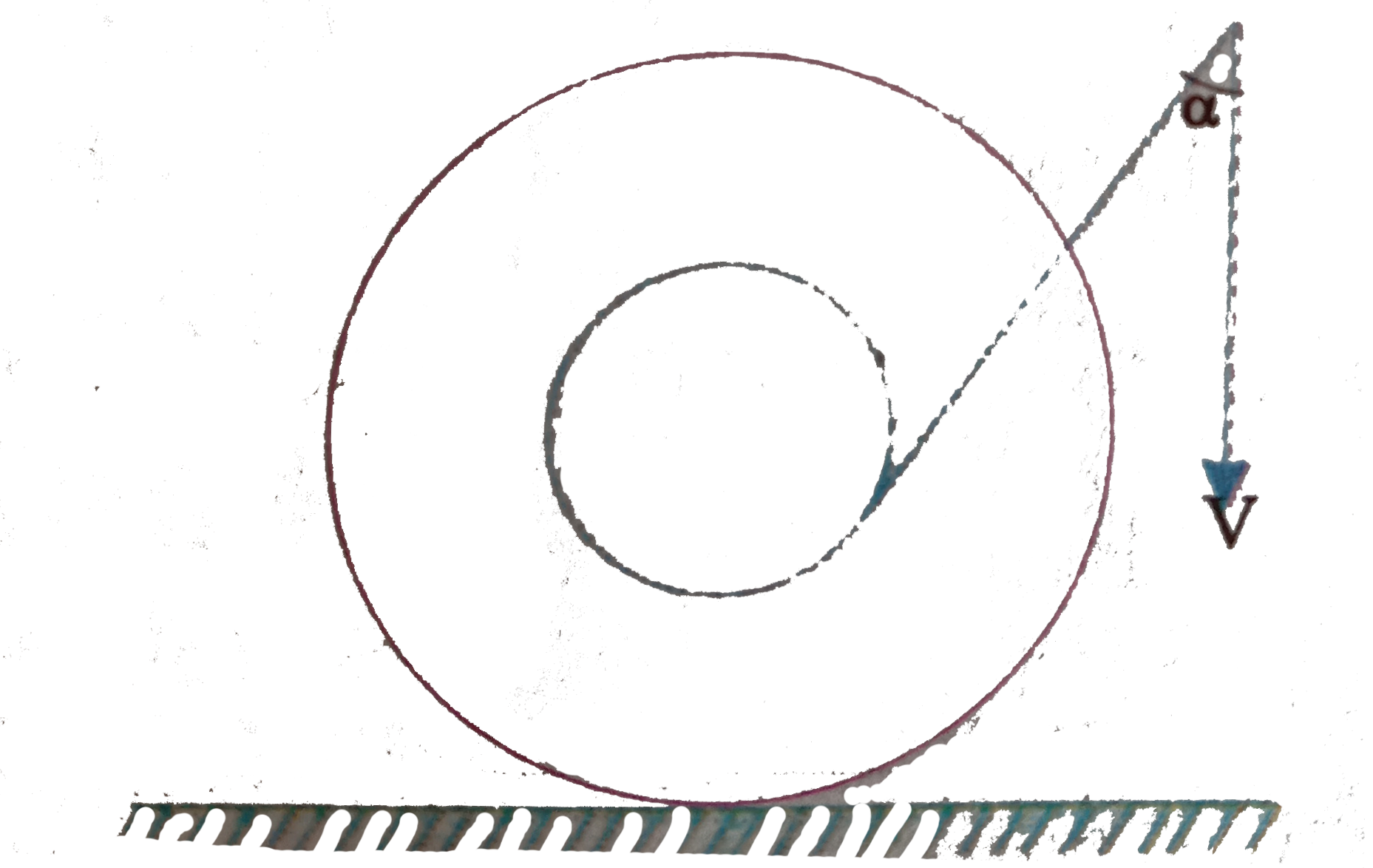
The free end of a thread wound on a bobbin is passed round a nail A hammered into the wall. The thread is pulled at a constant velocity 'v' . Assuming pure rolling of bobin, find the velocity `v_(0)` of the centre of the bobbin at the instant when the thread forms an angle `alpha` with the vertical: (`R` and `r` are outer and inner radii off the babbin)

Promotional Banner

Similar Questions

Explore conceptually related problems

Figure shows a rod of length £ resting on a wall and the floor. Its lower end A is pulled towards left with a constant velocity v. Find the velocity of the other end B downward when the rod makes an angle Q with the horizontal

Figure shows a rod of length l resting on a wall and the floor. Its lower end A is pulled towards left with a constant velocity v. Find the velocity of the other end B downward when the rod makes an angle theta with the horizontal.

Figure shows a rod of length l resting on a wall and the floor. Its lower end A is pulled towards left with a constant velocity v. Find the velocity of the other end B downward when the rod makes an angle theta with the horizontal.

Figure shows a rod of length l resting on a wall and the floor. Its lower end A is pulled towards left with a constant velocity v. Find the velocity of the other end B downward when the rod makes an angle theta with the horizontal.

End A of a rod AB is being pulled on the floor with a constant velocity v_(0) as shown. Taking the length of the rod as l , at an instant when the rod makes an angle 37^@ with the horizontal, calculate the velocity of the CM of the rod

A light thread is tightly wrapped around a fixed disc of radius R. A particle of mass m is tied to the end P of the thread and the vertically hanging part of the string has length piR . The particle is imparted a horizontal velocity V=sqrt((4pigR)/3) . The string wraps around the disc as the particle moves up. At the instant the velocity of the particle makes an angle of theta=60^(@) with horizontal, calculate. (a) Speed of the particle (b) Tension in the string