

Home
Class 11
PHYSICS
A small ball (of negligible size) is pla...

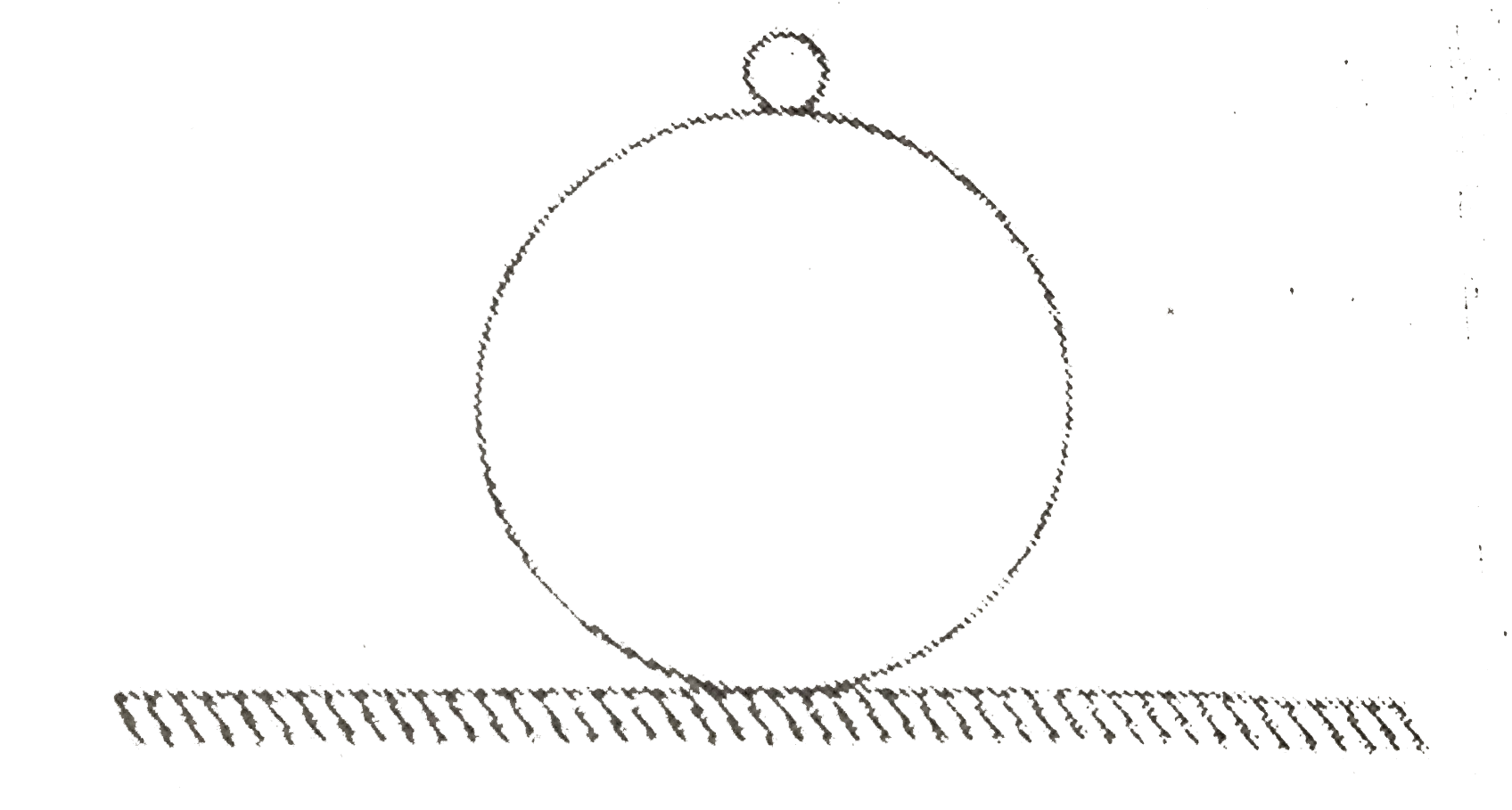
A small ball (of negligible size) is placed over a sphere of same mass and radius 1 m as shown. All surface are smooth. A slight push is given to the ball. When the radius vector joining the ball makes an angle of `30^(@)` with the vertical, speed of sphere is `v. (g = 10 m//s^(2))`
If mass of ball and sphere be 1 kg each then the normal reaction between the two at this instant is ltBRgt

Promotional Banner

Similar Questions

Explore conceptually related problems

A small ball (of negligible size) is placed over a sphere of same mass and radius 1 m as shown. All surface are smooth. A slight push is given to the ball. When the radius vector joining the ball makes an angle of 30^(@) with the vertical, speed of sphere is v. (g = 10 m//s^(2)) Value of v in m/s is

A small ball (of negligible size) is placed over a sphere of same mass and radius 1 m as shown. All surface are smooth. A slight push is given to the ball. When the radius vector joining the ball makes an angle of 30^(@) with the vertical, speed of sphere is v. (g = 10 m//s^(2)) Value of v in m/s is

A small ball of mass m is released from rest from the position shown . All contact surface are smooth . The speed of the ball when it reaches its lowest position is

A small ball of mass m is released from rest from the position shown . All contact surface are smooth . The speed of the ball when it reaches its lowest position is

A small ball of mass m is released from rest from the position shown . All contact surface are smooth . The speed of the ball when it reaches its lowest position is

A small sphere of radius r = 2cm and mass ‘m’ is placed on a big sphere of mass 2m and radius R = 10 cm, which is kept on a smooth horizontal surface as shown in figure. The displacement (in cm) of hemisphere when line joining between centre of small sphere and hemisphere make angle 30^(@) with vertical is (Assuming that small spheres does not break-off the surface of hemisphere) -

A spherical ball of lead of radius 14 cm is melted and recast into spheres of radius 2 cm. The number of the small spheres is