

Home
Class 11
PHYSICS
Block A weight 4N and block B weighs 8N ...

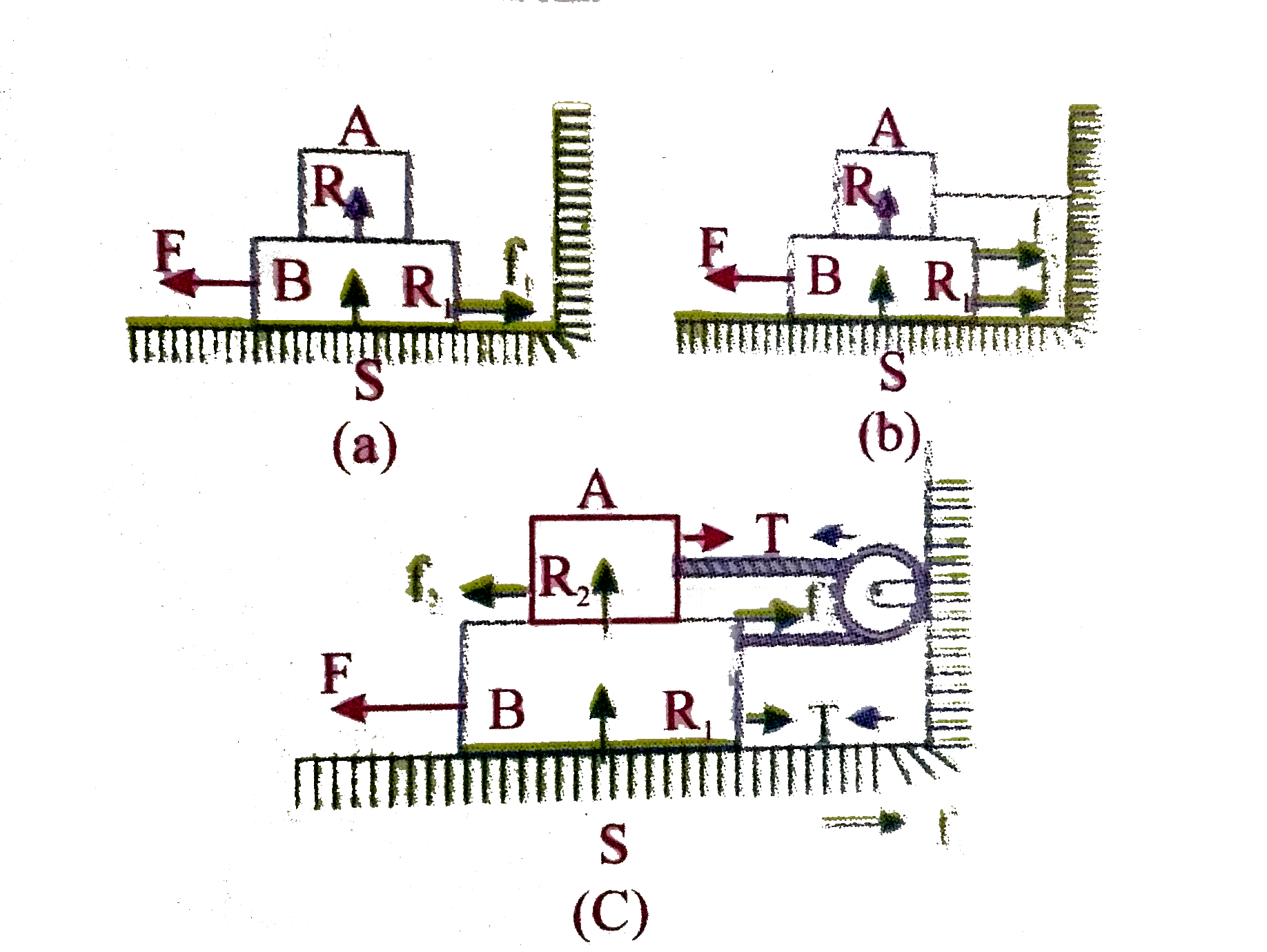
Block `A` weight `4N` and block `B` weighs `8N` The coefficient of kinetic friction is 0.25 for all surfaces. Find the force `F` to slide `B` at a constant speed when (a) A rests on `B` and moves with it (b) A is held at rest and `(c)` A and `B` are connected by a light cord passing over a smooth pulley as shown in and respectively .
.

Promotional Banner

Similar Questions

Explore conceptually related problems

Block A weighs 4 N and block weigh 8 N The coefficient of kinetic friction is 0.25 for all surface find the force F to slide B at a constant speed when (a) A rest on B and moves with it (b) A is held at rest and (c ) A and B are connected by a light cord passing over a smooth putting as shown in fig 7.31 (a - c) restively.

Block A weighs 4 N and block weigh 8 N The coefficient of kinetic friction is 0.25 for all surface find the force F to slide B at a constant speed when (a) A rest on B and moves with it (b) A is held at rest and (c ) A and B are connected by a light cord passing over a smooth putting as shown in fig 7.31 (a - c) restively.

Block A weights 4 N and block B weights 8 N. The coefficient of kinetic friction is 0.25 for all surfaces. The force F to slide B at a constant speed, when A rests on B and moves with it, is

Block A in figure-2.207 weights 2.7N and block B weighs 5.4 N the coefficient of kinetic friction between all surfaces is 0.25. Find the magnitude of the horizontal force F necessary to drag blocks to the left at constant speed if A and B are connected by a light, flexible cord passing around a fixed frictionless pulley

Block A as shown in Fig weighs 2.0 N and block B weighs 6.0 N The coefficient of ikinetic friction between all surface is 0.25 Find the magnitude of the horizontal force necessary to drag block B to the left at constant speed if A and B are connected by a light , flxeible cord passing around a fixed, frictionless pulley

Block A as shown in Fig weighs 2.0 N and block B weighs 6.0 N The coefficient of ikinetic friction between all surface is 0.25 Find the magnitude of the horizontal force necessary to drag block B to the left at constant speed if A and B are connected by a light , flxeible cord passing around a fixed, frictionless pulley

Block A as shown in figure weight 1.40 N and block B weight 4.20 N The coefficient of kinetic friction between all surface is 0.30 Find the magnitude of the horizontal force necessary to drag block B to the left at constant speed if A and B are connected by a light , fiexible cort passing around a fixed , frictionless pulled.

Block A as shown in figure weight 1.40 N and block B weight 4.20 N The coefficient of kinetic friction between all surface is 0.30 Find the magnitude of the horizontal force necessary to drag block B to the left at constant speed if A and B are connected by a light , fiexible cort passing around a fixed , frictionless pulled.

Two blocks A and B , each of mass 10 kg , are connected by a light string passing over a smooth pulley as shown in the figure. Block A will remain at rest if the friction on it is

In the diagram shown, the blocks A, B and C weight, 3kg, 4kg and 5kg respectively. The coefficient of sliding friction between any two surface is 0.25. A is held at rest by a massless rigid rod fixed to the wall while B and C are connected by a light flexible cord passing around a frictionless pulley. Find the force F necessary to drag C along the horizontal surface to the left at constant speed. Assume that the arrangement shown in the diagram, B on C and A on B, is maintained all through. (g=9.8m//s^2)