


Similar Questions
Explore conceptually related problems
Recommended Questions
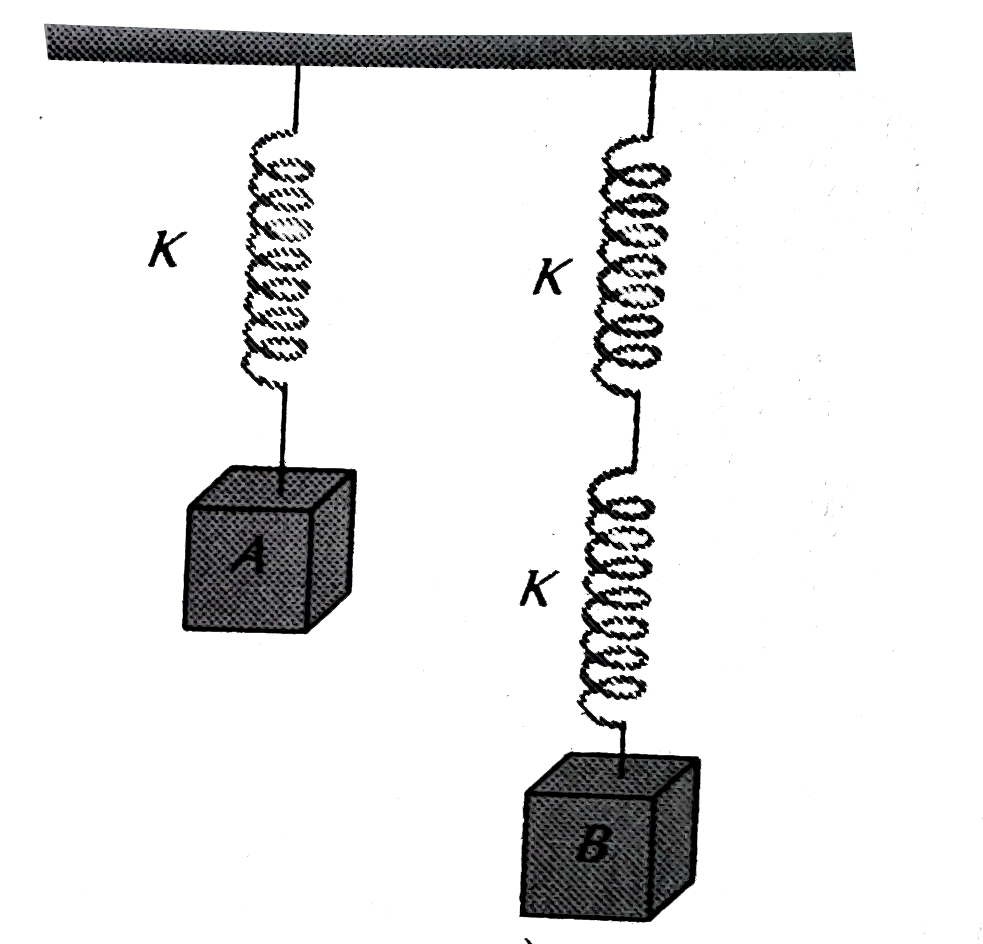
- The springs shown are identical. When A =4 kg , the elongation of spr...
Text Solution
|
- A spring connects two particles of masses m(1) and m(2) A horizontal f...
Text Solution
|
- If the above diagram initially there is no elongation in spring if the...
Text Solution
|
- A block of mass 5 kg having charge q is attached to a spring of const...
Text Solution
|
- In the previous problem , the maximum elongation of the spring is
Text Solution
|
- The spring is compressed by a distance a and released. The block again...
Text Solution
|
- The springs shown are identical. When A =4 kg , the elongation of spri...
Text Solution
|
- A spring is made of material of Young's modulus 10^(11)N//m^(2) . When...
Text Solution
|
- A body of mass m is tied to one end of a spring and whirled ...
Text Solution
|