

Home
Class 11
PHYSICS
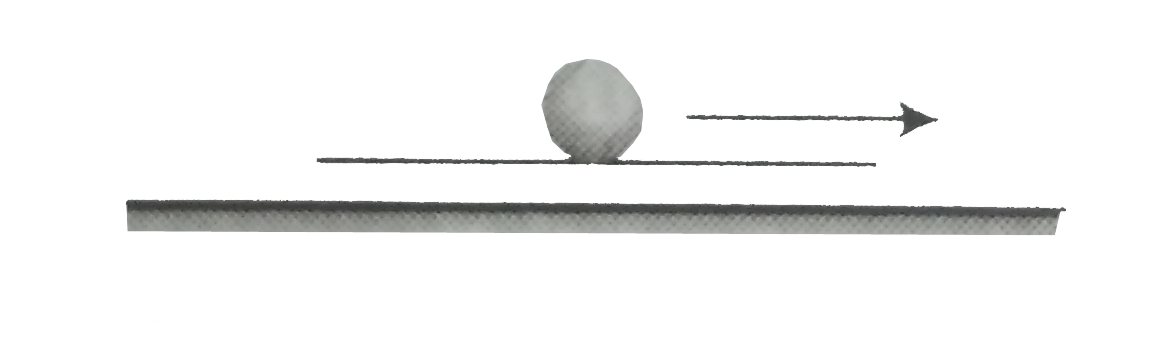
A ball rests upon a flat piece of paper ...

A ball rests upon a flat piece of paper on a table top. The paper is pulled horizontally but quickly towards right as shwon. Relative to its initial position with respect to the table, the ball

(`i`) remains stationary if there is no friction between the paper and the bell.
(`ii`) moves to the left and starts rolling backwards, i.e. to the left if there is a friction between the paper and the ball.
(`iii`) moves forward, i.e. in the direction in which the paper is pulled.
(`iv`) Here, the correct statements/s/is/are

Promotional Banner

Similar Questions

Explore conceptually related problems

A ball rests upon a flat piece of paper on a table to. The paper is pulled horizontally but quickly towards right as shown. Relative to its initial position with respect to the table the ball (1) remains stationary if there is no friction between the paper and the ball (2) moves to the left if ther is a friction between the paper and the ball. (3) moves forward, i.e. in the direction in which the paper is pulled. Here, the correct statement/s is/ are

In the figure shown, the frictional coefficient between the table and the block is 0.2. Find the ratio of tensions in the right and the left strings.

A ball rolls off the edge of a horizontal table top 4 m high. If it strikes the floor at a point 5 m horizontally away from the edge of the table, what was its speed at the instant it left the table?

A ball rolls off the edge of a horizontal table top 4 m high. If it strikes the floor at a point 5 m horizontally away from the edge of the table, what was its speed at the instant it left the table?

I took a white rectangular piece of paper. I divided in horizontally into 3 equal parts and coloured.

A piece of paper is in the form of a sector, making an angle a. The paper is rolled to form a right circular cone of radius 5 cm and height 12 cm. Then the value of angle a is

A ball of mass m moving with speed v towards the right strikes a wall moving towards the left with speed u . Find the change in the K.E. of the ball if the collision is elastic.

(b) Plot the following points on the graph paper and write whether they are on the right side or on the left side of the y-axis. (i) (5,-7)