

Home
Class 11
PHYSICS
Passage III A block of mass m =1/2 kg is...

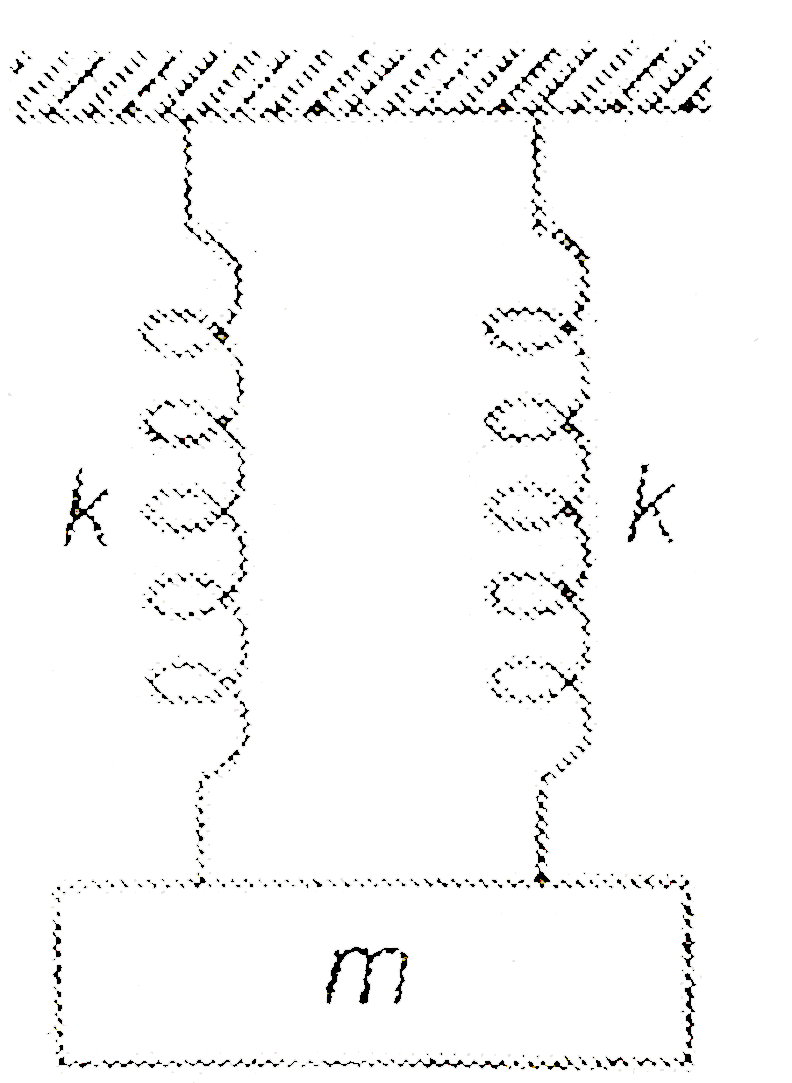
Passage III A block of mass m =1/2 kg is attached with two springs each of force contant k=10N/m as shown. The block is oscillating vertically up and down with amplitude A=25cm. When the block is at its mean position one of the spring breaks without changing momentum of block.

If instead of breaking one spring m/2 mass would have fallen from the block, then what will be the new amplitude?

Promotional Banner

Similar Questions

Explore conceptually related problems

Passage III A block of mass m =1/2 kg is attached with two springs each of force contant k=10N/m as shown. The block is oscillating vertically up and down with amplitude A=25cm. When the block is at its mean position one of the spring breaks without changing momentum of block. What is the new amplitude of osciallation of the block.

Passage III A block of mass m =1/2 kg is attached with two springs each of force contant k=10N/m as shown. The block is oscillating vertically up and down with amplitude A=25cm. When the block is at its mean position one of the spring breaks without changing momentum of block. What is the new amplitude of osciallation of the block.

A block of mass m is attached to two unstretched springs of spring constant k , each as shown. The block is displaced towards right through a distance x and is released The speed of the block as it passes through the mean position will be

A block of mass m is attached to two unstretched springs of spring constant k , each as shown. The block is displaced towards right through a distance x and is released The speed of the block as it passes through the mean position will be

A block of mass m = 2 kg is attached to two unstretched spring of force constant k_(1)=100 N//m and k_(2)=125 N//m The block is displaced towards left through a distance of 10 cm and released. Find the speed of the block as it passes through the mean position.

A block of mass m = 2 kg is attached to two unstretched spring of force constant k_(1)=100 N//m and k_(2)=125 N//m The block is displaced towards left through a distance of 10 cm and released. Find the speed of the block as it passes through the mean position.

Calculate the period of oscillations of block of mass m attached with a set of springs as shown

A block of mass 20 kg is hung with the help of ideal string, pulleys and spring (Spring constant k = 1000 N/m) as shown in figure. If block is in equilibrium position then extension in the spring will be (g = 10 ms^-2)

A 2 kg block is connected with two springs of force constants k_(1)=100 N//m and k_(2)=300 N//m as shown in figure. The block is released from rest with the springs unstretched. The acceleration of the block in its lowest postion is (g=10 m//s^(2))

A 2 kg block is connected with two springs of force constants k_(1)=100 N//m and k_(2)=300 N//m as shown in figure. The block is released from rest with the springs unstretched. The acceleration of the block in its lowest postion is (g=10 m//s^(2))