

Home
Class 11
PHYSICS
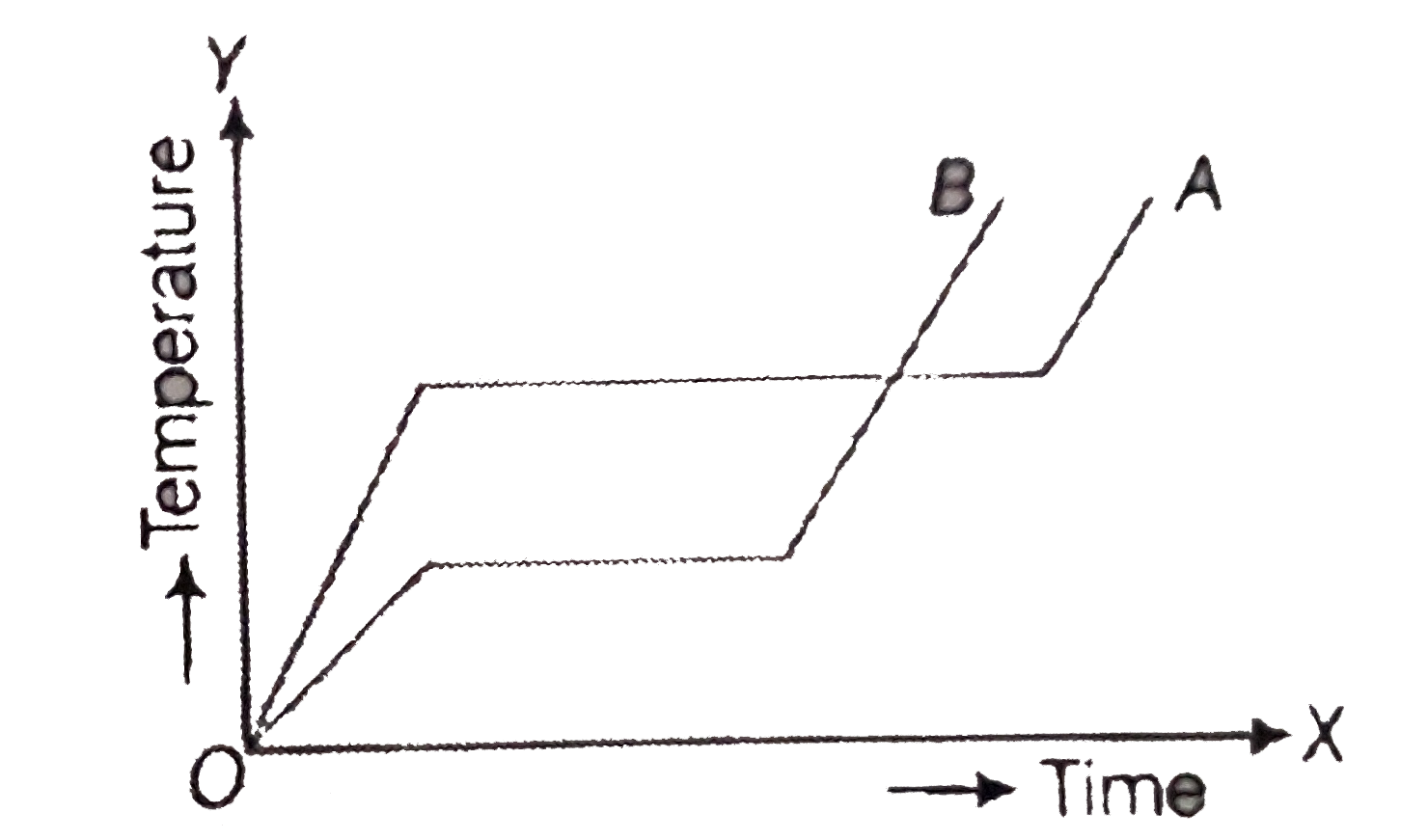
Equal masses of two liquids A and B cont...

Equal masses of two liquids A and B contained in vessels of negligible heat capacity are supplied heat at the same rate. The temperature-time graphs for the liquids are shown in the figure. If S represents specific heat and L represents latent heat of liquid, then

Promotional Banner

Similar Questions

Explore conceptually related problems

A source of heat supplies heat at constant rate to a solid cube. The variatiion of the temperature of the cube with heat supplied is shown in figure. The portion DE of the graph represents conversion of

The temperature of a hot liquid in a container of negligible heat capacity falls at the rate of 3K//min due to heat emission to the surroundings, just before it begins to solidify. The temperature then remains constant for 30min , by the time the liquid has all solidfied. Find the ratio of specific heat capacity of liquid to specific latent heat of fusion.

The temperature of a hot liquid in a container of negligible heat capacity falls at the rate of 3K//min due to heat emission to the surroundings, just before it begins to solidify. The temperature then remains constant for 30min , by the time the liquid has all solidfied. Find the ratio of specific heat capacity of liquid to specific latent heat of fusion.

Heat is supplied to a certain homogeneous sample of matter, at a uniform rate. Its temperature is plotted against time, as shown Which of the following conclusions can be drawn? (i) Its specific heat capacity is greater in the solid state than the liquid state. (ii) Its specific heat capacity is greater in the liquid state than in the solid state. (iii) Its latent heat of vaporization is greater than its latent heat of fusion. (iv) Its latent heat of vaporization is smaller than its latent heat of fusion

Heat is supplied to a certain homogeneous sample of matter, at a uniform rate. Its temperature is plotted against time, as shown Which of the following conclusions can be drawn? (i) Its specific heat capacity is greater in the solid state than the liquid state. (ii) Its specific heat capacity is greater in the liquid state than in the solid state. (iii) Its latent heat of vaporization is greater than its latent heat of fusion. (iv) Its latent heat of vaporization is smaller than its latent heat of fusion

Two different metal bodies A and B of equal mass are heated at a uniform rate under similar conditions. The variation of temperature of the bodies is graphically represented as shown in the figure. The ratio of specific heat capacities is :

Which liquid has the highest specific heat capacity?