

Home
Class 11
PHYSICS
Two rectangular blocks, having identical...

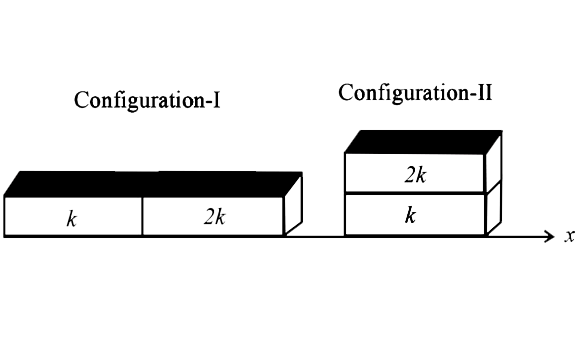
Two rectangular blocks, having identical dimensions, an be arranged either in configuration-I or in configuration-II as shown in the figure. One of the blocks has thermal conductivity k and the other 2k. The temperature difference between the ends along the x-axis is the same in both the configurations. It takes 9s to transport a certain amount of heat from the hot end to the cold end in the configuration-I. The time to transport the same amount of heat in the configuration-II is

Promotional Banner

Similar Questions

Explore conceptually related problems

Two rectangular blocks, having identical dimensions can be arranged either in configuration-I or in configuration- Il as shown in the figure. One of the blocks has thermal conductivity K and the other 2K. The temperature difference between the ends along the x-axis is the same in both the configurations. It takes 9 s to transport a certain amount of heat from the hot and to the cold end in the configuration-I. The time to transport the same amount of heat in the configuration-II is

Three rods of the same dimension have thermal conductivity 3K, 2K and K as shown in the figure. The temperature of the junction in steady-state is

A thermal conductor is heated at one end. What is the theoretical value of its thermal conductivity in order that the other end also attains the same temperature?

Three rods of same dimensions have thermal conductivity 3K,2K and K They are arranged as shown in Then the temperature of the junction in steady state is .

The electron configuration of the starting and ending elements of fourth period are

" In a "p" - block pnitcogen valency configuration is "

Five identical springs are used in the three configurations a shown in figure. The time periods of vertical oscillations in configurations (a), (b) and (c ) are in the ratio :

Thermal conductivity of coppe is 9 times that of steel. As shown in figure the temperature difference between ends of copper and steel is 100^(@)C . Find the temperature of their contact surface.