

Home
Class 11
PHYSICS
A small disc A is placed on an inclined ...

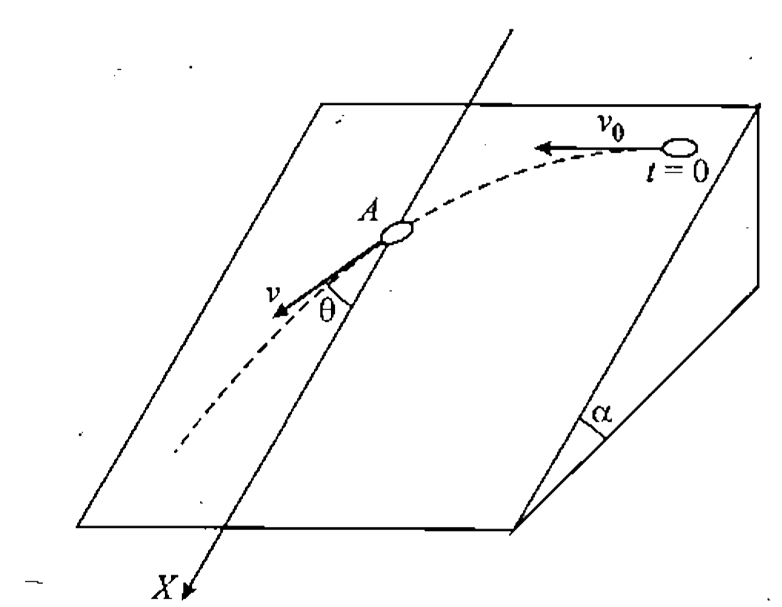
A small disc A is placed on an inclined plane forming an angle `alpha` with the horizontal and is imparted an initial velocity `v_(0)`. Find how the velocity of the disc depends on the angle `theta`, shown in figure-2.209, if the friction coefficient `mu = tan alpha` and at the initial moment `theta=pi//2`

Promotional Banner

Similar Questions

Explore conceptually related problems

A block is at rest on an inclined plane making an angle alpha with the horizontal. As the angle of the incline is increased the block start slipping when the angle of inclination becomes theta then coefficient of friction is equal to

A block is at rest on an inclined plane making an angle alpha with the horizontal. As the angle of the incline is increased the block start slipping when the angle of inclination becomes theta then coefficient of friction is equal to

A trolley containing a liquid slides down a smooth inclined plane of angle alpha with the horizontal. Find the angle of inclination theta of the free surface with the horizontal.

A trolley containing a liquid slides down a smooth inclined plane of angle alpha with the horizontal. Find the angle of inclination theta of the free surface with the horizontal.

A block is at rest on an inclined plane making an angle alpha with the horizontal . As the angle alpha of the incline is increased the block starts slipping when the angle of inclination becomes theta . The coefficient of static friction between the block and the surface of the inclined plane is or A body starts sliding down at an angle theta to the horizontal. Then the coefficient of friction is equal to

Particle "A" is released from a point "P" on a smooth inclined plane inclined at an angle alpha with the horizontal.At the same instant another particle "B" is projected with initial velocity 'u' making an angle beta 'with the horizontal.Both the particles meet again on the inclined plane.the relation between ' alpha and beta is 1) alpha+beta=(pi)/(6) 2) alpha+beta=(pi)/(4) 3) alpha+beta=(pi)/(3) 4) alpha+beta=(pi)/(2)