

Home
Class 12
PHYSICS
A sound source emits two sinusoidal soun...

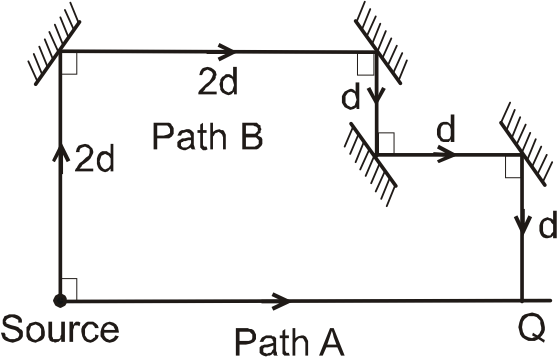
A sound source emits two sinusoidal sound waves, both of wavelength `lambda`, along paths A and B as shown in figure.The sound travelling along path B is reflected from five surfaces as shown and then merges at point Q, producing minimum intensity at that point.The minimum value of d in terms of `lambda` is :

Promotional Banner

Similar Questions

Explore conceptually related problems

A sound wave of wavelength 32 cm enters the tube at S as shown in the figure. Then the smallest radius r so that a minimum of sound is heard at detector D is

Sound wave from a source A, follows two paths AOB and APQB in a tube as shown in figure. For silence at B, possible wavelength of sound will be

In the figure shown, light waves A and B both of wavelength lambda are initially in phase and travelling rightward as incident by the two rays. Wave A is reflected from four parallel surfaces but ends up travelling in original direction. The possible value(s) of distance L in terms of wavelength lambda in figure which put A and B exactly out of phase with each other after all the reflected is/are

Two sound sources emitting sound each of wavelength lambda are fixed at a given distance apart. A listener moves with a velocity u along the line joining the two sources. The number of beats heard by him per second is

Two sound sources emitting sound each of wavelength lambda are fixed at a given distance apart. A listener moves with a velocity u along the line joining the two suorces. The number of beats heard by him per second is

A sound wave having wavelength lambda forms stationary waves after reflection from a surface. The distance between two consecutive nodes is

Two coherent sound sources A and B produce a sound of wavelength lambda. If at t=0 a detector starts moving with constant velocity v_(0) from point O along y - direction, then the minimum time, after which it detects the sound of maximum intensity, is (D gt gt lambda)