

Home
Class 11
PHYSICS
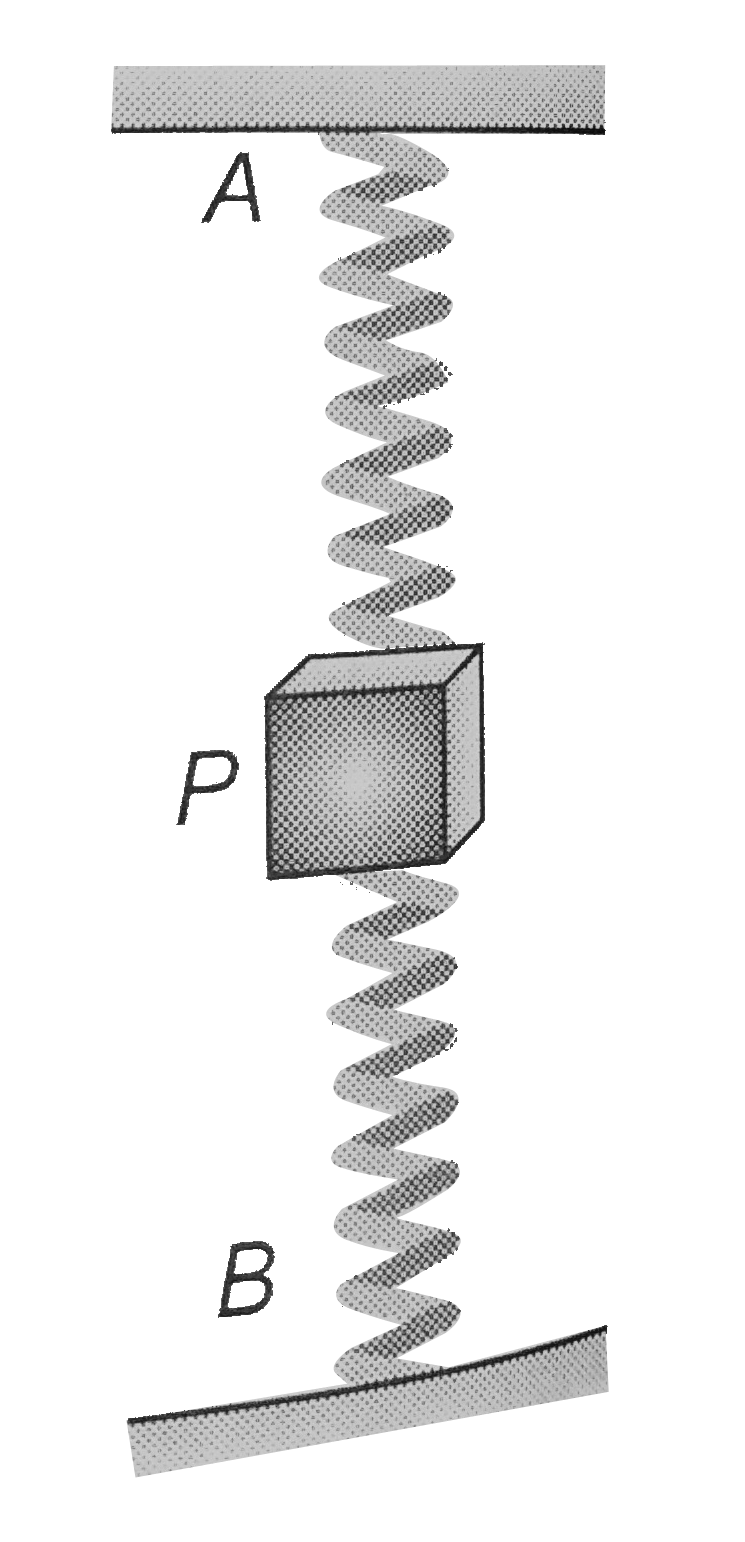
Two idetical spring are attached to a sm...

Two idetical spring are attached to a smalll block `p` The other ends of the springs are fixed at A and B. when `P` is equilibrium the extertion of top spring is `20cm` and extertion of bottom spring is `10cm` The period at small vertical oscilation of `p` about its equilibrium position is (use`g = 9.8m//s^(2))`

Promotional Banner

Similar Questions

Explore conceptually related problems

Two identical spring are attached to a small block P The other ends of the springs are fixed at A and B. when P is equilibrium the extension of top spring is 20cm and extension of bottom spring is 10cm The period at small vertical oscillation of p about its equilibrium position is (use g = 9.8m//s^(2))

Two identical springs are attached to a small block P. The other ends of the springs are fixed at A and B, When P is in equilibrium the extension of bottom spring is 10 cm. The period of small vertical oscillations of P about is equilibrium position is (use "g"=9.8 m//s^(2))

Two identical springs are attached to a small block P. The other ends of the springs are fixed at A and B, When P is in equilibrium the extension of bottom spring is 10 cm. The period of small vertical oscillations of P about is equilibrium position is (use "g"=9.8 m//s^(2))

In the figure, a block of mass m is rigidly attached to two identical springs of stiffness k each. The other ends of the springs are connected to the fixed wall. When the block is in equilibrium, length of each spring is b, which is greater than the natural length of the spring. The time period of the oscillation of the block if it is displaced by small distance perpendicular to the length of the springs and released. Space is gravity free.

In the figure, a block of mass m is rigidly attached to two identical springs of stiffness k each. The other ends of the springs are connected to the fixed wall. When the block is in equilibrium, length of each spring is b, which is greater than the natural length of the spring. The time period of the oscillation of the block if it is displaced by small distance perpendicular to the length of the springs and released. Space is gravity free.

A block of mass m is tied to one end of a spring which passes over a smooth fixed pulley A and under a light smooth movable pulley B . The other end of the string is attached to the lower end of a spring of spring constant K_2 . Find the period of small oscillation of mass m about its equilibrium position (in second). (Take m=pi^2kg , K_2k=4K_1 , K_1=17(N)/(m). )

A block of mass m is tied to one end of a spring which passes over a smooth fixed pulley A and under a light smooth movable pulley B . The other end of the string is attached to the lower end of a spring of spring constant K_2 . Find the period of small oscillation of mass m about its equilibrium position (in second). (Take m=pi^2kg , K_2k=4K_1 , K_1=17(N)/(m). )

A light pulley is suspended at the lower end of a spring of constant k_(1) , as shown in figure. An inextensible string passes over the pulley. At one end of string a mass m is suspended, the other end of the string is attached to another spring of constant k_(2) . The other ends of both the springs are attached to rigid supports, as shown. Neglecting masses of springs and any friction, find the time period of small oscillations of mass m about equilibrium position.

A light pulley is suspended at the lower end of a spring of constant k_(1) , as shown in figure. An inextensible string passes over the pulley. At one end of string a mass m is suspended, the other end of the string is attached to another spring of constant k_(2) . The other ends of both the springs are attached to rigid supports, as shown. Neglecting masses of springs and any friction, find the time period of small oscillations of mass m about equilibrium position.

A rod of length l and mass m , pivoted at one end, is held by a spring at its mid - point and a spring at far end. The spring have spring constant k . Find the frequency of small oscillations about the equilibrium position.