

Home
Class 11
PHYSICS
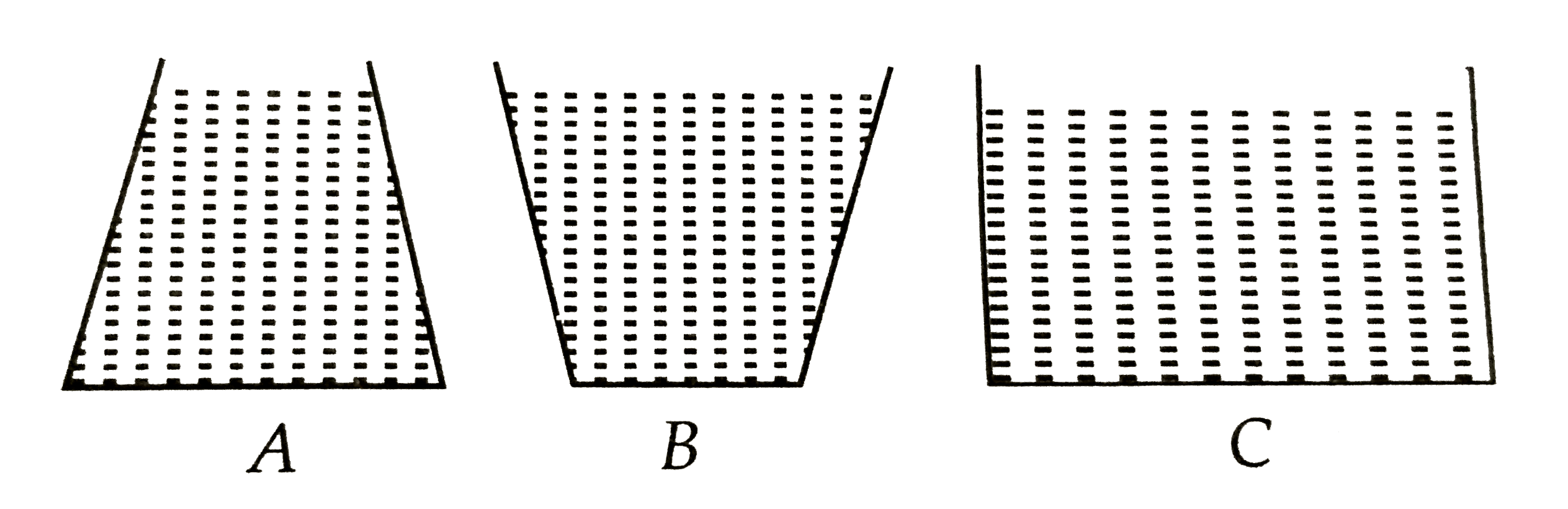
Three vessels A,B,and C of different sha...

Three vessels A,B,and C of different shapes contain a water upto the same height as shown in the figure .`P_(A) ,P_(B)` ,and `P_(C)` be the pressure exerted by the water at the bottom of the vessels A ,B and C respectively . Then

Promotional Banner

Similar Questions

Explore conceptually related problems

Three vessels A, B and C of different shapes contain a water upto the same in the figure P_A, P_B and P_C be the pressure exerted by the water at the bottom of the vessels A, B and C respectively. Then

Two vessels A and B of different shapes have the same base area and are filled with water up to the same height h (see figure). The force exerted by water on the base is F_(A) for vessel A and F_(B) for vessel B . The respective weights of the water filled in vessels are W_(A) and W_(B) . Then

Two vessels A and B of different shapes have the same base area and are filled with water up to the same height h (see figure). The force exerted by water on the base is F_(A) for vessel A and F_(B) for vessel B . The respective weights of the water filled in vessels are W_(A) and W_(B) . Then

Three vessels of different shapes are filled with water to the same height 'h' and their bottom parts are connected to manometers measuring the pressure. The water levels in all the vessels remain the same. . Predict the pressure level shown by the manometers.

Three vessels of different shapes are filled with water to the same height 'h' and their bottom parts are connected to manometers measuring the pressure. The water levels in all the vessels remain the same. . Identify the above phenomenon.

When two liquids A and B of equal weight are filled inside two identical containers, the height of the liquid Column A is greater than the height of the liquid Column B. If P_(A)andP_(B) are the pressures exerted by A and B at the bottom of the containers, respectively, and d_(A),d_(B) are the densities of A and B, respectively, which of the following statements is true ?

Two vessels A and B of cross sections as shown contain a liquid up to the same height. As the temperature rises, the liquid pressure at the bottom (neglecting expansion of the vessels ) will :

Four vessels A, B, C and D have different shapes and hold different amount of water. Which of the following is correct.