

Home
Class 11
PHYSICS
particles of masses 2M m and M are resec...

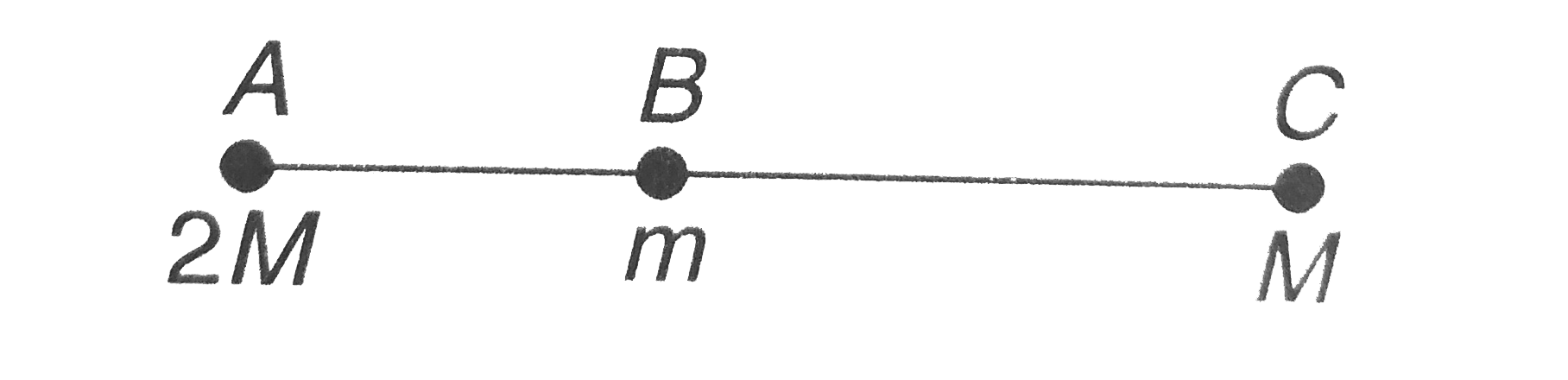
particles of masses 2M m and M are resectively at points A , B and C with ` AB = (1)/(2) (BC)` m is much - much smaller than M and at time ` t=0` they are all at rest as given in figure . As subsequent times before any collision takes palce .

Promotional Banner

Similar Questions

Explore conceptually related problems

Particles of masses 2M, m and M ae are respectively at points A,B and C with AB = 1/2 (BC) . m is much-much smaller than M and at time t = 0, they are all at rest (show in the figuare) AT subsequent times before any collision takes place.

Particles of masses 2M, m and M are respectively at points A, B and C with sqrt((GM)/(R))(sqrt(2)+1) is much-much smaller than M and at time t=0 , they are all at rest as given in figure At subsequent time before any collision takes place.

Two particle of masses m and 2m are coliding elastically as given in figure. If V_(1) and V_(2) speed of particle just after collision then

Two particle of masses m and 2m are coliding elastically as given in figure. If V_(1) and V_(2) speed of particle just after collision then

A particle A of mass m initially at rest slides down a height of 1.25 m on a frictionless ramp, collides with and sticks to an identical particles B of mass m at rest as shown in the figure. Then, particles A and B together collide elastically with particle G of mass 2m at rest. The speed of particle G after the collision with combined body (A+B) would be (Take, g =10 ms^(-2))

A particle A of mass m initially at rest slides down a height of 1.25 m on a frictionless ramp, collides with and sticks to an identical particles B of mass m at rest as shown in the figure. Then, particles A and B together collide elastically with particle G of mass 2m at rest. The speed of particle G after the collision with combined body (A+B) would be (Take, g =10 ms^(-2))

Two particles of masses m_1 and m_2 in projectile motion have velocities vecv_1 and vecv_2 respectively at time t=0. They collide at time t_0. Their velocities become vecv_1' and vecv_2' at time 2t_0 while still moving in air. The value of |(m_1vecv_1' + m_2vecv_2') - (m_1vecv_1 + m_2vecv_2)| is