

Home
Class 11
PHYSICS
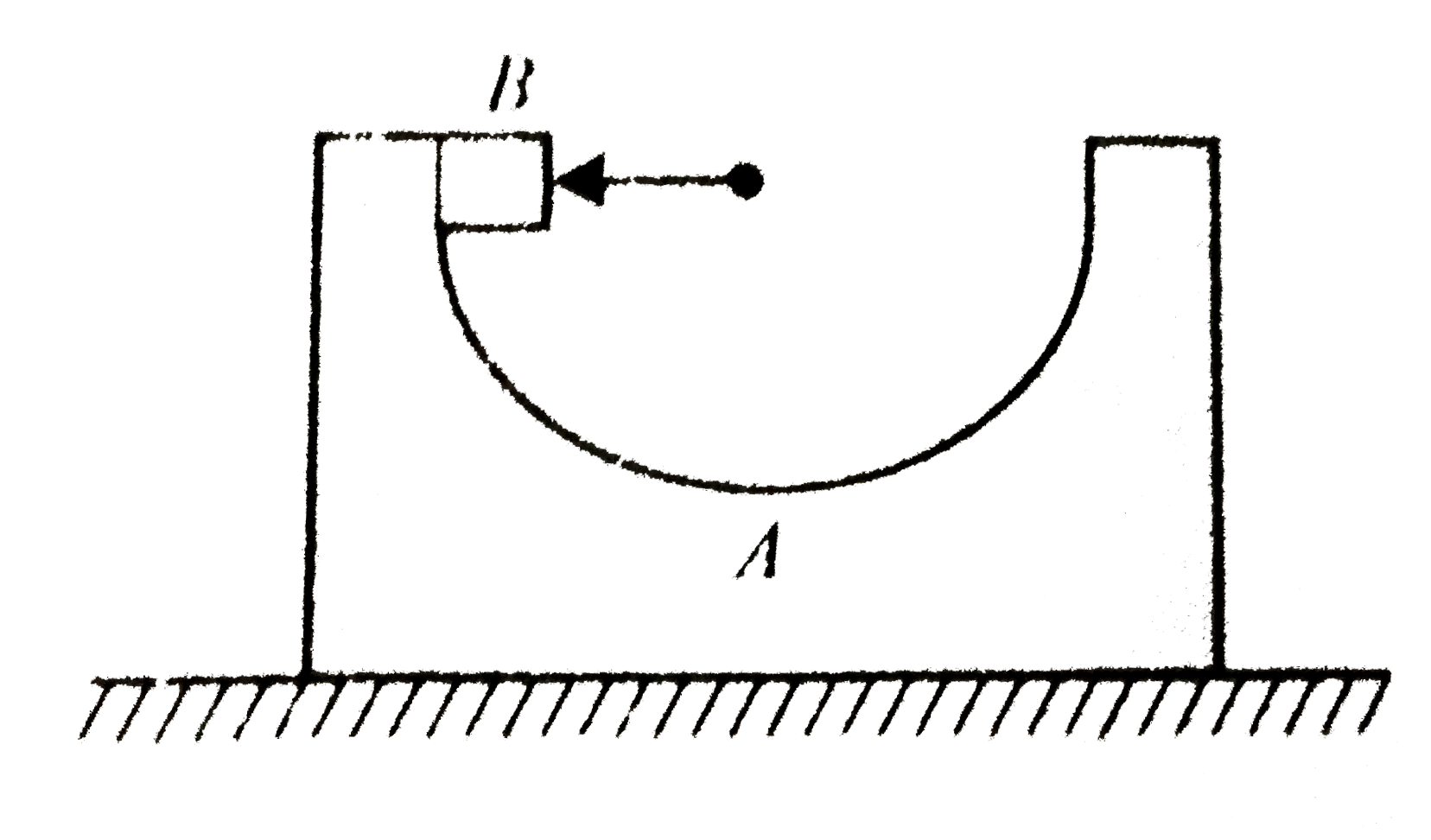
Figure shows a block A of mass 6 m havin...

Figure shows a block `A` of mass `6 m` having a smooth semicircular groove of radius a placed on a smooth horizontal surface. A block `B` of mass `m` is released from a position in groove where its radius is horizontal. Find the speed of the bigger block when the smaller block reaches its bottom most position.

Promotional Banner

Similar Questions

Explore conceptually related problems

Figure shows a wedge A of mass 6 m smooth semicircular groove of radius a= 8.4 m placed on a smooth horizontal surface. A small block B of mass m is released from a position in groove where its radius is horizontal. Find the speed (in ms^(-1) ) of bigger block when smaller block reaches its bottommost position.

Figure shows a wedge A of mass 6 m smooth semicircular groove of radius a= 8.4 m placed on a smooth horizontal surface. A small block B of mass m is released from a position in groove where its radius is horizontal. Find the speed (in ms^(-1) ) of bigger block when smaller block reaches its bottommost position.

A block of mass m is placed at rest on a smooth wedge of mass M placed at rest on a smooth horizontal surface. As the system is released

A block of mass m is placed at rest on a smooth wedge of mass M placed at rest on a smooth horizontal surface. As the system is released

Figure shows a small block of mass m which is started with a speed v on the horizontal part of the bigger block of mas m placed on a horizontal floor. The curved part of the surface shown is semicircular. All the surfaces are frictionless. Find the speed of the bigger block when the smaller block reaches the point A of the surface.

Figure shows a small block of mass m which is started with a speed v on the horizontal part of the bigger block of mas m placed on a horizontal floor. The curved part of the surface shown is semicircular. All the surfaces are frictionless. Find the speed of the bigger block when the smaller block reaches the point A of the surface.

Figure shows a small block of mass m which is started with a speed v on the horizontal part of the bigger block of mas m placed on a horizontal floor. The curved part of the surface shown is semicircular. All the surfaces are frictionless. Find the speed of the bigger block when the smaller block reaches the point A of the surface.

A smooth wedge of mass M rests on a smooth horizontal surface. A block of mass m is projected from its lowermost point with velocity v_(0) . What is the maximum height reached by the block?

A smooth wedge of mass M rests on a smooth horizontal surface. A block of mass m is projected from its lowermost point with velocity v_(0) . What is the maximum height reached by the block?

A smooth wedge of mass M rests on a smooth horizontal surface. A block of mass m is projected from its lowermost point with velocity v_(0) . What is the maximum height reached by the block?