

Home
Class 11
PHYSICS
Three particles of equal masses are plac...

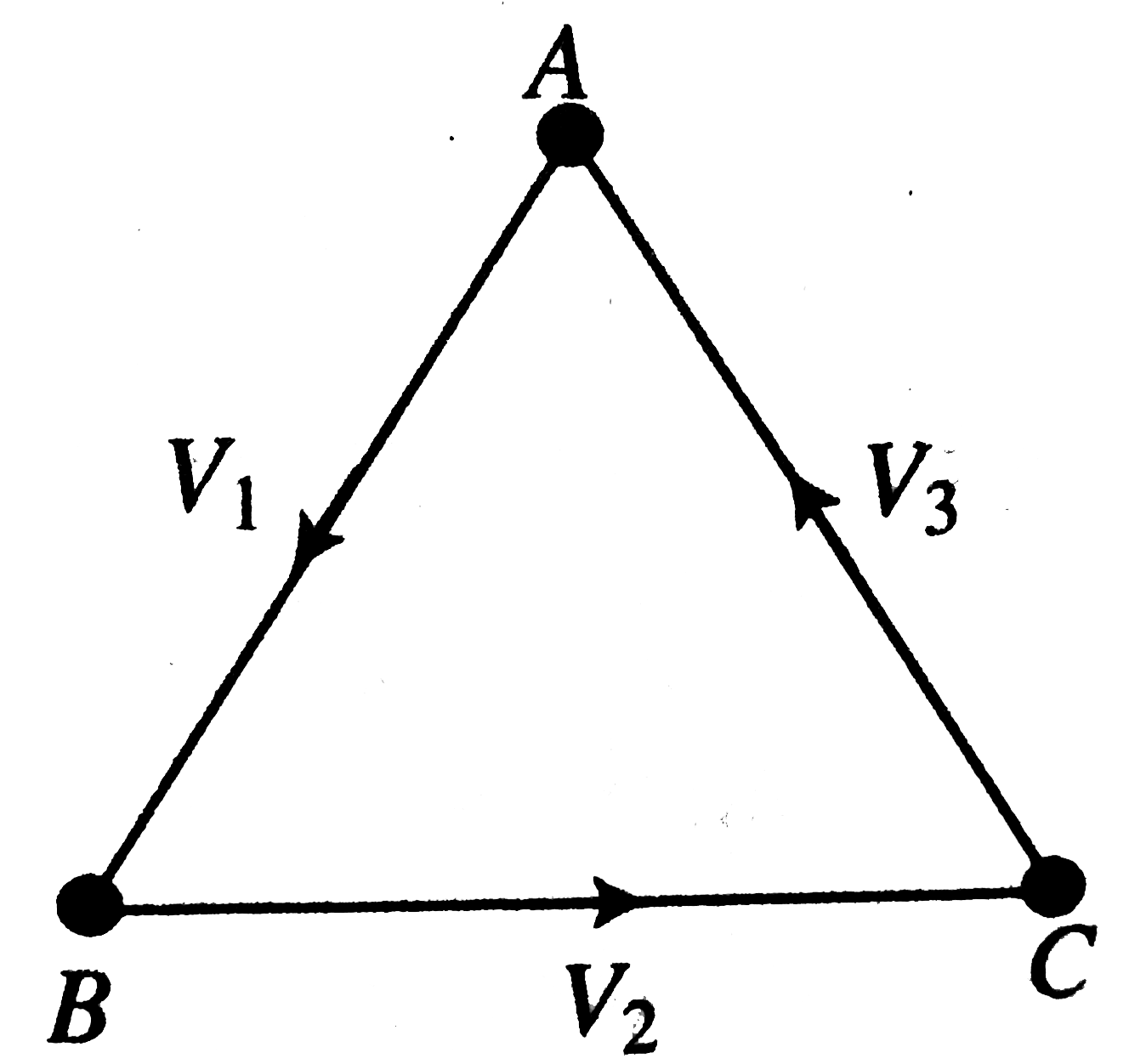
Three particles of equal masses are placed at the corners of an equilateral triangle as shown in the figure. Now particle `A` starts with a velocity `v_(1)` towards line `AB`, particle `B` starts with a velocity `v_(2)` towards line `BC` and particle `C` starts with velocity `v_(3)` towards line `CA`. The displacement of `CM` of three particle `A, B` and `C` after time `t` will be (given if `v_(1)=v_(2)=v_(3))`

Promotional Banner

Similar Questions

Explore conceptually related problems

Let there are three equal masses situated at the vertices of an equilateral triangle, as shown in Fig. Now particle A starts with a velocity v_(1) towards line AB , particle B starts with the velocity v_(2) , towards line BC and particle C starts with velocity v_(3) towards line CA . Find the displacement of the centre of mass of the three particles A, B and C after time t . What would it be if v_(1)=v_(2)=v_(3) ?

Let there are three equal masses situated at the vertices of an equilateral triangle, as shown in Fig. Now particle A starts with a velocity v_(1) towards line AB , particle B starts with the velocity v_(2) , towards line BC and particle C starts with velocity v_(3) towards line CA . Find the displacement of the centre of mass of the three particles A, B and C after time t . What would it be if v_(1)=v_(2)=v_(3) ?

Three particles A, B, Care located at the comers of an equilateral triangle as shown in figure. Each of the particle is moving with velocity v. Then at the instant shown, the relative angular velocity of

Three particles A, B, Care located at the comers of an equilateral triangle as shown in figure. Each of the particle is moving with velocity v. Then at the instant shown, the relative angular velocity of

Three particles A, B, Care located at the comers of an equilateral triangle as shown in figure. Each of the particle is moving with velocity v. Then at the instant shown, the relative angular velocity of

Thre identical masses are kept at the corners of an equilateral triangle ABC. A moves towards B with a velocity V, B moves towards C with velocity V, and C moves towards A with same velocity V. Then the velocity of centre of mass of the system of particles is