

Home
Class 11
PHYSICS
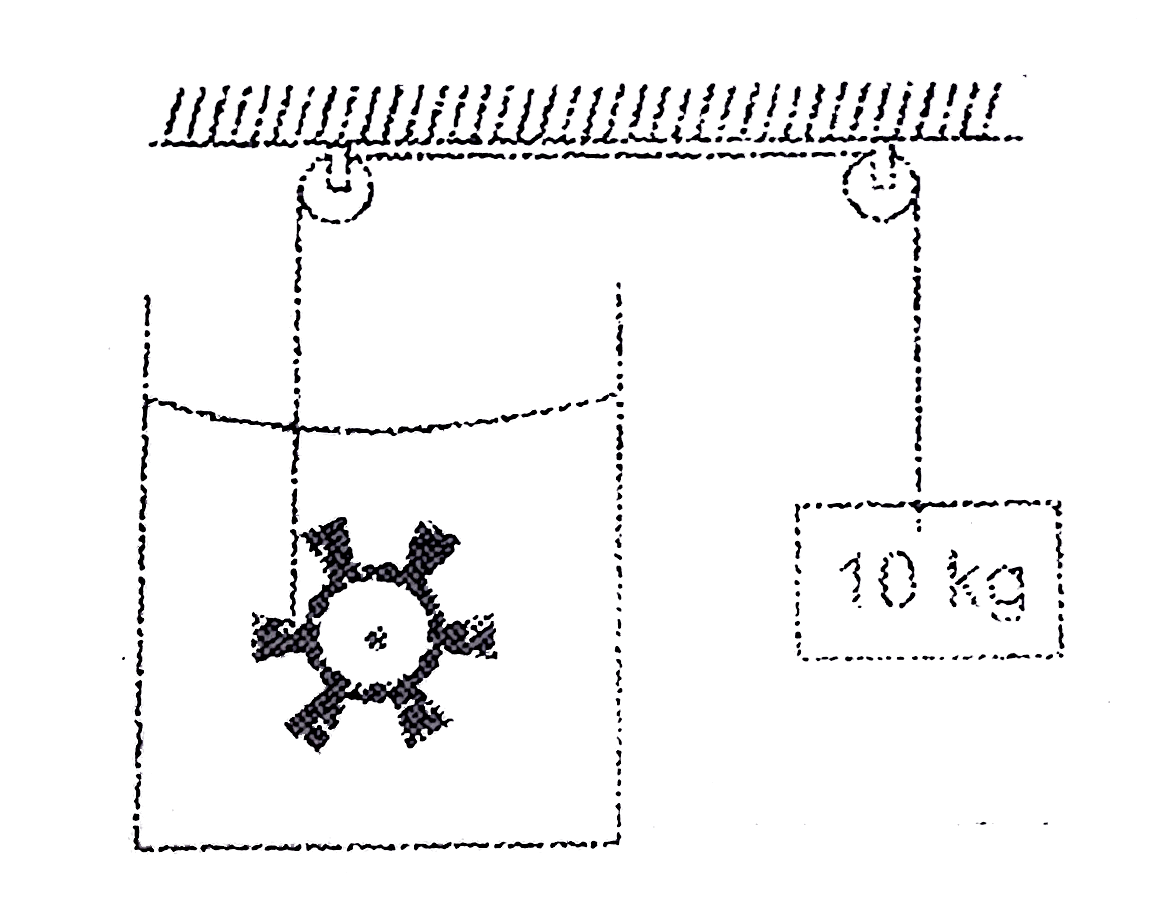
A paddle wheel is connected with a block...

A paddle wheel is connected with a block of mass `10kg` as shown in figure. The wheel is completely immersed in liquid of heat capacity `400 J//K` . The container is adiabatic. For the time interval in which block goes down `1m` slowly calculate
(a) Work done on the liuid
(b) Heat supplied to the liquid
(c ) Rise in the temperature of the liquid Neglect the heat capacity of the container and the paddle. `(g = 10 m//s^(2))`

Promotional Banner

Similar Questions

Explore conceptually related problems

As shown in figure a paddle wheel coupled to a mass of 12 kg through fixed frictionless pulleys. The paddle is immersed in a liquid of heat capacity 4200(J)/(K) kept in an adiabatic container. Consider a time interval in which the 12 kg block falls slowly through 70 cm. (a) How much heat is given to the liquid? (b) How much work is done on the liquid? (c ) Calculate the rise in the temperature of the liquid neglecting the heat capacity of the container and the paddle.

Shows a peddle wheel couple to a mass of 12 kg through fixed frictionless pulley. The paddle is immersed in a liquid of heat capacity 4200 J K^(-1) kept in an adiabatic container. Consider a time interval in which the 12 kg block falls slowly through 70cm. (a) how much heat is given to the liquid ? (b) how much work is done on the liquid? (c ) calculate the rise in the temperature of the liquid neglecting the heat capacity of the container and the paddle.

Shows a peddle wheel couple to a mass of 12 kg through fixed frictionless pulleus. The paddle is immersed in a liquid of heat capacity 4200 J K^(-1) kept in an adiabatic container. Consider a time interval in which the 12 kg block falls slowly through 70cm. (a) how much heat is given to the liquid ? (b) how much work is done on the liquid? (c ) calculate the rise in the temperature of the liquid neglecting the heat capacity of the container and the paddle.

Shows a peddle wheel couple to a mass of 12 kg through fixed frictionless pulley. The paddle is immersed in a liquid of heat capacity 4200 J K^(-1) kept in an adiabatic container. Consider a time interval in which the 12 kg block falls slowly through 70cm. (a) how much heat is given to the liquid ? (b) how much work is done on the liquid? (c ) calculate the rise in the temperature of the liquid neglecting the heat capacity of the container and the paddle.

A block of ice at -20^(@)C having a mass of 2kg is added to a 3kg water at 15^(@)C . Neglecting heat losses and the heat capacity of the container

A lead block of mass 2 kg is supplied with a heat energy of 3600 J. Calculate the rise in temperature, if the sp. heat capacity of lead is 130 J kg^(-1) C^(-1) .

A hammer of mass 200 kg strikes a steel block of mass 200 g with a velocity 8 ms^(-1) . If 23% of the energy is utilized to heat the steel block, the rise in temperature of the block is (Specific heat capacity of steel, = 460 J kg ^(-1) K^(-2) )

A block of mass 5 kg and volume 0.05"m"^(3) floats in a liquid of density 140 "kg m"^(-3) . The fraction of block inside liquid is

Two vessels A and B of cross sections as shown contain a liquid up to the same height. As the temperature rises, the liquid pressure at the bottom (neglecting expansion of the vessels ) will :

A closed bottle contains some liquid. The bottle is shaken vigorously for 5 minutes. It is found that the temperature of the liquid is increased. Is heat transferred of the liquid? Is work done on the liquid? Neglect expansion on heating.