

Home
Class 11
PHYSICS
A Stick of length L and mass M lies on a...

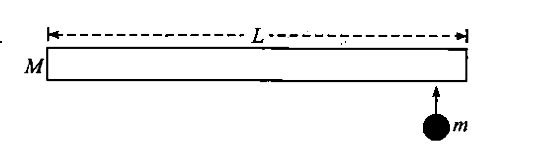
A Stick of length L and mass M lies on a fnctionless horizontal surface on which it is free to move in any way. A ball of mass m moving with speed v collides elastically with the stick as shownin figure-5.115. If after the collision ball comes to rest, then what should be the mass of the ball ?

Promotional Banner

Similar Questions

Explore conceptually related problems

A stick of length L and mass M lies on a frictionless horizontal surface on which it is free to move in any way. A ball of mass m moving with speed v collides elastically with the stick as shown in the figure. If after the collision the ball comes to rest, then what would be the mass of the ball?

A stick of length L and mass M lies on a frictionless horizontal surface on which it is free to move in any way. A ball of mass m moving with speed v collides elastically with the stick as shown in the figure. If after the collision the ball comes to rest, then what would be the mass of the ball?

A ball of mass m moving with velocity v collides head on elastically with another identical ball moving with velocity - V. After collision

A ball of mass m moving with velocity v collides head on elastically with another identical ball moving with velocity - V. After collision

A ball of mass m, moving with a speed 2v_0 collides inelastically (e>0) with an identical ball at rest. Show that for head-on collision, both the balls move forward.

A stick of length l lies on horizontal table. It has a mass M and is free to move in any way on the table. A bal of mass m moving perpendicularly to the stick at a distance d from its centre with speed v collides elastically with it as shown in figure. what quantities are conserved in the collision ? what must be the mass of the ball, so that it remains at rest immediately after collision?

A stick of length l lies on horizontal table. It has a mass M and is free to move in any way on the table. A bal of mass m moving perpendicularly to the stick at a distance d from its centre with speed v collides elastically with it as shown in figure. what quantities are conserved in the collision ? what must be the mass of the ball, so that it remains at rest immediately after collision?

A ball of mass M moving with speed v collides perfectly inelastically with another ball of mass m at rest. The magnitude of impulse imparted to the first ball is