

Home
Class 12
PHYSICS
PQ is an infinite current carrying condu...

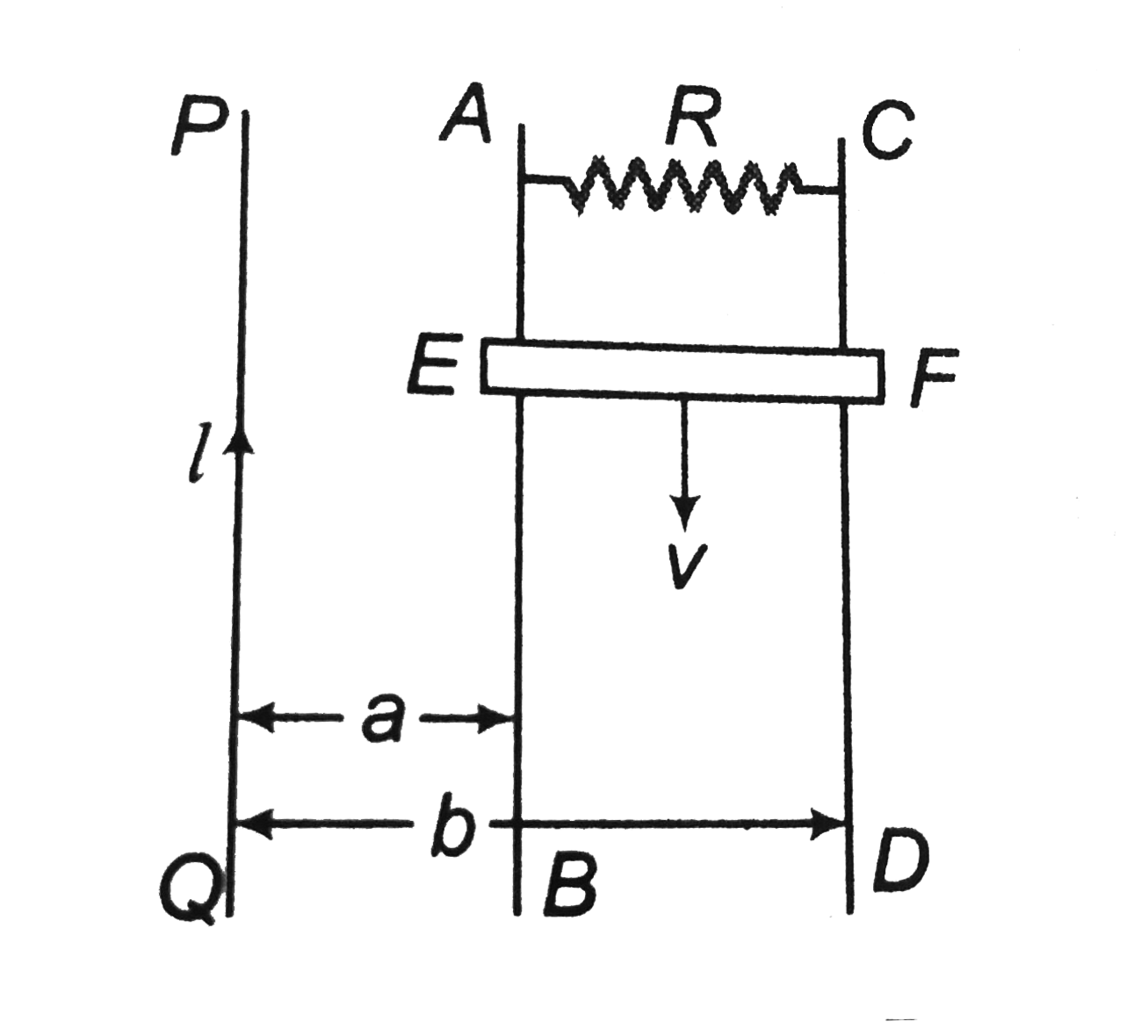
`PQ` is an infinite current carrying conductor. `AB` and `CD` are smooth conducting rods on which a conductor `EF` moves with constant velocity `v` as shown. The force needed to maintain constant speed of `EF` is

Promotional Banner

Similar Questions

Explore conceptually related problems

A conducting circular loop of radius a and resistance per unit length R is moving with a constant velocity v_0 , parallel to an infinite conducting wire carrying current i_0 . A conducting rod of length 2a is approaching the centre of the loop with a constant velocity v_0/2 along the direction 2 of the current. At the instant t = 0 , the rod comes in contact with the loop at A and starts sliding on the loop with the constant velocity. Neglecting the resistance of the rod and the self-inductance of the circuit, find the following when the rod slides on the loop. (a) The current through the rod when it is at a distance of (a/2) from the point A of the loop. (b) Force required to maintain the velocity of the rod at that instant.

A conducting circular loop of radius a and resistance per unit length R is moving with a constant velocity v_0 , parallel to an infinite conducting wire carrying current i_0 . A conducting rod of length 2a is approaching the centre of the loop with a constant velocity v_0/2 along the direction 2 of the current. At the instant t = 0 , the rod comes in contact with the loop at A and starts sliding on the loop with the constant velocity. Neglecting the resistance of the rod and the self-inductance of the circuit, find the following when the rod slides on the loop. (a) The current through the rod when it is at a distance of (a/2) from the point A of the loop. (b) Force required to maintain the velocity of the rod at that instant.

The end B of the rod AB which makes angle theta with the floor is being pulled with a constant velocity v_(v) as shown. The length of the rod is l .

The end B of the rod AB which makes angle theta with the floor is being pulled with a constant velocity v_(v) as shown. The length of the rod is l .

A conductor PQ , with PQ=r , moves with a velocity v in a uniform magnetic field of induced B . The emf induced in the rod is

A conductor AB of length l carrying a current i is placed perpendicular to a long straight conductor XY carrying a current I , as shown. The force on AB will act

PQ is a long straight conductor carrying a current of 3 A as shown in figure below. An electron moves with a velocity of 2 xx 10^7ms^(-1) parallel to it. Find the force acting on the electron.

In the figure shown a long conductor carries constant current I . A rod PQ of length l is in the plane of the rod.The rod is rotated about point P with constant angular velocity omega as shown in the figure.Find the e.m.f induced in the rod in the position shown.Indicate which points is at high potential.

In the figure shown a long conductor carries constant current I . A rod PQ of length l is in the plane of the rod.The rod is rotated about point P with constant angular velocity omega as shown in the figure.Find the e.m.f induced in the rod in the position shown.Indicate which points is at high potential.

A conducting rod of resistence r moves uniformely with a constant speed v. If the rod keeps moving uniformly, then the amount of force required is -