Home
Class 12
PHYSICS
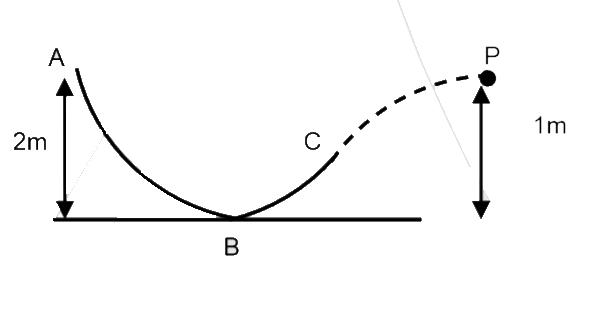
A particle is released at point A. Find ...

A particle is released at point A. Find Kinetic energy at point P Given m = 1 kg and all surfaces are frictionless

Text Solution

Verified by Experts

The correct Answer is:

10
Promotional Banner

Similar Questions

Explore conceptually related problems

A particle of mass m has momentum p. Its kinetic energy will be

A box of 5 kg mass moves up a ramp from point A to point B at a constant speed. Given that the surfaces are smooth (frictionless). What is the gain in the potential energy by the box? (Take "g = 10 m/s"^2 )

A block of mass 1 kg is released from the top of a wedge of mass 2 kg. Height of wedge is 10 meter and all the surfaces are frictionless. Then

A thin uniform bar lies on a frictionless horizontal surface and is free to move in any way on the surface. Its mass is 0.16 kg and lengths is sqrt(3)m . Two particles, each of mass 0.08 kg , are moving on the same surface and towards the bar in a direction perpendicular to the bar, one with a velocity of 10 ms^(-1) and the other with 6ms^(-1) , as shown in fig. The first particle strikes the bar at point A and the other at point B. Points A and B are at a distance 0.5 m from the centre of the bar. The particles strike the bar at same instant of time and stick to the bar on collision. Calculate the loss of kinetic energy of the system in the above collision process.

In a region of space an electric field line is in the shape of a semicircle of radius R. Magnitude of the field at all point is E. A particle of mass m having charge q is constrained to move along this field line. The particle is released from rest at A. (a) Find its kinetic energy when it reaches point B. (b) Find the acceleration of the particle when it is at midpoint of the path from A to B.

A thin uniform bar lies on a frictionless horizonta surface and is free to move in any way on th surface. Its mass is 0.16 kg and length sqrt3 meters. Two particless, each of mass 0.08 kg, are moving on the same surface and towards the bar in a direction perpendicular to the bar, one with a velocity of 10 m/s, and other with 6m/s as shown in fig. The first particle strikes the bar at point A and the other at point B. Points A and B are at a distane of 0.5m from the centre of the bar. The particles strike the bar at the same instant of time and stick to the bar on collision. Calculate the loss of the kinetic energy of the system in the above collision process.

A particle is projected at 60 ^@ to the horizontal with kinetic energy K. Its kinetic energy at the highest point is :

In the system shown in figure, mass m is released from rest from position A. Suppose potential energy of m at point A with respect to point B is E. Dimensions of m negligible and all surfaces are smooth. When mass reaches at point B.
