

Home
Class 11
PHYSICS
Two identical blocks A and B, each of ma...


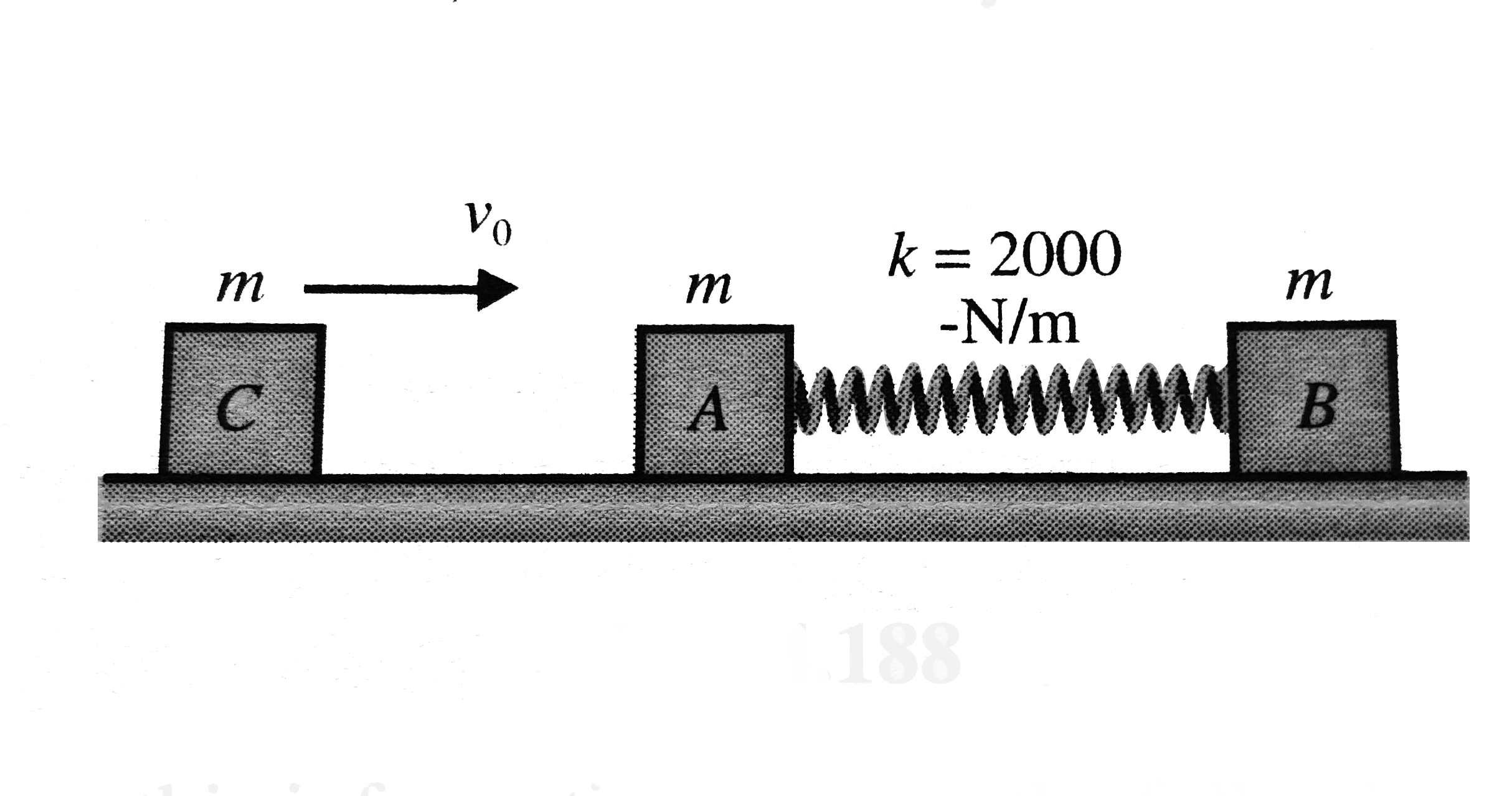
Two identical blocks A and B, each of mass `m=3kg`, are connected with the help of an ideal spring and placed on a smooth horizontal surface as shown in Fig. Another identical blocks C moving velocity `v_0=0.6(m)/(s)` collides with A and sticks to it, as a result, the motion of system takes place in some way
Based on this information answer the following questions:
Q. The maximum compression of the spring is

Promotional Banner

Similar Questions

Explore conceptually related problems

Two identical blocks A and B, each of mass m=3kg , are connected with the help of an ideal spring and placed on a smooth horizontal surface as shown in Fig. Another identical blocks C moving velocity v_0=0.6(m)/(s) collides with A and sticks to it, as a result, the motion of system takes place in some way Based on this information answer the following questions: Q. After the collision of C and A, the combined body and block B would

Two identical blocks A and B, each of mass m=3kg , are connected with the help of an ideal spring and placed on a smooth horizontal surface as shown in Fig. Another identical blocks C moving velocity v_0=0.6(m)/(s) collides with A and sticks to it, as a result, the motion of system takes place in some way Based on this information answer the following questions: Q. After the collision of C and A, the combined body and block B would

Two identical blocks A and B, each of mass m=3kg , are connected with the help of an ideal spring and placed on a smooth horizontal surface as shown in Fig. Another identical blocks C moving velocity v_0=0.6(m)/(s) collides with A and sticks to it, as a result, the motion of system takes place in some way Based on this information answer the following questions: Q. After the collision of C and A, the combined body and block B would

Two identical blocks A and B, each of mass m=3kg , are connected with the help of an ideal spring and placed on a smooth horizontal surface as shown in Fig. Another identical blocks C moving velocity v_0=0.6(m)/(s) collides with A and sticks to it, as a result, the motion of system takes place in some way Based on this information answer the following questions: Q. Oscillation energy of the system i.e., part of the energy which is oscillation (changing) between potention and kinetic forms is

Two identical blocks A and B, each of mass m=3kg , are connected with the help of an ideal spring and placed on a smooth horizontal surface as shown in Fig. Another identical blocks C moving velocity v_0=0.6(m)/(s) collides with A and sticks to it, as a result, the motion of system takes place in some way Based on this information answer the following questions: Q. Oscillation energy of the system i.e., part of the energy which is oscillation (changing) between potention and kinetic forms is

Two identical blocks A and B, each of mass m=3kg , are connected with the help of an ideal spring and placed on a smooth horizontal surface as shown in Fig. Another identical blocks C moving velocity v_0=0.6(m)/(s) collides with A and sticks to it, as a result, the motion of system takes place in some way Based on this information answer the following questions: Q. Oscillation energy of the system i.e. part of the energy which is oscillating between potential and kinetic forms

Two identical blocks A and B, each of mass m=3kg , are connected with the help of an ideal spring and placed on a smooth horizontal surface as shown in Fig. Another identical blocks C moving velocity v_0=0.6(m)/(s) collides with A and sticks to it, as a result, the motion of system takes place in some way Based on this information answer the following questions: Q. After the collision of C and A, the combined body and block B would Option1 oscillate about centre of mass of system and centre of mass is at rest. Option2 oscillate about centre of mass of system and centre of mass is moving. Option3 oscillate but about different location other than the centre of mass. Option4 not oscillate.

A block of mass M is kept on a smooth horizontal surface. Another block of mass m, moving with velocity v, collides with it and coalesces. What is the resultant velocity of the system?

Two identical blocks A and B each of mass M are connected to each other through a light string. The system is placed on a smooth horizontal floor. When a constant force F is applied horizontally on the block A, find the tension in the string.