

Home
Class 11
PHYSICS
Three components of a force acting on a ...

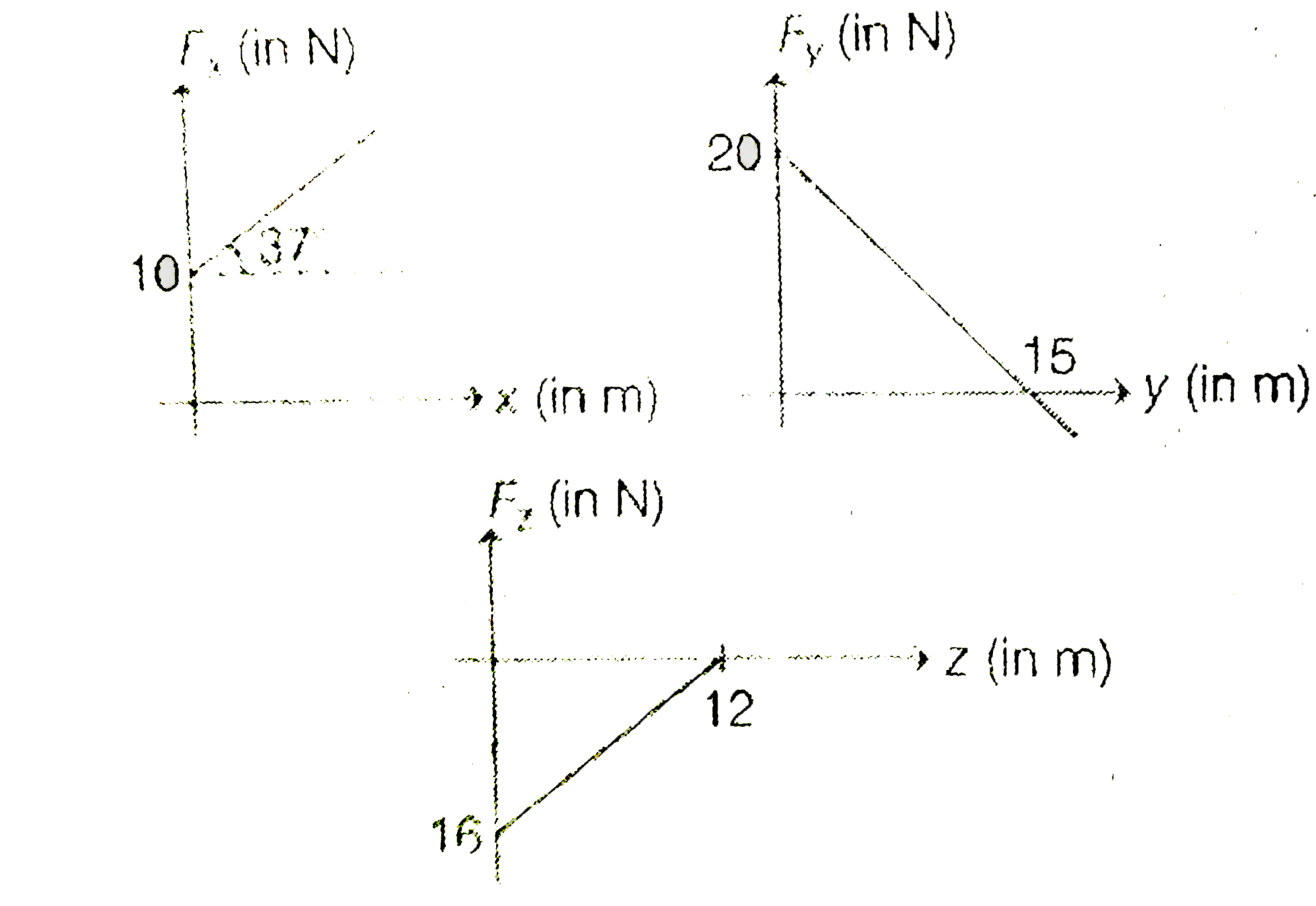
Three components of a force acting on a particle are varying according to the graphs as shown. To reach at point B(8, 20, 0)m from point A(0, 5, 12)m the particle moves on paths parallel to x-axis then y-axis and then z-axis, then work done by this force is:

Promotional Banner

Similar Questions

Explore conceptually related problems

A force F acting on a particle varies with the position x as shown in figure. Find the work done by this force in displacing the particle from

A force F acting on a particle varies with the position x as shown in figure. Find the work done by this force in displacing the particle from

Force acting on a particle moving along x-axis as shown in figure. Find points of stable and unstable equlibrium. .

Force acting on a particle moving along x-axis as shown in figure. Find points of stable and unstable equlibrium. .

A force vecF=(4hati+5hatj)N acts on a particle moving in XY plane. Starting from origin, the particle first goes along x-axis to the point (5.0) m and then parallel to the Y-axis to the point (5,4 m. The total work done by the force on the particle is

A force vecF=(4hati+5hatj)N acts on a particle moving in XY plane. Starting from origin, the particle first goes along x-axis to the point (5.0) m and then parallel to the Y-axis to the point (5,4 m. The total work done by the force on the particle is

Force acting on a particle varies with x as shown in figure. Calculate the work done by the force as the particle moves from x = 0 to x = 6.0 m.

A force F=-k(^hati + x^hatj) (where k is a positive constant) acts on a particle moving in the x-y plane. Starting from the origin, the particle is taken along the positive x-axis to the point (a,0) and then parallel to the y-axis to the point (a,a) . The total work done by the force F on the particle is (a) -2ka^(2) , (b) 2ka^(2) , (c) -ka^(2) , (d) ka^(2)

A force F=-k(^hati + x^hatj) (where k is a positive constant) acts on a particle moving in the x-y plane. Starting from the origin, the particle is taken along the positive x-axis to the point (a,0) and then parallel to the y-axis to the point (a,a) . The total work done by the force F on the particle is (a) -2ka^(2) , (b) 2ka^(2) , (c) -ka^(2) , (d) ka^(2)