

Home
Class 12
PHYSICS
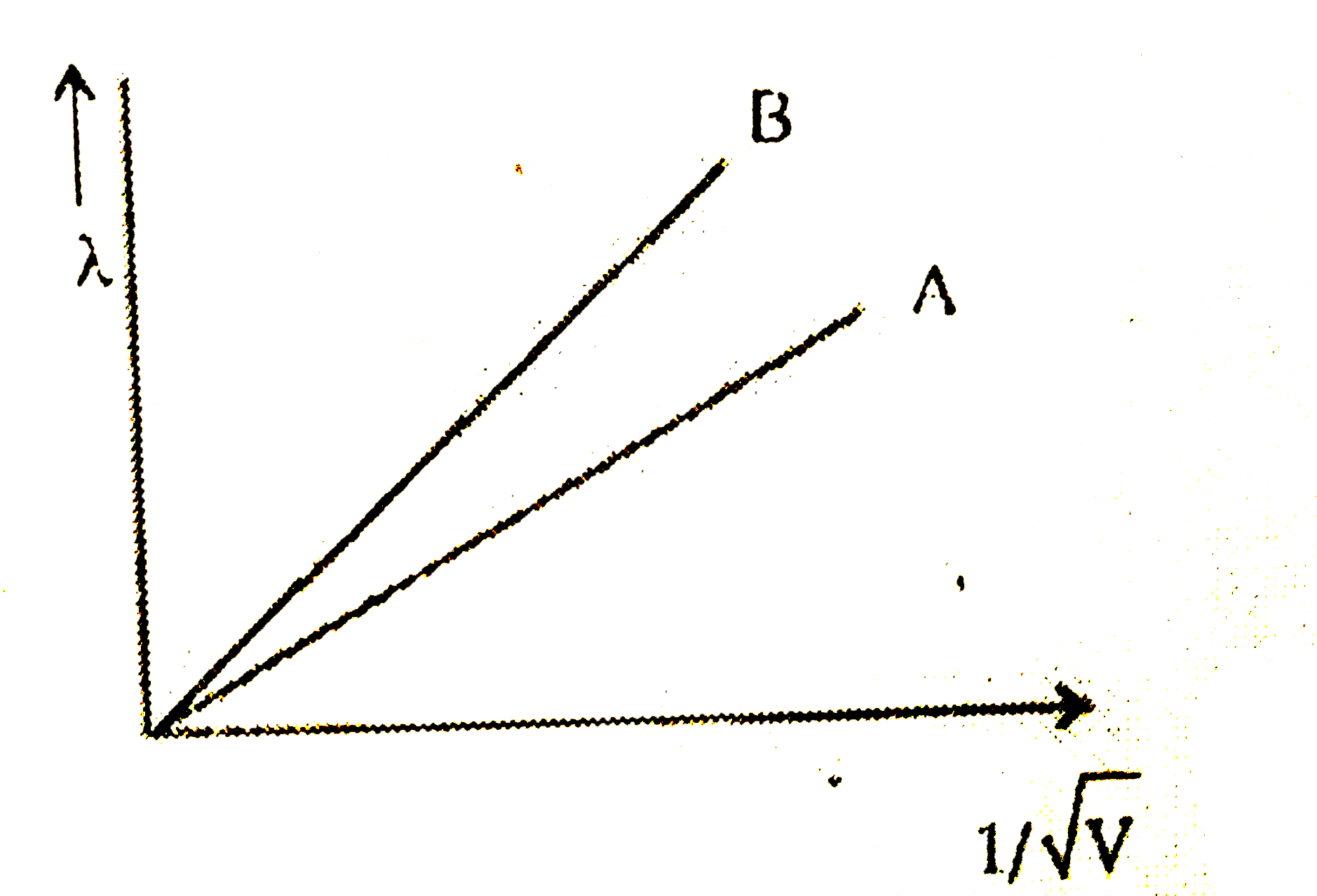
Two lines, A and B, in the plot given ...

Two lines, A and B, in the plot given below show the variation of de-Broglie wavelength, `lambda` versus `1//sqrt(V)`, where V is the accelerating potential difference, for two particles carrying the same charge. Which one of two represents a particle of smaller mass?

Promotional Banner

Similar Questions

Explore conceptually related problems

Plot a graph showing variation of de-broglie wavelength lambda versus 1//sqrtV , where V is accelerating potential for two particle A and P carrying same charge but of masses m_1 and m_2(m_1gtm_2) . Which one of the two represents a particle of smaller mass and why?

Plot a graph showing variation of de-broglie wavelength lambda versus 1//sqrtV , where V is accelerating potential for two particle A and P carrying same charge but of masses m_1 and m_2(m_1gtm_2) . Which one of the two represents a particle of smaller mass and why?

The two lines A nad B in Fig.2.06 show the plot of de-Broglie wavelength (lambda) as a function of 1//sqtV ( is the accelertaing potential ) for two particles having the same charge.Which of the two represents the particle sof heavier mass? .

Plot a graph showing variation of de-Broglie wavelength lambda versus (1)/( sqrt(V)) , where V is accelerating potential for two particles A and B carrying same charge but of masses m_(1),m_(2),(m_(1) gt m_(2)) . Which one of the two represents a particle of smaller mass and why ?

The two lines A and B in fig. shows the plot of de- Broglie wavelength (lamda) as a function of (1)/(sqrtV) (V is the accelerating potential) for the particles having the same charge. Which of the two represents the particle of heavier mass?

The two lines A and B in fig. shoe the phot of de Broglie wavelength (lamda) as a function of (1)/(sqrtV) (V is the accelerating potential) for teo particles having the same charge. Which of the two represents the particle of heavier mass?

The two lines A and B shown in the graph plot the de Broglie wavelength (lambda) as a function of 1/sqrtV (V is the accelerating potential) for two particles having the same charge which of the two represents the particle for heavier mass? Write down Eienstein’s equation in photoelectrie effect.

The de-Broglie wavelength lambda associated with charged particle of charge q, mass m and potential difference V is

The ratio of de-Broglie wavelength associated with a proton and a mu -particle accelerated through the same potential difference 'V' is