

Home
Class 11
PHYSICS
Two blocks of masses 3kg block is attach...

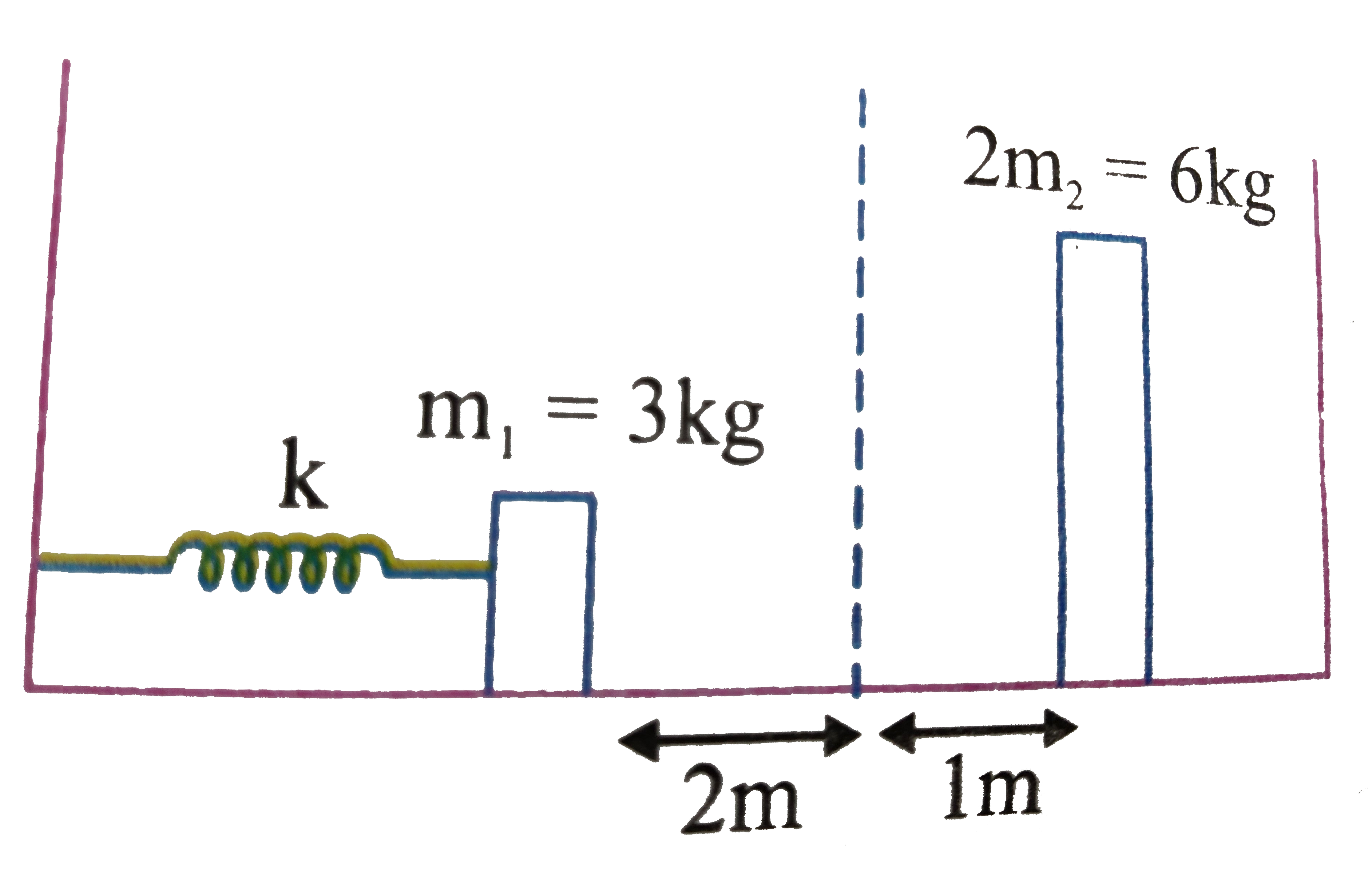
Two blocks of masses `3kg` block is attached to a spring with a force constant, `k k = 900N//ma` which is compressed `2m` initially from its equilibrium position. When `3kg` mass is released, it strikes the `6kg` mass and the two stick togther in an inelastic collision.

The velocities of a particle executing `S.H.M.` are `30cm//s` and `16 cm//s` when its displacements are `8cm` and `15cm` from the equilibrium position. then its amplitude of oscillation in cm is:

Promotional Banner

Similar Questions

Explore conceptually related problems

Two blocks of masses 3kg block is attached to a spring with a force constant, k k = 900N//ma which is compressed 2m initially from its equilibrium position. When 3kg mass is released, it strikes the 6kg mass and the two stick togther in an inelastic collision. The common velocity of the blocks after collision is

Two blocks of masses 3kg block is attached to a spring with a force constant, k k = 900N//ma which is compressed 2m initially from its equilibrium position. When 3kg mass is released, it strikes the 6kg mass and the two stick togther in an inelastic collision. The amplitude of resulting oscillation after the collision is:

Two blocks of masses 3 kg and 6kg rest on horizontal smooth surface. The 3 kg block is attached to a spring with a long constant k=900Nm^(-1) which is compressed 2m from beyond 1m from mean position. 3kg mass strikes the 6 kg mass and the two stick together.

Two blocks of masses 3 kg and 6kg rest on horizontal smooth surface. The 3 kg block is attached to a spring with a long constant k=900Nm^(-1) which is compressed 2m from beyond 1m from mean position. 3kg mass strikes the 6 kg mass and the two stick together.

Two blocks of masses 3 kg and 6kg rest on horizontal smooth surface. The 3 kg block is attached to a spring with a force constant k=900Nm^(-1) which is compressed 2m from beyond the equilibrium position. The 6 kg mass is at rest at 1m from mean position. 3kg mass strikes the 6 kg mass and the two stick together.

A body executing S.H.M . has its velocity 10cm//s and 7 cm//s when its displacement from the mean positions are 3 cm and 4 cm respectively. Calculate the length of the path.

A body executing S.H.M . has its velocity 10cm//s and 7 cm//s when its displacement from the mean positions are 3 cm and 4 cm respectively. Calculate the length of the path.

A body executing S.H.M . has its velocity 10cm//s and 7 cm//s when its displacement from the mean positions are 3 cm and 4 cm respectively. Calculate the length of the path.

A cart of mass 2.00kg is attached to the end of a horizontal spring with force constant k = 150N//m . The cart is displaced 15.0cm from its equilibrium position and released. What are (a) the amplitude (b) the period ( c) the mechanical energy (e) the maximum velocity of the cart ? Neglect friction.