

Home
Class 11
PHYSICS
figure shown a partical mass m = 100g at...

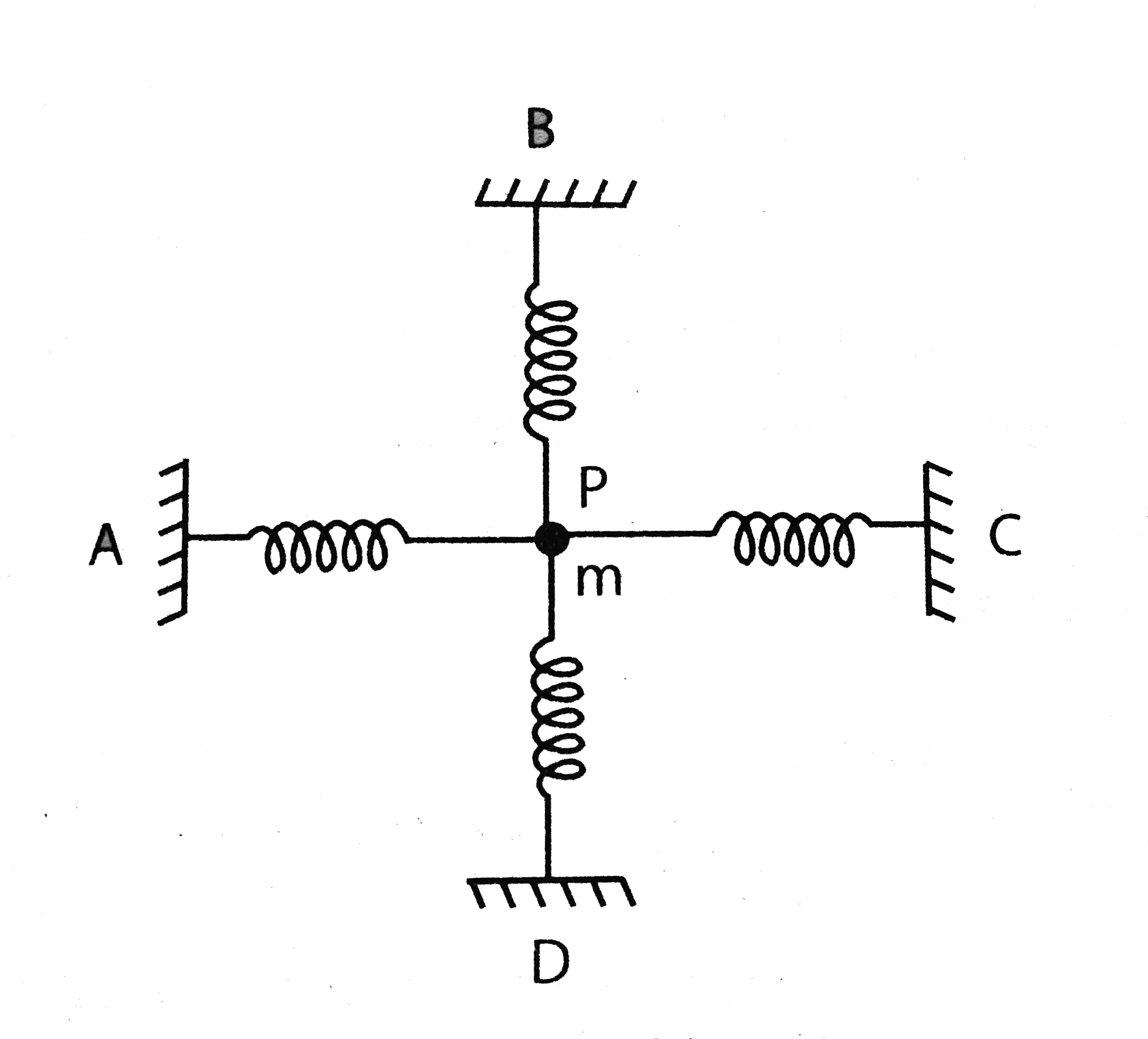
figure shown a partical mass `m = 100g` attaches with four identical spring , each of length `l = 10 cm` . Initical tension in each spring is `F_(0) = 25 N`. Neglecting gravity , Calculate the period of small obscillation of the article along a line perpenducular to the plane of the figure .

Promotional Banner

Similar Questions

Explore conceptually related problems

figure shown a partical mass m = 100g attaches with four identical spring , each of length l = 10 cm . Initial tension in each spring is F_(0) = 25 N . Neglecting gravity , Calculate the period of small oscillation of the article along a line perpendicular to the plane of the figure .

Figure shows a particle mass m = 100g attaches with four identical spring , each of length l = 10 cm . Initial tension in each spring is F_(0) = 25 N . Neglecting gravity , Calculate the period of small oscillation of the particle along a line perpendicular to the plane of the figure .

The following figure shows a particle of mass, m , attached with four identical springs, each of length l . Initial tension in each spring is F_(0) . The period of small oscillations of the particle along a line perpendicular to the plane of the figure is (neglect gravity)

A ball of mass, m is attractive to two springwhich are already stretched so that each pulls on to ball with a force F. length of each spring . In this Determine the period of small oscillations of the ball in a difference perpendicular of length of psirng. Difference of the mass of spring and gravity .

A particle of mass 'm' is attached to three identical springs A,B and C each of force constant 'K' as shown in figure. If the particle of mass 'm' is pushed slightly against the spring 'A' and released the period of oscillations is

A particle of mass 'm' is attached to three identical springs A,B and C each of force constant 'K' as shown in figure. If the particle of mass 'm' is pushed slightly against the spring 'A' and released the period of oscillations is

A particle of mass 'm' is attached to three identical springs A,B and C each of force constant 'K' as shown in figure. If the particle of mass 'm' is pushed slightly against the spring 'A' and released the period of oscillations is

A particle of mass m is attached to three identical massless springs of spring constant 'k' as shown in the figure. The time period of vertical oscillation of the particle is