

Home
Class 12
PHYSICS
A connector AB can slide without frict...

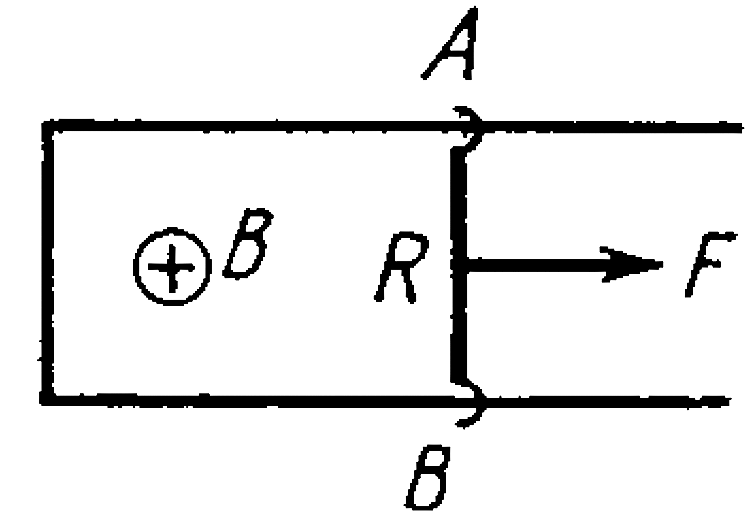
A connector `AB` can slide without frictiion along a `II`-shaped conductor located in a horizontal plane (Fig). The connector has a length `l`, mass `m` and resistance `R`. The whole system is located in a unifrom magnetic field of induction `B` directed vertically. At the moment `t = 0` a constant horizontal force `F` starts acting on the connector shifting it translationwise to the right. Find how th e velocity o fhte connector varies with time `t`. The inductance of the loop and the resistance of the II-shaped conductor conductor are assumed to be negligible

Promotional Banner

Similar Questions

Explore conceptually related problems

A copper connector of mass m slides down two smooth cooper bars, set at an angle alpha to the horizontal due to gravity (Fig). At the top the bars is equal to l . The system is located in a unifrom magnetic field of induction B , perpendicular to the plane in which the connector slides. The resistances of the bars, the connector and the sliding contacts, as well as the self-inductance of the loop, are assumed to be negligible. Find the steady-state velocity of the connector.

A wire bent as a parabola y=ax^(2) is located in a uniformed magnetic field of induaction B , the vector B being perpendicular to the plane x-y . At moment t=0 a connector starts sliding translationwise from the parabola apex with a constant acceleration omega . Find the emf of electromagnetic induction in the loop thus formed as a function of y

A wire bent as a parabola y=ax^(2) is located in a uniformed magnetic field of induaction B , the vector B being perpendicular to the plane x-y . At moment t=0 a connector starts sliding translationwise from the parabola apex with a constant acceleration omega . Find the emf of electromagnetic induction in the loop thus formed as a function of y

A conductor rod AB of mass m slides without friction over two long conducting rails separated by a distance (Fig) At the left end the raidls are interconnected by a resistance R . The system is located in a unifrom magnetic fileld perpendicular to the plane of the loop. At the moment t = 0 the rod AB starts moving to the right with an initial velocity v_(0) . Neglecting the resistances of the rails and the rod AB , as wellas the self -indcuctance, find: (a) the distance covered by the rod until it comes to a standsill, (b) the amount of heat generated in the resitance R during this process.

A wire bent as a parabola y=kx^(2) is located in a uniform magnetic field of induction B, the vector B being perpendicular to the plane xy. At t=0 , the sliding wire starts sliding from the vertex O with a constant acceleration a linearly as shown in Fig. Find the emf induced in the loop -

A wire bent as a parabola y=kx^(2) is located in a uniform magnetic field of induction B, the vector B being perpendicular to the plane xy. At t=0 , the sliding wire starts sliding from the vertex O with a constant acceleration a linearly as shown in Fig. Find the emf induced in the loop -

A long straight wire carrying a current I and a II - shaped conductor with siding connector are located in the same plane as shown in Fig. The connector of length l and resistance R sides to the right with a current induced in the loop as a function of separation r between the connector and the stragiht wire. The resistance of the II -shaped conductor and the self-induced of the loop are assumed to be negligible.

A coil of inductance L connects the upper ends of two vertical copper bars separated by a distance l . A horizontal conducting connnector of mass m starts falling with zero initial velocit along the bars without losing contact with them. The whole system is located in a uniform magnetic field with induction B perpendicular to the plane of the bars. Find the law of motion x(t) of the connector.