

Home
Class 11
PHYSICS
A square of side 4 m having uniform thic...

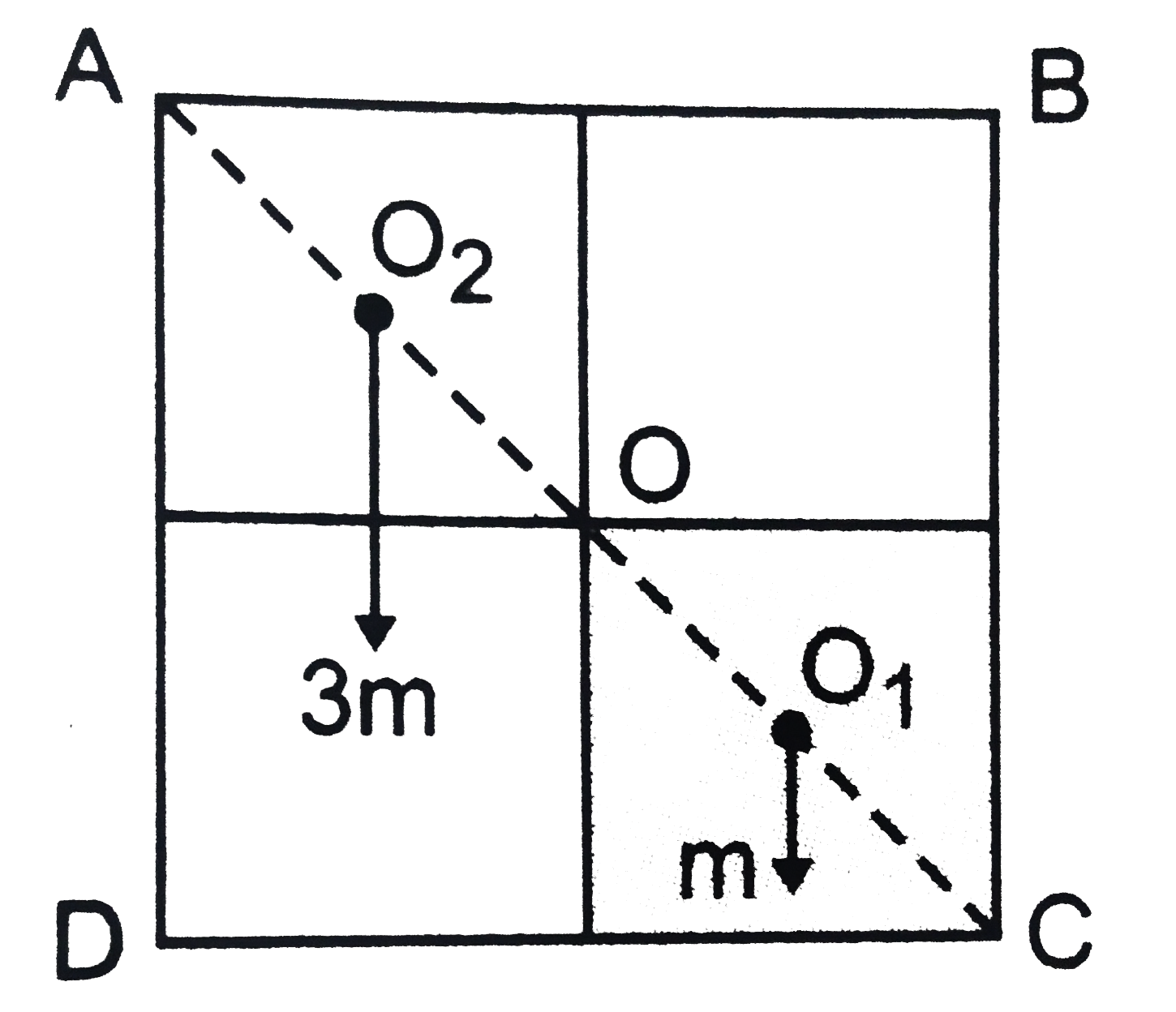
A square of side `4 m` having uniform thickness is divided into four equal squares as shown in Fig. If one of the squares is cut off, find

the position of centre of mass of the remaining portion from the centre `O`.

Promotional Banner

Similar Questions

Explore conceptually related problems

A square of side 4 cm and of uniform thickness is divided into four equal squares. If one of them is cut off (OECF), then the position of the centre of mass of the remaining portion from O is (sqrt2)/k cm . Find the value of K.

A square of side 4 cm and of uniform thickness is divided into four equal squares. If one of them is cut off (OECF), then the position of the centre of mass of the remaining portion from O is (sqrt2)/k cm . Find the value of K.

A square of side a and uniform thickness is divided into four equal parts. If upper right part is removed, then find the coordinates of centre of mass of remaining part. .

A square of side 4cm and uniform thickness is divided into four squares. The square portion A^'AB^'D is removed and the removed portion is placed over the portion DB^'BC^' . The new position of centre of mass is

A square of side 4cm and uniform thickness is divided into four squares. The square portion A^'AB^'D is removed and the removed portion is placed over the portion DB^'BC^' . The new position of centre of mass is

Figure shows a square plate of uniform thickness and side length sqrt 2 m . One fourth of the plate is removed as indicated. The distance of centre of mass of the remaining portion from the centre of the original square plate is

A circular plate of uniform thickness has a diameter fo 56cm. A circular portion of diameter 42 cm is removed from one edge of the plate as shown in figure. Find the position of the centre of mass of the remaining portion.