

Home
Class 11
PHYSICS
Air is contained in a piston-cylinder ar...

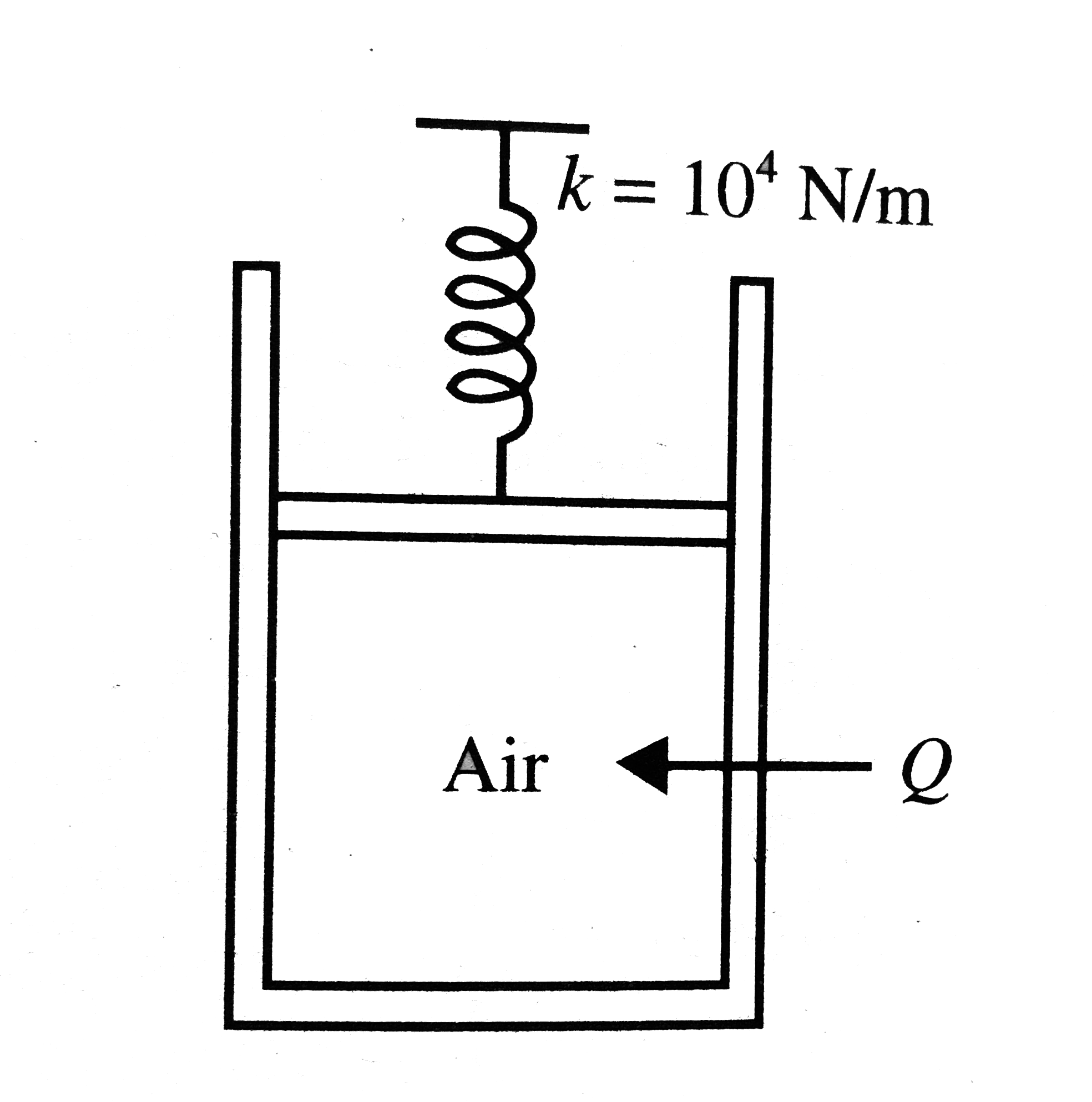
Air is contained in a piston-cylinder arrangement as shown in Fig. with a cross-sectional area of `4 cm^(2)` and an initial volume of `20 cc`. The air is initially at a pressure of 1 atm and temperature of `20^(@)C`. The piston is connected to a spring whose spring constant is `k = 10^(4) N//m`, and the spring is initially underformed. How much heat must be added to the air inside cylinder to increase the pressure to 3 atm (for air, `CV = 718 J//kg.^(@)C`, molecular of air 28.97)?

Promotional Banner

Similar Questions

Explore conceptually related problems

Air is contained in a piston-cylinder arrangement as shown in Fig. with a cross-sectional area of 4 cm^(2) and an initial volume of 20 cm^3 . The air is initially at a pressure of 1 atm and temperature of 20^(@)C . The piston is connected to a spring whose spring constant is k = 10^(4) N//m , and the spring is initially underformed. How much heat must be added to the air inside cylinder to increase the pressure to 3 atm (for air, CV = 718 J//kg.^(@)C , molecular of air 28.97)?

Air contained in a cylinder at 20.0^(@)C is compressed froma n initial pressure of 1.00 atm, and volume of 700 cm^(3) to a volume of 70.0cm^(3) . If the final pressure is 15.0 atm then what is the final temperature?

A spring has spring constant k = 200 N//m . How much work does it take to stetch the spring 10 cm from equilibrium ?

The piston cylinder arrangement shown contains a diatomic gas at temperature 300 K The cross sectinal area of the cylinder is 1m2. Initially the height of the piston above th base of the cyclinder is 1 m. The temperature is now raised to 400 K at constant pressure. There is no heat loss in the process.. Find the new height (in m) of the piston above the base of the cylinder.

The piston cylinder arrangement shown contains a diatomic gas at temperature 300 K The cross sectinal area of the cylinder is 1m2. Initially the height of the piston above th base of the cyclinder is 1 m. The temperature is now raised to 400 K at constant pressure. There is no heat loss in the process.. Find the new height (in m) of the piston above the base of the cylinder.

A mass of 2 kg initially at a height of 1.2 m above an uncompressed spring with spring constant 2 xx 10^4 N/m , is released from rest to fall on the spring. Taking the acceleration due to gravity as 10 m//s^2 and neglecting the air resistance , the compression of the spring in mm is

In a petrol engine (internal combustion engine ) air at atmospheric pressure and temperature of 20^(@)C is compressed in the cylinder by the piston to 1//8 of its original volume . Calculate the termperature of the compressed air .

A balloon containing 1 mole air at 1 atm initially is filled further with air till pressure increases to 4 atm. The intial diameter of the ballon is 1 m and the pressure at each stage is proportional to diameter of the balloon. How many moles of air added to change the pressure from 1 atm to 4 atm.

A balloon containing 1 mole air at 1 atm initially is filled further with air till pressure increases to 4 atm. The intial diameter of the ballon is 1 m and the pressure at each stage is proportional to diameter of the balloon. How many moles of air added to change the pressure from 1 atm to 4 atm.

Air in the cyclinder of a diesel engine is compressed to 1/15 of its initial volume. If initial temperature is 300K and initial pressure is 10^(5)Pa , find the final temperature and final pressure. Take gamma= 1.4 .