

Home
Class 12
PHYSICS
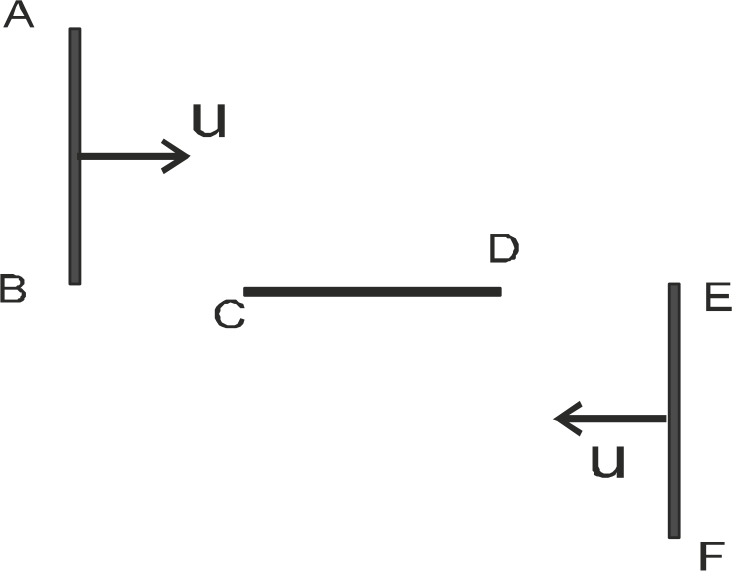
Three identical horizontal rods AB, CD a...

Three identical horizontal rods AB, CD and EF each of length 2m are on a smooth horizontal surface. Rod CD is at rest while the rods AB and EF are purely translating with equal and opposite velocities of magnitude 5 m/s.The ends B and E collide simultaneously with the ends C and D respectively, and the rods rigidly join just after the collisions.Find the angular speed of the system in rad/s just after the collision.

Promotional Banner

Similar Questions

Explore conceptually related problems

A uniform rod AB of mass m and length l at rest on a smooth horizontal surface . An impulse P is applied to the end B . The time taken by the rod to turn through a right angle is :

A uniform rod AB of mass m and length l at rest on a smooth horizontal surface. An impulse P is applied to the end B . The time taken by the rod to turn through a right angle is :

A uniform rod AB of mass m and length l at rest on a smooth horizontal surface . An impulse P is applied to the end B . The time taken by the rod to turn through a right angle is :

A uniform rod AB of mass m and length l at rest on a smooth horizontal surface . An impulse P is applied to the end B . The time taken by the rod to turn through a right angle is :

A uniform rod AB of mass m and length l is at rest on a smooth horizontal surface. An impulse p is applied to the end B. The time taken by the rod to turn through a right angle is

A uniform rod AB of mass m and length l is at rest on a smooth horizontal surface. An impulse J is applied to the end B perpendicular to the rod in horizontal direction. Speed of the point A of the rod after giving impulse is:

A uniform rod of mass M and length l is placed on a smooth- horizontal surface with its one end pivoted to the surface. A small ball of mass m moving along the surface with a velocity v_(0) , perpendicular to the rod, collides elastically with the free end of the rod. Find: a. the angular velocity of the rod after collision. b. the impulse applied by the pivot on the rod during collision. (Take M//m = 2 )

A uniform rod of mass M and length l is placed on a smooth- horizontal surface with its one end pivoted to the surface. A small ball of mass m moving along the surface with a velocity v_(0) , perpendicular to the rod, collides elastically with the free end of the rod. Find: a. the angular velocity of the rod after collision. b. the impulse applied by the pivot on the rod during collision. (Take M//m = 2 )

A uniform rod of mass m , length l rests on a smooth horizontal surface. Rod is given a sharp horizontal impulse p perpendicular to the rod at a distance l//4 from the centre. The angular velocity of the rod will be