

Home
Class 11
PHYSICS
A cylinder contains equal volumes of Ar ...

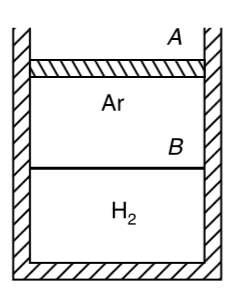
A cylinder contains equal volumes of Ar and `H_(2)`, separated by a freely movable piston B. Piston A can also move without friction. Volume of each gas in equilibrium is`V_(0)`. All walls of the container including piston A are non conducting.
(i) Piston A is pushed down slowly till the volume occupied by argon becomes `(V_(0))/(4)` . Find the volume of `H_(2)`. Assume that piston B is also non conducting.
(ii) Now assume that piston B is conducting and assume that each gas has n moles. The external agent performs work `W_(0)` in slowly pushing down the piston A. Find rise in temperature of each gas.

Promotional Banner

Similar Questions

Explore conceptually related problems

An insulating cylinder contains equal volumes of He and O_(2) separated by a massless freely moving adiabatic piston as shown. The gas is compressed by moving the insulating piston so that volume of He becomes half. Select the correct alternative(s).

In a cylindrical container two pistons enclose gas in two compartments as shown in the figure. The pistons have negligible thickness and can move without friction. The sys- tem is originally in equilibrium. The outer piston is slowly moved out by 10 cm and the inner piston is found to move by 4 cm. Find the distance of the inner piston in equilibrium from the closed end of the cylinder if the outer piston is slowly moved out of the cylinder. Assume temperature of the gas to remain constant.

A closed and isolated cylinder contains ideal gas. An adiabatic separator of mass m, cross sectional area A divides the cylinder into two equal parts each with volume V_(0) and pressure P_(0) in equilibrium Assume the sepatator to move without friction. If the piston is slightly displaced by x, the net force acting on the piston is

A cylinder fitted with a piston contains 0.2 moles of air at temperature 27^(@) . The piston is pushed so slowly that the air within the cylinder remains in thermal equilibrium with the surroundings. Find the approximate work done by the system if the final volume is twice the initial volume

A cylinder fitted with a piston contains 0.2 moles of air at temperature 27^(@) . The piston is pushed so slowly that the air within the cylinder remains in thermal equilibrium with the surroundings. Find the approximate work done by the system if the final volume is twice the initial volume

An ideal gas enclosed in a vertical cylindrical container supports a freely moving piston of mass M. the piston and the cylinder have equal cross sectional area A. when the piston is in equilibrium, the volume of the gas is V_(0) and its pressure is P_(0) . the piston is slightly displaced from the equilibrium posittion and released. assuming that the system is completely isolated from its surrounding, the piston executes a simple harmonic motion with frequency

Figure shows initial state of an ideal gas trapped in a container with conducting walls and a piston (mass m ) which can move without any friction. The container is placed on point supports and its wall are conducting. Assuming that atmospheric pressure is P_(0) and the mass of the ideal gas is negligible as compared to the mass of the piston and the mass of container. Take the cross section area of piston to be A. The piston is slowly lifted by an external agent and held in its position. Let M be the maximum mass of container so that it may "lift off" while pulling the piston upwards and P_(i) be the pressure of ideal gas in initial state. Pick the correct choice: