

Home
Class 12
PHYSICS
Two charges +Q each are fixed at points ...

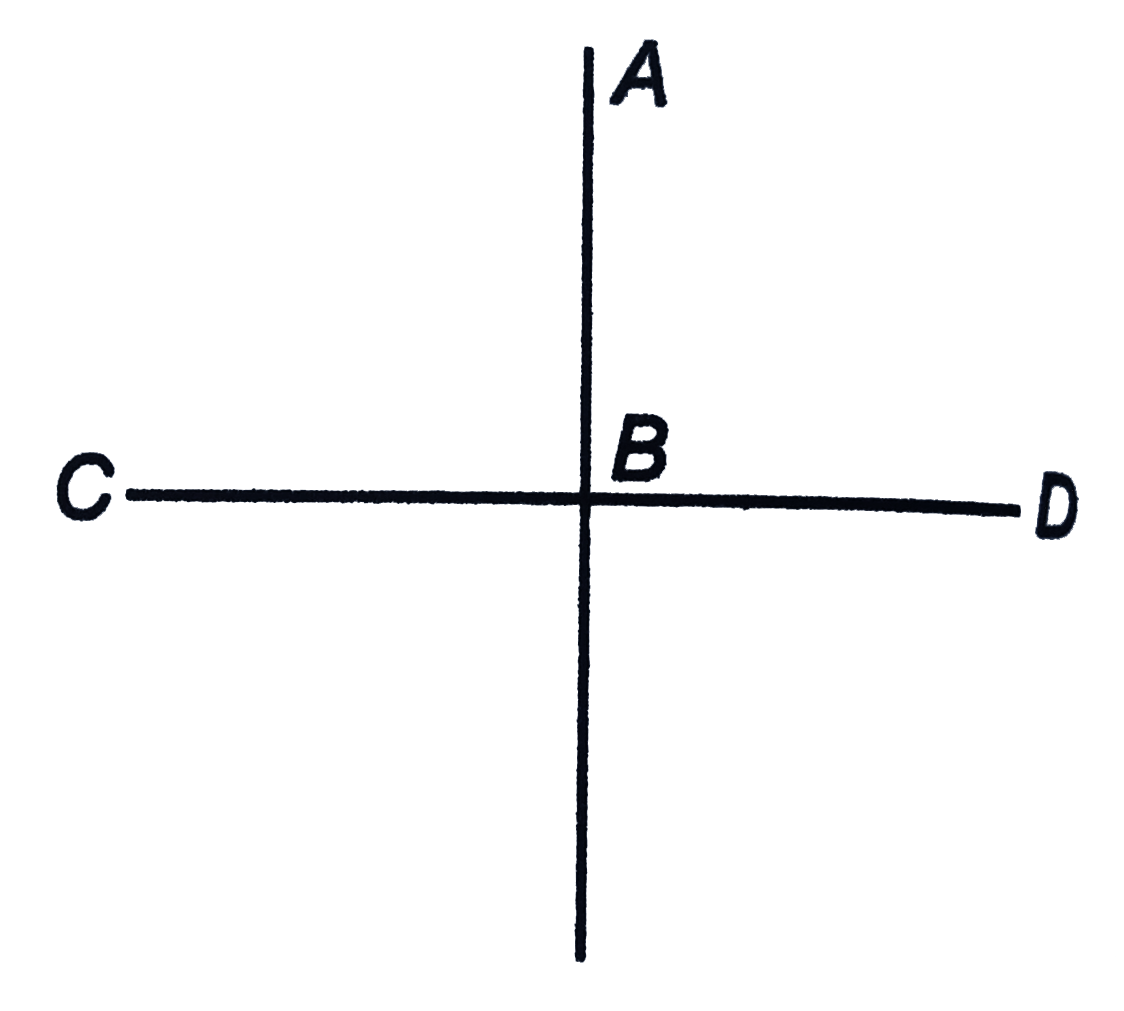
Two charges `+Q` each are fixed at points C and D. Line AB is the bisector line of CD. A third charge `+q` is moves from A to B, then from B to C

Promotional Banner

Similar Questions

Explore conceptually related problems

Assertion: Two charges -q each are fixed points A and B. When a third chrge -q is moves from A to B, electrical potential energy first decreases than increases, Reason: Along the line joining A and B, third charge is stable equilibrium position at centre.

Assertion: Two charges -q each are fixed points A and B. When a third chrge -q is moves from A to B, electrical potential energy first decreases than increases, Reason: Along the line joining A and B, third charge is stable equilibrium position at centre.

Two charges +q and-q are kept apart, Then at any point on the right bisector of line joining the two charges

Two charge +aq and -q are kept apart. Then , at any point on the right bisector of line joining the two charge

Two charge +aq and -q are kept apart. Then , at any point on the right bisector of line joining the two charge

A positive charge +Q is fixed at a point A. Another positively charged particle of mass m and charge +q is projected from a point B with velocity u as shown in (Fig. 3.103). Point B is at a large distance from A and at distance d from the line A C. The initial velocity is parallel to the line A C. The point C is at a very large distance from A. Find the minimum distance (in meter) of +q from +Q during the motion. Take Q q = 4 pi epsilon_0 m u^2 d and d (sqrt(2) - 1) m . .

A charge (-q) and another charge (Q) are kept at two points A and B respectively. Keeping the charge (+Q) fixed at B , the charge (-q) at A is moved to another point C such that ABC forms an equilateral triangle of side l . The net work done in moving teh charge (-q) is

A charge (-q) and another charge (Q) are kept at two points A and B respectively. Keeping the charge (+Q) fixed at B , the charge (-q) at A is moved to another point C such that ABC forms an equilateral triangle of side l . The net work done in moving teh charge (-q) is

Charges 2q and 8q are placed at the end points A and B repsectively of a 9 cm long straight line. A third charge q is placed at a point C of AB such that the potential energy of the system is minimum . The distance of C from A is

A positive charge +Q is fixed at a poibt A. Another positively charged particle of mass m and charge +q is projected from a point B with velocity u as shown in (Fig. 3.103). Point B is at a large distance from A and at distance d from the line A C. The initial velocity is parallel to the line A C. The point C is at a very large distance from A. Find the minimum distance (in meter) of +q from +Q during the motion. Take Q q = 4 pi epsilon_0 m u^2 d and d (sqrt(2) - 1) m . .