

Home
Class 11
PHYSICS
Two soap bubbles of radius R(1) and R(2)...

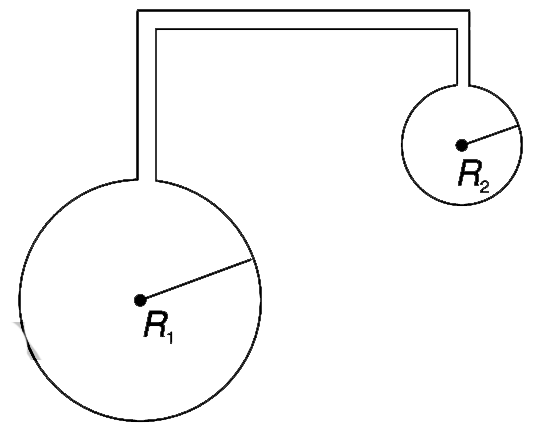
Two soap bubbles of radius `R_(1) and R_(2) (lt R_(1))` are joined by a straw. Air flows from one bubble to another and a single bubble of radius `R_(3)` remains.

(a) From which bubble does the air flow out ?
(b) Assuming no temperature change and atmospheric pressure to be `P_(o), find the surface tension of the soap solution.

Promotional Banner

Similar Questions

Explore conceptually related problems

Two soap bubbles of radii a and b coalesce to form a single bubble of radius c . If the external pressure is P , find the surface tension of the soap solution.

Two soap bubbles of radii a and b coalesce to form a single bubble of radius c . If the external pressure is P , find the surface tension of the soap solution.

Two soap bubbles of radius R_1 and R_2 combine isothermally to form a new soap bubble. Find radius of new soap bubble

When two soap bubbles of radius r_(1) and r_(2)(r_(2) gt r_(1)) coalesce, the radius of curvature of common surface is

Two soap bubbles of radius r_(1) and r_(2) combine. Find radius of curvature of the common surface separating them.

Two soap bubbles of radii r_1 and r_2 combine to form a bigger bubble under isothermal conditions. The radius of bigger bubble will be

Two identical soap bubbles each of radius r and of the same surface tension T combine to form a new soap bubble of radius R . The two bubbles contain air at the same temperature. If the atmospheric pressure is p_(0) then find the surface tension T of the soap solution in terms of p_(0) , r and R . Assume process is isothermal.

Two identical soap bubbles each of radius r and of the same surface tension T combine to form a new soap bubble of radius R . The two bubbles contain air at the same temperature. If the atmospheric pressure is p_(0) then find the surface tension T of the soap solution in terms of p_(0) , r and R . Assume process is isothermal.