

Home
Class 11
PHYSICS
(a) In the last question find the angle ...

(a) In the last question find the angle between the tangents drawn to the bubble surfaces at point A.
(b) In the above question assume that `r_(1) = r_(2) = r`. What is the shape of the common interface ACB? Find length AB in this case.
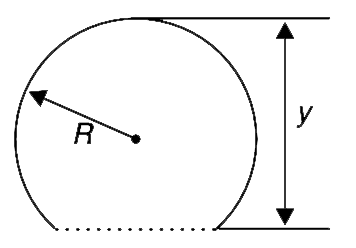
(c) With `r_(1) = r_(2) = r` the common wall bursts and the two bubbles form a single bubble find the radius of this new bubble. It is given that volume of a truncated sphere of radius R and height y is `pi/3 y ^(2) (3R -y)` [see figure]

Promotional Banner

Similar Questions

Explore conceptually related problems

Find the common radius of curvature when two soap bubbles with radii r_(1)

Two soap bubbles of radius R_1 and R_2 combine isothermally to form a new soap bubble. Find radius of new soap bubble

Two soap bubbles of radius r_(1) and r_(2) combine. Find radius of curvature of the common surface separating them.

Two soap bubbles are stuck together with an intermediate film separating them. Compute the radius of curvature of this film given that the radii of the bubbles in this arrangement are r_(1) and r_(2) respectively. If r_(1) gt r_(2) state clearly which way the intermediate film will bulge. For the case when r_(1)=r_(2)=2cm calculate he radius of the bubble formed by bursting the intermediate film. The volume of a spherical dome of radius R and height h is pib^(2)(3R-b)//3 .

Two soap bubbles are stuck together with an intermediate film separating them. Compute the radius of curvature of this film given that the radii of the bubbles in this arrangement are r_(1) and r_(2) respectively. If r_(1) gt r_(2) state clearly which way the intermediate film will bulge. For the case when r_(1)=r_(2)=2cm calculate he radius of the bubble formed by bursting the intermediate film. The volume of a spherical dome of radius R and height h is pib^(2)(3R-b)//3 .

Two soap bubbles of radii r_1 and r_2 combine to form a bigger bubble under isothermal conditions. The radius of bigger bubble will be

The radii of two soap bubbles are r_(1) and r_(2) (r_(2) lt r_(1)) . They meet to produce a double bubble. The radius of their common interface is