

Home
Class 12
PHYSICS
A nylon guiter string has a linear densi...

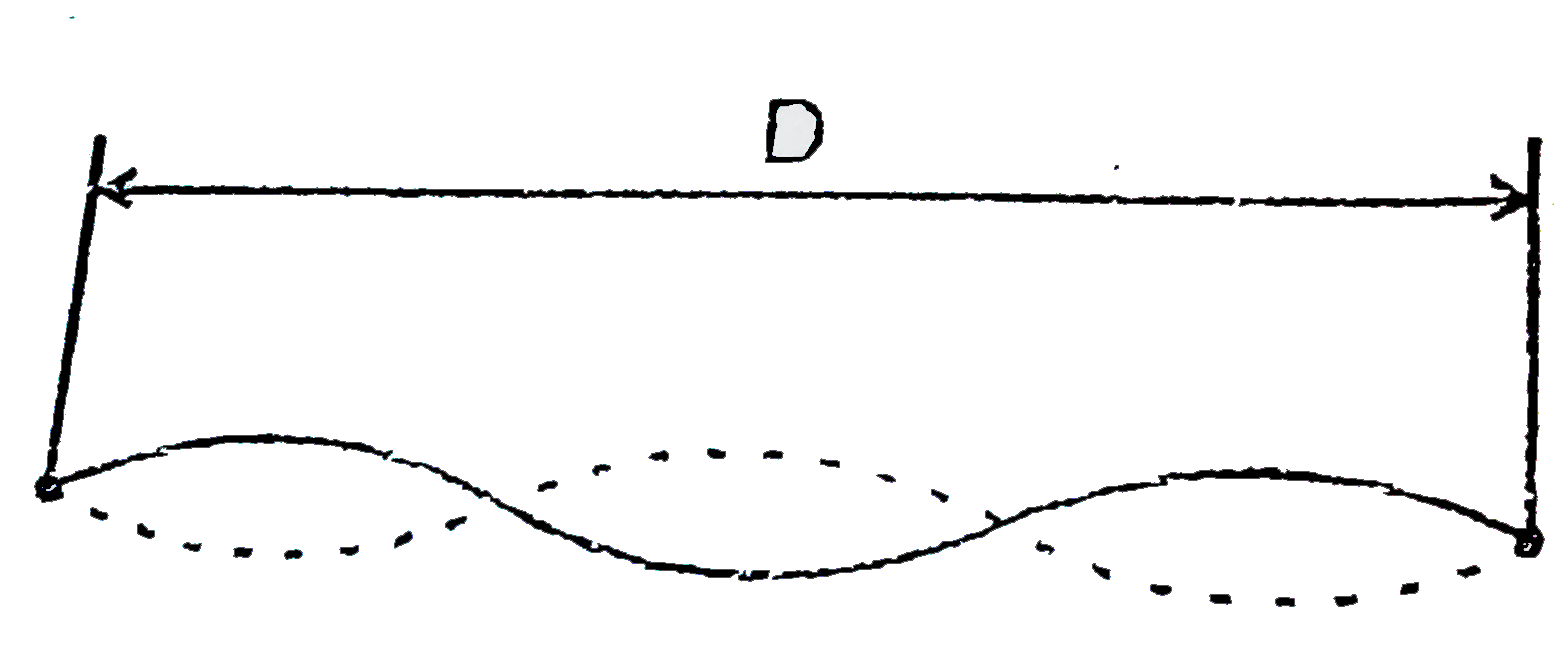
A nylon guiter string has a linear density of `7.20 g//m` and is under a tension of `150 N`. The fixed supports are distance `D = 90.0 cm` apart. The string is osillating in the stading wave pattern shown in figure. Calculate the (a) speed. (b) wavelength and (c) frequency of the travelling waves whose superposition gives this standing wave. ltbgt

Promotional Banner

Similar Questions

Explore conceptually related problems

A nylon guitar string has a linear density of 7.20 g/m and is under a tension of 180 N. The fixed supports are distance D =90.0 cm apart. The string is oscillating in the standing wave pattern shown in Fig. 16-42. Calculate the (a) speed, (b) wavelength, and (c) frequency of the traveling waves whose superposition gives this standing wave.

A string has linear density mu=525 g//m and is under tension tau=45N . We send a sinusoidal wave with frequency f=120Hz and amplitude y_(m)=8.5 mm along the string. At what average rate does the wave transport energy?

A tuning fork of frequency 440 Hz is attached to a long string of linear mass density 0.01 kg m^-1 kept under a tension of 49 N. The fork produces transverse waves of amplitude 0.50 mm on the string. (a) Find the wave speed and the wavelength of the waves. (b) Find the maximum speed and acceleration of a particle of the string. (c) At what average rate is the tuning fork transmitting energy to the string ?

A tuning fork of frequency 440 Hz is attached to a long string of linear mass density 0.01 kg m^-1 kept under a tension of 49 N. The fork produces transverse waves of amplitude 0.50 mm on the string. (a) Find the wave speed and the wavelength of the waves. (b) Find the maximum speed and acceleration of a particle of the string. (c) At what average rate is the tuning fork transmitting energy to the string ?

A tuning fork of frequency 440 Hz is attached to a long string of linear mass density 0.01 kg m^-1 kept under a tension of 49 N. The fork produces transverse waves of amplitude 0.50 mm on the string. (a) Find the wave speed and the wavelength of the waves. (b) Find the maximum speed and acceleration of a particle of the string. (c) At what average rate is the tuning fork transmitting energy to the string ?

A string fixed at both ends is 7.50 m long and has a mass of 0.120 kg. It is subjected to a tension of 96.0 N and set oscillating (a) What is the speed of the waves on the string? (b) What is thc longest possible wavelength for a standing wave? (c) Give the frequency of that wave.

A string fixed at both ends is 8.40 m long and has a mass of 0.120 kg . It is subjected to a tension of 96.0 N and set oscillating. (a) What is the speed of the waves on the string? (b) What is the longest possible wavelength for a standing wave ? (c) Give the frequency of the wave.

A string fixed at both ends is 8.40 m long and has a mass of 0.120 kg . It is subjected to a tension of 96.0 N and set oscillating. (a) What is the speed of the waves on the string? (b) What is the longest possible wavelength for a standing wave ? (c) Give the frequency of the wave.

Transverse waves travel with a speed of 20.0 m//s in a string under a tension of 6.00 N. what tension is requared for a wave speed of 30.0 m//s in the same string?