

Home
Class 11
PHYSICS
A cylinder rod of length 1, thermal cond...

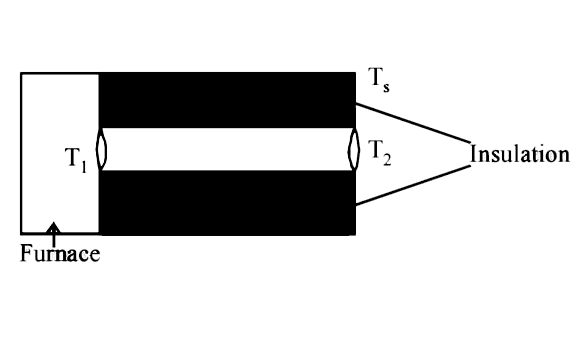
A cylinder rod of length 1, thermal conductivity K and area of cross section A has one end in the furnace at temperature `T_1` and the other end in surrounding at temperature `T_2`. Surface of the rod exposed to the surrounding has emissivity e. Also `T_2=T_s+DeltaT and T_sgt gt DeltaT`. If `T_1-T_s prop DeltaT`,find the proportionality constant.

Promotional Banner

Similar Questions

Explore conceptually related problems

A cylindrical rod of length l, thermal conductivity k and area of cross section A has one end in a furnace maintained at constant temperature. The other end of the rod is exposed to surrounding. The curved surface of the rod is well insulated from the surrounding. The surrounding temperature is T_(0) and the furnace is maintained at T_(1) = T_(0) + DeltaT_(1) . The exposed end of the rod is found to be slightly warmer then the surrounding with its temperature maintained T_(2) = T_(0) + DeltaT_(2) [DeltaT_(2) ltlt T_(0)] . The exposed surface of the rod has emissivity e. Prove that DeltaT_(1) is proportional to DeltaT_(2) and find the proportionality constant.

One end of a rod of length L and crosssectional area A is kept in a furnace at temperature T_(1) . The other end of the rod is kept at a temperature T_(2) . The thermal conductivity of the matrieal of the rod is K and emissivity of the rod is e. It is gives that T_(!)=T_(s)+DeltaT , where DeltaTltlt T_(s),T_(s) is the temperature of the surroundings. If DeltaTprop(T_(1)-T_(2)) find the proportional constant, consider that heat is lost only by rediation at the end where the temperature of the rod is T_(1) .

One end of rod of length L and cross-sectional area A is kept in a furance of temperature T_(1) . The other end of the rod is kept at at temperature T_(2) . The thermal conductivity of the material of the rod is K and emissivity of the rod is e . It is given that T_(2)=T_(S)+DeltaT where DeltaT lt lt T_(S) , T_(S) being the temperature of the surroundings. If DeltaT prop (T_(1)-T_(S)) , find the proportionality constant. Consider that heat is lost only by radiation at the end where the temperature of the rod is T_(2) .

One end of rod of length L and cross-sectional area A is kept in a furance of temperature T_(1) . The other end of the rod is kept at at temperature T_(2) . The thermal conductivity of the material of the rod is K and emissivity of the rod is e . It is given that T_(2)=T_(S)+DeltaT where DeltaT lt lt T_(S) , T_(S) being the temperature of the surroundings. If DeltaT prop (T_(1)-T_(S)) , find the proportionality constant. Consider that heat is lost only by radiation at the end where the temperature of the rod is T_(2) .

One end of rod of length L and cross-sectional area A is kept in a furance of temperature T_(1) . The other end of the rod is kept at at temperature T_(2) . The thermal conductivity of the material of the rod is K and emissivity of the rod is e . It is given that T_(2)=T_(S)+DeltaT where DeltaT lt lt T_(S) , T_(S) being the temperature of the surroundings. If DeltaT prop (T_(1)-T_(S)) , find the proportionality constant. Consider that heat is lost only by radiation at the end where the temperature of the rod is T_(2) .

Consider two rods of same length and different specific heats ( S_1 and S_2 ), conductivities K_1 and K_2 and area of cross section ( A_1 and A_2 ) and both having temperature T_1 and T_2 at their ends. If the rate of heat loss due to conduction is equal then

Consider two rods of same length and different specific heats ( S_1 and S_2 ), conductivities K_1 and K_2 and area of cross section ( A_1 and A_2 ) and both having temperature T_1 and T_2 at their ends. If the rate of heat loss due to conduction is equal then

If K_1 is the equilibrium constant at temperature T_1 and K_2 is the equilibrium constant at temperature T_2 and If T_2 gt T_1 and reaction is endothermic then

If K_1 is the equilibrium constant at temperature T_1 and K_2 is the equilibrium constant at temperature T_2 and If T_2 gt T_1 and reaction is endothermic then

All the rods have same conductance 'K' and same area of cross section ' A' . If ends A and C are maintained at temperature 2T_(0) and T_(0) respectively then which of the following is // are correct?