

Home
Class 12
PHYSICS
A YDSE is performed in a medium of refra...

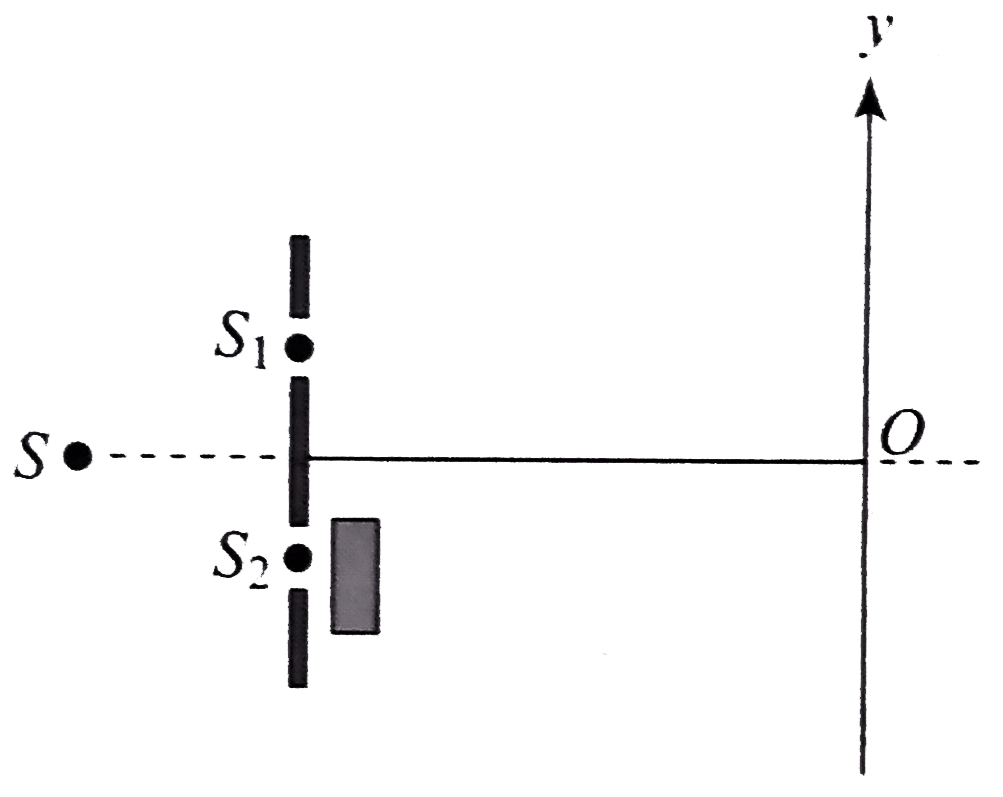
A YDSE is performed in a medium of refractive index `4 // 3`, A light of 600 nm wavelength is falling on the slits having 0.45 nm separation . The lower slit `S_(2)` is covered b a thin glass plate of thickness 10.4 mm and refractive index 1.5. The interference pattern is observed on a screen placed 1.5 m from the slits as shown in figure. (All the wavelengths in this problem are for the given medium of refractive index `4 // 3`, ignore absorption.)

Now, if 600 nm, find the wavelength of the ligth that forms maximum exactly at point O.

Promotional Banner

Similar Questions

Explore conceptually related problems

A YDSE is performed in a medium of refractive index 4 // 3 , A light of 600 nm wavelength is falling on the slits having 0.45 nm separation . The lower slit S_(2) is covered b a thin glass plate of thickness 10.4 mm and refractive index 1.5. The interference pattern is observed on a screen placed 1.5 m from the slits as shown in figure. (All the wavelengths in this problem are for the given medium of refractive index 4 // 3 , ignore absorption.) Find the light intensity at point O relative t maximum fringe intensity.

A YDSE is performed in a medium of refractive index 4 // 3 , A light of 600 nm wavelength is falling on the slits having 0.45 nm separation . The lower slit S_(2) is covered b a thin glass plate of thickness 10.4 mm and refractive index 1.5. The interference pattern is observed on a screen placed 1.5 m from the slits as shown in figure. (All the wavelengths in this problem are for the given medium of refractive index 4 // 3 , ignore absorption.) Find the light intensity at point O relative t maximum fringe intensity.

A YDSE is performed in a medium of refractive index 4 // 3 , A light of 600 nm wavelength is falling on the slits having 0.45 nm separation . The lower slit S_(2) is covered b a thin glass plate of thickness 10.4 mm and refractive index 1.5. The interference pattern is observed on a screen placed 1.5 m from the slits as shown in figure. (All the wavelengths in this problem are for the given medium of refractive index 4 // 3 , ignore absorption.) The location of the central maximum (bright fringe with zero path difference) on the y-axis will be

A YDSE is performed in a medium of refractive index 4 // 3 , A light of 600 nm wavelength is falling on the slits having 0.45 nm separation . The lower slit S_(2) is covered b a thin glass plate of thickness 10.4 mm and refractive index 1.5. The interference pattern is observed on a screen placed 1.5 m from the slits as shown in figure. (All the wavelengths in this problem are for the given medium of refractive index 4 // 3 , ignore absorption.) The location of the central maximum (bright fringe with zero path difference) on the y-axis will be

The Young's double-slit experiment is done in a medium of refractive index 4//3. A light of 600 nm wavelength is falling on the slits having 0.45 mm separation. The lower shift S_(2) is covered by a thin glass sheet of thickness 10.4 mm and refractive index. 1.5. The interference pattern is observed on a screen placed 1.5 m from the slits as shown in Figure Find the light intensity of point O relative to the maximum fringe intensity.

The Young's double-slit experiment is done in a medium of refractive index 4//3. A light of 600 nm wavelength is falling on the slits having 0.45 mm separation. The lower shift S_(2) is covered by a thin glass sheet of refractive index. 1.5. The interference pattern is observed on a screen placed 1.5 m from the slits as shown in Figure a. Find the location of central maximum (bright fringe with zero path difference) on the y-axis.