

Home
Class 11
PHYSICS
Figure shows in cross section a wall con...

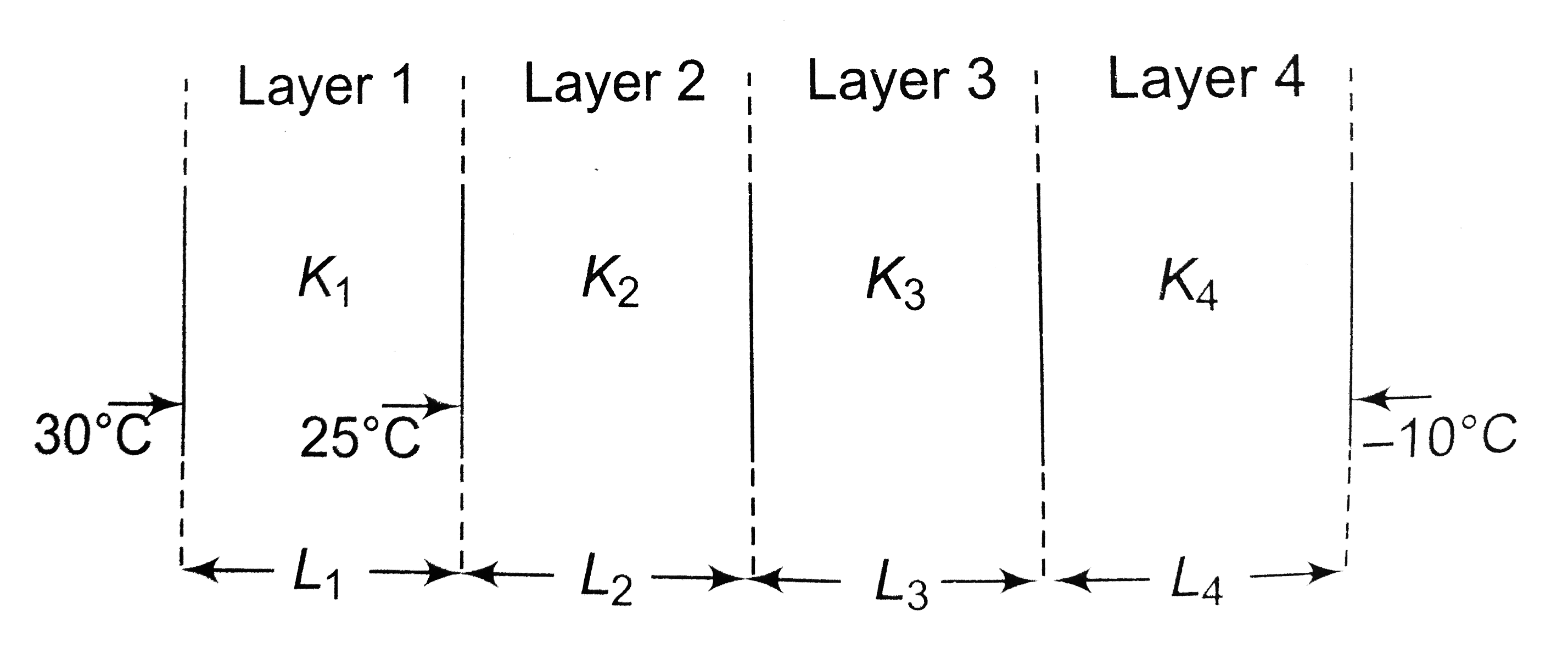
Figure shows in cross section a wall consisting of four layers with thermal conductivities `K_(1) = 0.06 W // mK, K_(3) = 0.04 W// mK and K_(4) = 0.10 W// mK`. The layer thickness are `L_(1) = 1.5 cm, L_(3) = 2.8 cm and L_(4) = 3.5 cm`. The temperature of interfaces is as shown in figure. energy transfer through the wall is in steady state. the temperature of the interface between layer `3 and 4` is:

Promotional Banner

Similar Questions

Explore conceptually related problems

Figure shows in cros section a wall consisting of four layers with thermal conductivities K_(1)=0.06W//mK K_(3)=0.04W//mK and K_(4)=0.10W//mK . The layer thicknesses are L_(1)=1.5cm,L_(3)=2.8 cm and L_(4)=3.5cm the temperature of interfaces is as shown in figure. energy transfer through the wall is in steady state. Q. The temperature of the inteface between layers 2 and 3 is

Figure shows in cros section a wall consisting of four layers with thermal conductivities K_(1)=0.06W//mK K_(3)=0.04W//mK and K_(4)=0.10W//mK . The layer thicknesses are L_(1)=1.5cm,L_(3)=2.8 cm and L_(4)=3.5cm the temperature of interfaces is as shown in figure. energy transfer through the wall is in steady state. Q. The temperature of the inteface between layers 2 and 3 is

Temperature shows in cross section a wall consisting of four layers with thermal conductivities K_(1)=0.06W//mK,K_(3)=0.04W//mK and K_(4)=0.10W//mK the layer thickness are L_(1)=1.5cm,L_(3)=2.8cm and L_(4)=3.5 cm. The temperature of interfaces is as shown in figure energy transfer through the wall is in steady state. Q. Temperature of outer surface of sphere is

Temperature shows in cross section a wall consisting of four layers with thermal conductivities K_(1)=0.06W//mK,K_(3)=0.04W//mK and K_(4)=0.10W//mK the layer thickness are L_(1)=1.5cm,L_(3)=2.8cm and L_(4)=3.5 cm. The temperature of interfaces is as shown in figure energy transfer through the wall is in steady state. Q. Thickness of hollow sphere is

Temperature shows in cross section a wall consisting of four layers with thermal conductivities K_(1)=0.06W//mK,K_(3)=0.04W//mK and K_(4)=0.10W//mK the layer thickness are L_(1)=1.5cm,L_(3)=2.8cm and L_(4)=3.5 cm. The temperature of interfaces is as shown in figure energy transfer through the wall is in steady state. Q. Electric power of heater is:

Figure shows ( in cross section ) a wall consisting of four layers, with thermal conductivities k_(1) = 0.060W//m.K, k_(3)= 0.040W//m.K , and k_(4) = 0.12W//m.K(k_(2) is not known). The layer thickness are L_(1) = 1.2 cm, L_(3) = 5.6 cm , and L_(4) = 4.0 cm ( L_(2) is not known ) . The known temperatures are T_(1) = 30^(@)C, T_(12) = 25^(@)C , and T_(4) = - 10^(@) C . Energy transfer through the wall is steady. What is interface temperature T_(34) ?

Figure shows the cross section of a wall made of three layers. The layer thicknesses are L_(1), L_(2) = 0.750L_(1), and L_(3) = 0.350L_(1) . The thermal conductivities are k_(1), k_(2) = 0.900k_(1) , and k_(3) = 0.800k_(1) . The temperature at the left side and right side of the wall are T_(H) = 30.0^(@)C and T_(C)= - 15.0^(@)C , respectively. Thermal conduction is steady . (a) What is the temperature difference Delta T_(2) across layer 2 ( between the left and right sides of the layer ) ? If k_(2) were, instead, equal to 1.1 k_(1) , (b) would the reate at which energy is conducted through the wall be greater than, less than, or the same as proviously, and (c ) what would be the value of Delta T_(2) ?

Two bars of thermal conductivities K and 3K and lengths 1 cm and 2 cm respectively have equal cross-sectional area, they are joined lengths wise as shown in the figure. If the temperature at the ends of this composite br is 0^(@)C and K^(2)//l respectively (see figure), then the temperature phi of the interface is

Two bars of thermal conductivities K and 3K and lengths 1 cm and 2 cm respectively have equal cross-sectional area, they are joined lengths wise as shown in the figure. If the temperature at the ends of this composite br is 0^(@)C and 100^(@)C respectively (see figure), then the temperature phi of the interface is

If layer thickness L_(2) is 1.4 cm , then its thermal conductivity K_(2) will have value ("in " W//mK)