

Home
Class 12
PHYSICS
An electron is either released from rest...

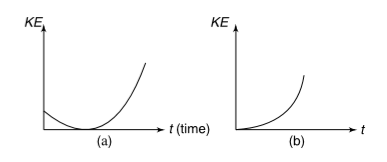
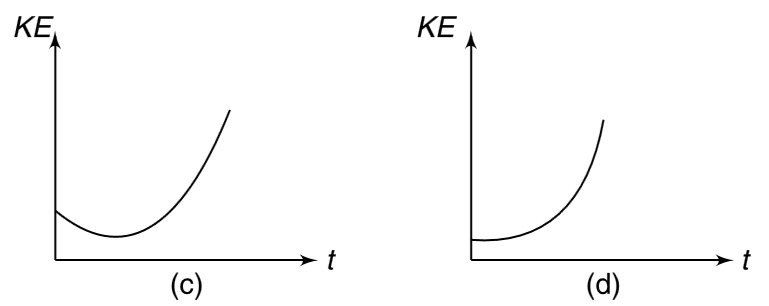
An electron is either released from rest or projected with some initial velocity in a uniform electric field. Neglect any other force on the electron apart from electrostatic force. Which of the graphs shown in fig could possibly represent the change in kinetic energy of the electron during its course of motion? Explain the situation in each case.

Promotional Banner

Similar Questions

Explore conceptually related problems

A rigid electric dipole is force to move in the electric field represented in the figure. Which one of the following phrases most accurately describes the initial motion of the dipole if it released from rest in the position shown ?

A particle of mass and charge is released from rest in a uniform electric field. If there is no other force on the particle, the dependence of its kinetic energy on the distance travelled by it is correctly given by (graphs are schematic and not drawn to scale)

A particle of mass and charge is released from rest in a uniform electric field. If there is no other force on the particle, the dependence of its kinetic energy on the distance travelled by it is correctly given by (graphs are schematic and not drawn to scale)

A particle of mass and charge is released from rest in a uniform electric field. If there is no other force on the particle, the dependence of its kinetic energy on the distance travelled by it is correctly given by (graphs are schematic and not drawn to scale)

an electron is released from rest in a region of uniform electric and magnetic field acting parallel to each other. The electron will (A) move in a straight line (B) move in a circle (C) remain stationary (D) move in a helical path

an electron is released from rest in a region of uniform electric and magnetic field acting parallel to each other. The electron will (A) move in a straight line (B) move in a circle (C) remain stationary (D) move in a helical path

A proton and an electron are released from an infinite distance apart and they get attracted towars each other. Which of the following statement about their kinetic energy is true?

A proton and an electron are released from an infinite distance apart and they get attracted towars each other. Which of the following statement about their kinetic energy is true?