

Home
Class 11
PHYSICS
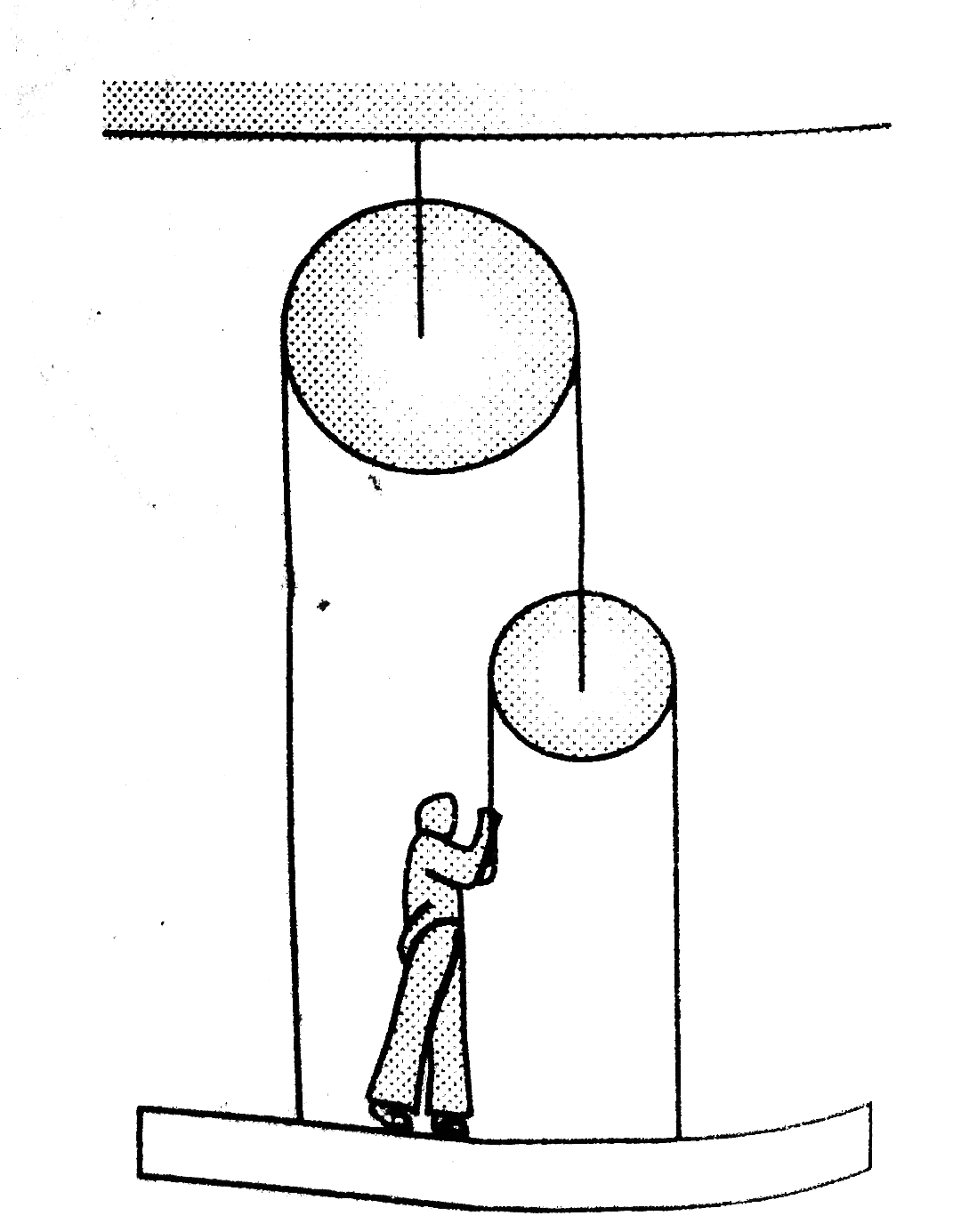
In the given diagram, with what force mu...

In the given diagram, with what force must the man pull the rope to hold the plank in position? Mass of the man is 80kg. Neglect the weights of plank, rope and pulley. Take.

Promotional Banner

Similar Questions

Explore conceptually related problems

In the given diagram, with what force must the man pull the rope to hold the plank in position? Weight of the man is 60 kg. Neglect the weight of plank, rope and pulley.

With what force must a man pull on the rope to hold the plank in position it the man weights 60 kg? Neglect the weight of the plank, rope and pulley ( Take g= 10m//s^(2))

In the figure shown the force with which the man should pull the rope to hold the plank in position is F . If weight of the man is 60kgf , the plank and pulleys have negligible masses, then.

In the given diagram, weight of the man is 60 kg and the weight of the machine, box, rope and pulley are neglected. If the man manages to keep the box at rest, then the reading of the machine will be

In the given diagram, weight of the man is 60 kg and the weight of the machine, box, rope and pulley are neglected. If the man manages to keep the box at rest, then the reading of the machine will be

A man of mass M stands on a.box of mass m as shown in the Fig. 2E. l (a). A rope attached to 'the box and passing over an overhead pulley allows the man to raise himself and the box by , pulling the rope downward. (i) With what minimum force should the ' man pull the rope so as to prevent himself , from falling down. (ii) If the man pulls the rope with a force F greater than the minimum force, then determine the acceleration of the (man + box) system. (iii) Determine. the normal reaction between the man and the trolley.

What force must man exert on rope to keep platform in equilibrium : (Take g=10m//s^(2) )

Figure 5-55 shows a man sitting in a bosun's chair that dangles from a mass-less rope, which runs over a massless, frictionless pulley and back down to the man's hand. The combined mass of man and chair is 103.0 kg. With what force magnitude must the man pull on the rope if he is to rise (a) with a constant velocity and (b) with an upward acceleration of 1.30" m"//"s"^(2) ?

A block of mass M is tied to one end of a massless rope the other end of the rope is in the hands of a man of mass 2M as shown in the figure the block and the man are resting on a rough plank of mass M as shown in the figure the whole system is resting on a smooth horizontal surface the man pulls the rope pulley is massless and friction what is the displacement of the plank when the block meets the pulley ( Man does not leave his position on plank during the pull)

A man with mass 85 kg stands on a platform with mass 25 kg. He pulls on the free end of a rope that runs over a pulley on the ceiling and has its other end fastened to the platform. The mass of the rope and the mass of the pulley can be neglected, and the pulley is frictionless. With what force does he have to pull so that he and the platform have an upward acceleration of 2.2m/s^(2) . (Take g= 10m/s^(2) )