

Home
Class 11
PHYSICS
Passage XII) A particle of mass m is con...

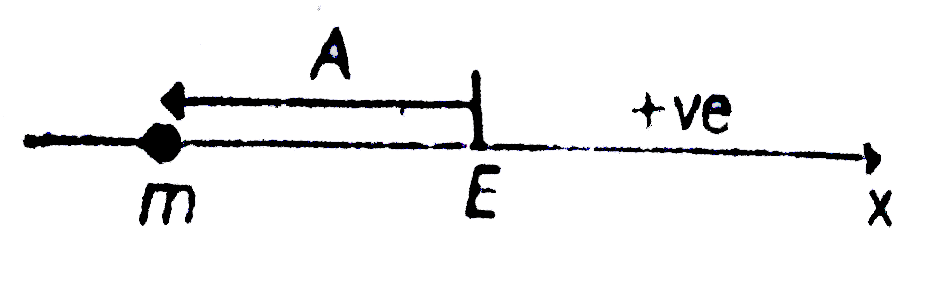
Passage XII)_ A particle of mass m is constrained to move along x-axis. A force F acts on the particle. F always points toward the position labelled E. For example, when the particle is to the left of E,Fpoints to the right. The magnitude of F is consant except at point E where it is zero. The systm is horizontal. F is the net force acting on the particle. the particle is displaced a distance A towards left from the equilibrium position E and released from rest at t=0.
Find minimum time it will take to reach from x`=-A/2` to 0

Promotional Banner

Similar Questions

Explore conceptually related problems

Passage XII)_ A particle of mass m is constrained to move along x-axis. A force F acts on the particle. F always points toward the position labelled E. For example, when the particle is to the left of E,Fpoints to the right. The magnitude of F is consant except at point E where it is zero. The systm is horizontal. F is the net force acting on the particle. the particle is displaced a distance A towards left from the equilibrium position E and released from rest at t=0. Velocity-time graph of the particle is

Passage XII)_ A particle of mass m is constrained to move along x-axis. A force F acts on the particle. F always points toward the position labelled E. For example, when the particle is to the left of E,Fpoints to the right. The magnitude of F is consant except at point E where it is zero. The systm is horizontal. F is the net force acting on the particle. the particle is displaced a distance A towards left from the equilibrium position E and released from rest at t=0. Velocity-time graph of the particle is

Passage XII)_ A particle of mass m is constrained to move along x-axis. A force F acts on the particle. F always points toward the position labelled E. For example, when the particle is to the left of E,Fpoints to the right. The magnitude of F is consant except at point E where it is zero. The systm is horizontal. F is the net force acting on the particle. the particle is displaced a distance A towards left from the equilibrium position E and released from rest at t=0. What it is the time period of periodic motion of particle.

Passage XII)_ A particle of mass m is constrained to move along x-axis. A force F acts on the particle. F always points toward the position labelled E. For example, when the particle is to the left of E,Fpoints to the right. The magnitude of F is consant except at point E where it is zero. The systm is horizontal. F is the net force acting on the particle. the particle is displaced a distance A towards left from the equilibrium position E and released from rest at t=0. What it is the time period of periodic motion of particle.

A particle of mass m is acted upon by a force F= t^2-kx . Initially , the particle is at rest at the origin. Then

A particle of mass m is acted upon by a force F= t^2-kx . Initially , the particle is at rest at the origin. Then

A particle of mass m initially moving with speed v.A force acts on the particle f=kx where x is the distance travelled by the particle and k is constant. Find the speed of the particle when the work done by the force equals W.

A particle of mass m initially moving with speed v.A force acts on the particle f=kx where x is the distance travelled by the particle and k is constant. Find the speed of the particle when the work done by the force equals W.

A particle of mass m initially at rest. A variabl force acts on the particle f=kx^(2) where k is a constant and x is the displacment. Find the work done by the force f when the speed of particles is v.

A particle of mass m initially at rest. A variabl force acts on the particle f=kx^(2) where k is a constant and x is the displacment. Find the work done by the force f when the speed of particles is v.