

Home
Class 11
PHYSICS
A small bell starts moving from A over a...

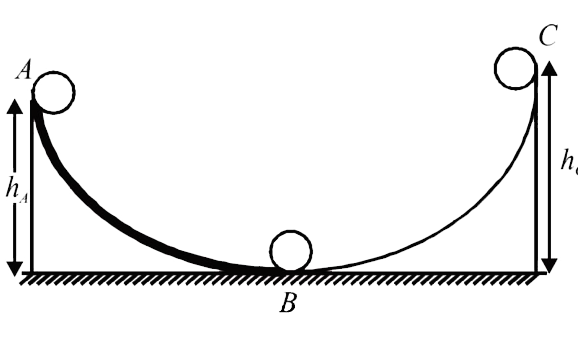
A small bell starts moving from `A` over `a` fixed track as shown in the figure . Surface `AB` is friction from `A` to `B` the bell roll ralis without sipping `BC` is friction , `K_(A)K_(B)` and` K_(C)` are kinetic energy of the bell at `A, B` and `C` respacecvely.Then

Promotional Banner

Similar Questions

Explore conceptually related problems

A ball moves over a fixed track as shown in the figure. From A and B the ball rolls without slipping. If surface B is frictionless and K_(A),K_(B) and K_(C) are kinetic energies of the ball at A,B and C respectively then:

A ball moves over a fixed track as shown in the figure. From A to B ball rolls without slipping. Surface BC is frictionless. K_(A), K_(B) and K_(C) are kinetix energies of the ball at A, B and C , respectively. Then .

A ball moves over a fixed track as shown in the figure. From A to B the ball rolls without slipping. If surface BC is frictionless and K_(A),K_(B) and K_(C) are kinetic energies of the ball at A, B and C respectively then (a). h_(A)gth_(C),K_(B)gtK_(C) (b). h_(A)gth_(C),K_(C)gtK_(A) (c). h_(A)=h_(C),K_(B)=K_(C) (d). h_(A)lth_(C),K_(B)gtK_(C)

A ball moves over a fixed track as shown in thre figure. From A to B the ball rolls without slipping. If surface BC is frictionless and K_(A),K_(B) and K_(C) are kinetic energies of the ball at A, B and C respectively then (a). h_(A)gth_(C),K_(B)gtK_(C) (b). h_(A)gth_(C),K_(C)gtK_(A) (c). h_(A)=h_(C),K_(B)=K_(C) (d). h_(A)lth_(C),K_(B)gtK_(C)

A small block of mass m slides along a smooth frictional track as shown in the figure. If it starts from rest at P, what is the resultant force acting on it at Q?

A small block of mass m slides along a smooth frictional track as shown in the figure. If it starts from rest at P, what is the resultant force acting on it at Q?

Portion AB of the wedge shown in figure is rough and BC is smooth. A solid cylinder rolld without slipping from A to B . Find the ratio of translational kinetic energy to rotational kinetic energy, when the cylinder reaches point C . .