

Home
Class 12
BIOLOGY
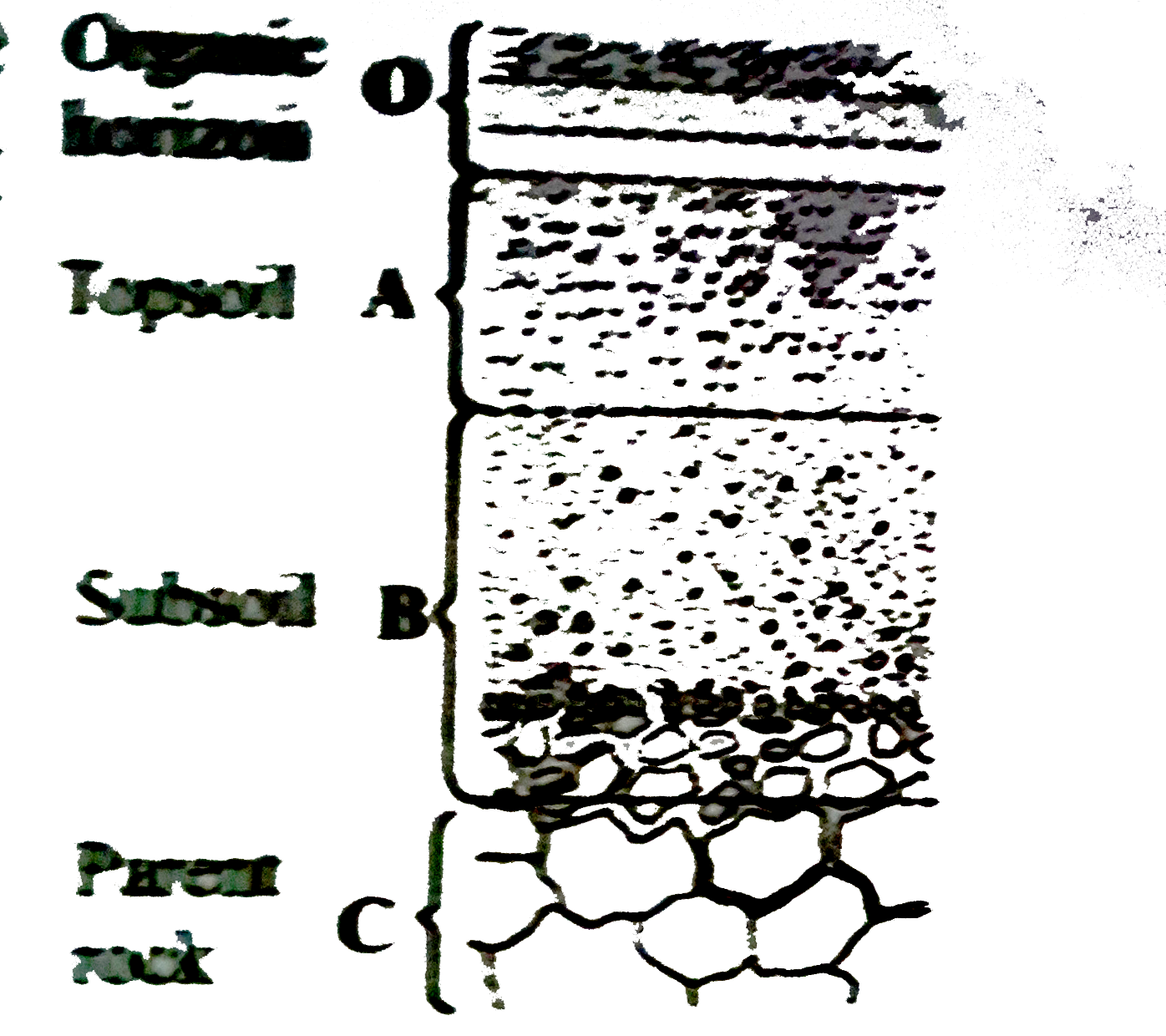
Given figure represents the soil profile...

Given figure represents the soil profile, showing different layers/horizons of soil. Which of the following statements regarding the soil profile are not true ?

(i) Maximum roots of plants are found in horizon `A`.
(ii) Maximum nutrients are present in horizon `B`.
(iii) Horizon `B` contains partly weathered rocks.
(iv) Horizon `C` contains roots of the plants and mineral salts.

Promotional Banner

Similar Questions

Explore conceptually related problems

Read the following statements with reference to soil (i) Weathering is a very fast process of soil formation (ii) Percolation of water is faster in sandy soils (iii) Loamy soil contains only sand and clay (iv) Top soil contains the maximum amount of humus. Choose the correct statements from the above

The diagram shows the structure of a fungal cell with different parts labelled as A,B,C and D. Which of the following statements are true with regard to the fungal cell structive? (i) A contains mucopolysaccharides which are also present in exoskeleton of insects and crustaceans. (ii) D are usually more than one in number in case of aseptate hyphae. (iii) Carotenes and xanthophylls are present in C, which harvest light energy for photosynthesis. (iv) B is the reverse food material, usually stored in the form of starch and oil.

The diagram shows the structure of a fungal cell with different parts labelled as A,B,C and D. Which of the following statements are true with regard to the fungal cell structive? (i) A contains mucopolysaccharides which are also present in exoskeleton of insects and crustaceans. (ii) D are usually more than one in number in case of aseptate hyphae. (iii) Carotenes and xanthophylls are present in C, which harvest light energy for photosynthesis. (iv) B is the reverse food material, usually stored in the form of starch and oil.

The diagram shows the structure of a fungal cell with different parts labelled as A,B,C and D. Which of the following statements are true with regard to the fungal cell structive? (i) A contains mucopolysaccharides which are also present in exoskeleton of insects and crustaceans. (ii) D are usually more than one in number in case of aseptate hyphae. (iii) Carotenes and xanthophylls are present in C, which harvest light energy for photosynthesis. (iv) B is the reverse food material, usually stored in the form of starch and oil.

Which of the following situations -'A' or 'B' - is advantageous for absorption of water and minerals ? Why? Situation 'A': Growth and branching of roots in the C-horizon Situation 'B': Growth and branching of roots in A and B-horizons.

Identify the wrong statement from the below. (I) Hydroponics was developed by David Durger. (II) It is called soil less culture. (III) plants are grown in nutrient solution. (IV) Nutrients are sprayed over the roots.

Consider the following statements : I. Glass is transparent to solar radiations II. Glass is opaque to infrared radiations III. Warm soil and plants emit solar radiation IV. Warm soil & plants emit infrared radiations Which of the above statements are true ?

Read the following statements and select the correct option: (a) Major reservoirs of phosphorus are phosphate rocks and fossil bone deposits laid down in the past geological ages. (b) During weathering of rocks, minute amounts of these phosphates dissolve in soil solution and are absorbed by the roots of the plants.

Read the following statements and select the correct option: (a) Major reservoirs of phosphorus are phosphate rocks and fossil bone deposits laid down in the past geological ages. (b) During weathering of rocks, minute amounts of these phosphates dissolve in soil solution and are absorbed by the roots of the plants.

Fragmentation, leaching and catabolism are some of the important steps of decomposition. Study the following statements I , ii and iii regarding these and select the correct option. (i) Detritivores (e.g., earthworm) breakdown detritus into smaller particles. (ii) Water soluble inorganic nutrients go down into soil horizon and get precipitated as unavailable salts. (iii) Decomposers (e.g., bacteria and fungi) secrete digestive enzymes and degrade detritus into simpler inorganic substances.