

Home
Class 11
PHYSICS
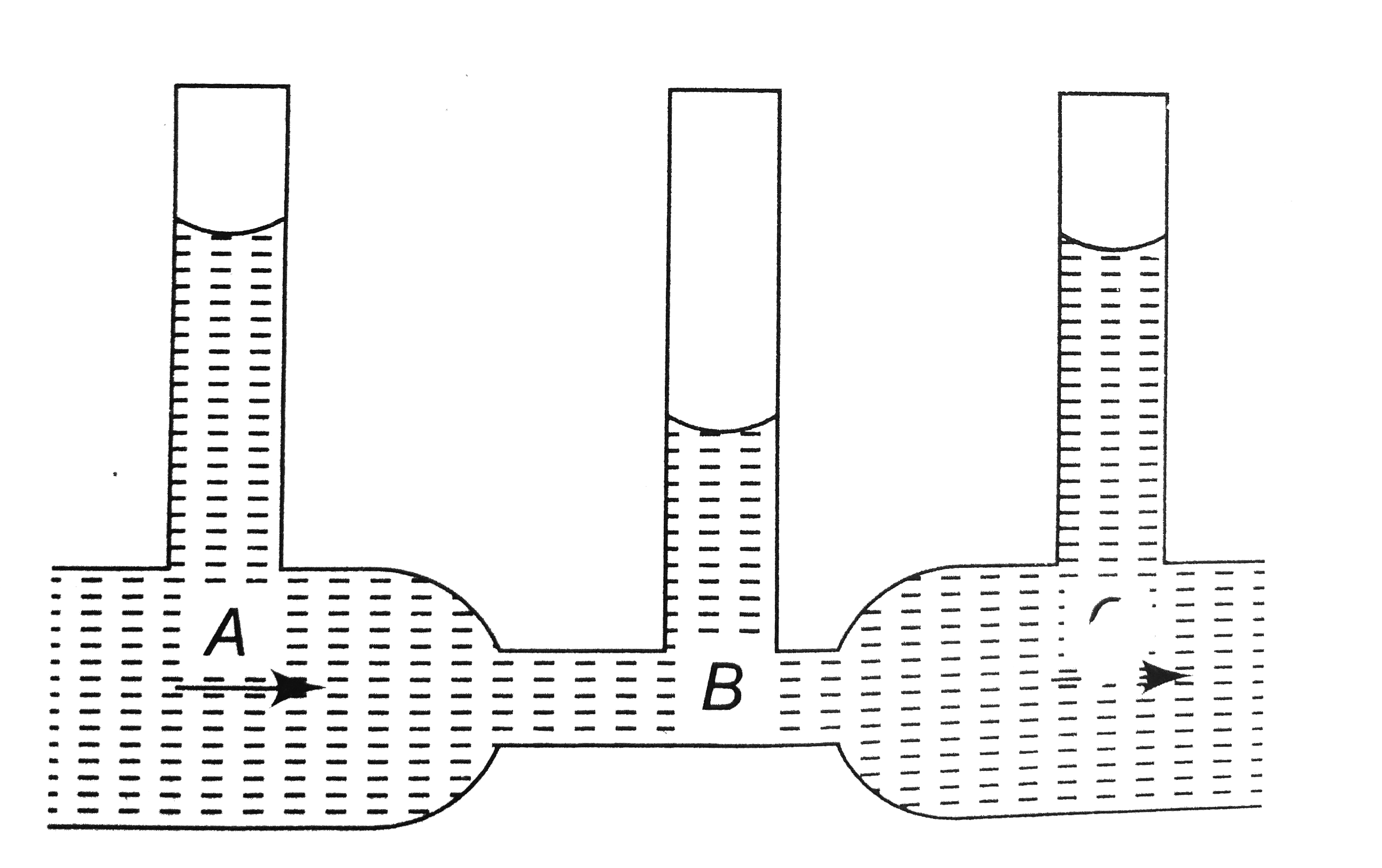
In the following fig., the flow of liqui...

In the following fig., the flow of liquid through a horizontal pioe is shown. Three tubes A, B and C are connected to the pipe. The radii of the tubes `A,B and C` at the junction are respectively `2 cm, 1 cm and 2 cm`. It can be said that the

Promotional Banner

Similar Questions

Explore conceptually related problems

In the Fig. 15.5.2 below in shown the flow of liquid through a horizontal pipe. Three tubes A, B and C are connected to the pipe. The radii of the tube, A, B and C at the junction are respectively 2 cm, 1 cm , and 2 cm. It can be said that the

A non-viscous liquid is flowing through a horizontal pipe as shown in the figure. Three tube A,B and C are connected to the pipe. The radii of the tubes A, B and C at the junction are 2 cm, 1 cm and 2 cm respectively. It can be said that the

Water is flowing through two horizontal pipes of different diameters which are connected together. The diameters of the two pipes are 3 cm and 6 cm respectively. If the speed of water in the narrower tube is 4 ms^(-1) . Then the speed of water in the wider tube is

Water is flowing through two horizontal pipes of different diameters which are connected together. The diameters of the two pipes are 3 cm and 6 cm respectively. If the speed of water in the narrower tube is 4 ms^(-1) . Then the speed of water in the wider tube is

Water is flowing through a horizontal tube of non-uniform cross-section. At a place, the radius of the tube is 1.0cm and the velocity of water is 2m//s . What will be the velocity of water where the radius of the pipe is 2.0 cm ?

Water is flowing through a horizontal tube of non-uniform cross-section. At a place, the radius of the tube is 1.0cm and the velocity of water is 2m//s . What will be the velocity of water where the radius of the pipe is 2.0 cm ?

Water flows through a horizontal tube as shown in figure. If the difference of heights of water colun in the vertical tubes is 2 cm and the area of cross section at A and B are 4cm^2 and 2cm^2 respectively, find the rate of flow of water across any section.

Water flows through a horizontal tube as shown in figure. If the difference of heights of water colun in the vertical tubes is 2 cm and the area of cross section at A and B are 4cm^2 and 2cm^2 respectively, find the rate of flow of water across any section.